The Dark History of IPv6: Why We've Been "Transitioning" for 30 Years and Still Haven't
IPv6 was supposed to save the internet from address exhaustion back in the 1990s, yet three decades later the transition remains incomplete. This article explores the technical, economic, and regulatory reasons why IPv4 stubbornly refuses to die.
In the early 1990s, it became clear that the 4.3 billion IPv4 addresses were insufficient for the growing internet. In 1994, the IETF engineering task force began developing a new protocol, IPv6, presented as a long-term solution to the limited address space problem. The base specification RFC 1883 was published in December 1995 and updated to RFC 2460 in 1998.
IPv6 received 128-bit addresses (compared to 32 bits for IPv4), providing approximately 340 undecillion address combinations. The protocol included built-in encryption support and IPSec, efficient routing, simplified packet headers, and device auto-configuration.
In the late 1990s, the first implementations appeared in operating systems (Linux in 1996, Windows from 2000). Internet giants actively experimented, creating the 6bone test network and regional IPv6 deployment organizations.
IPv4 Is Alive, Thanks Everyone
Before IPv6 arrived, the industry had already deployed classless addressing (CIDR), variable-length subnet masks (VLSM), and NAT (Network Address Translation). Thanks to NAT, multiple devices could hide behind a single public IPv4 address.
Formally, free IPv4 addresses have run out: in 2011, IANA allocated the last large blocks to regional registries, and by 2020 regional pools were exhausted. However, the internet didn't collapse — providers deployed CGNAT (Carrier-Grade NAT) at the operator level.
A secondary market for IPv4 addresses emerged: Microsoft bought a block of Nortel's addresses in 2011 for $7.5 million, and the average price per address reached $60.
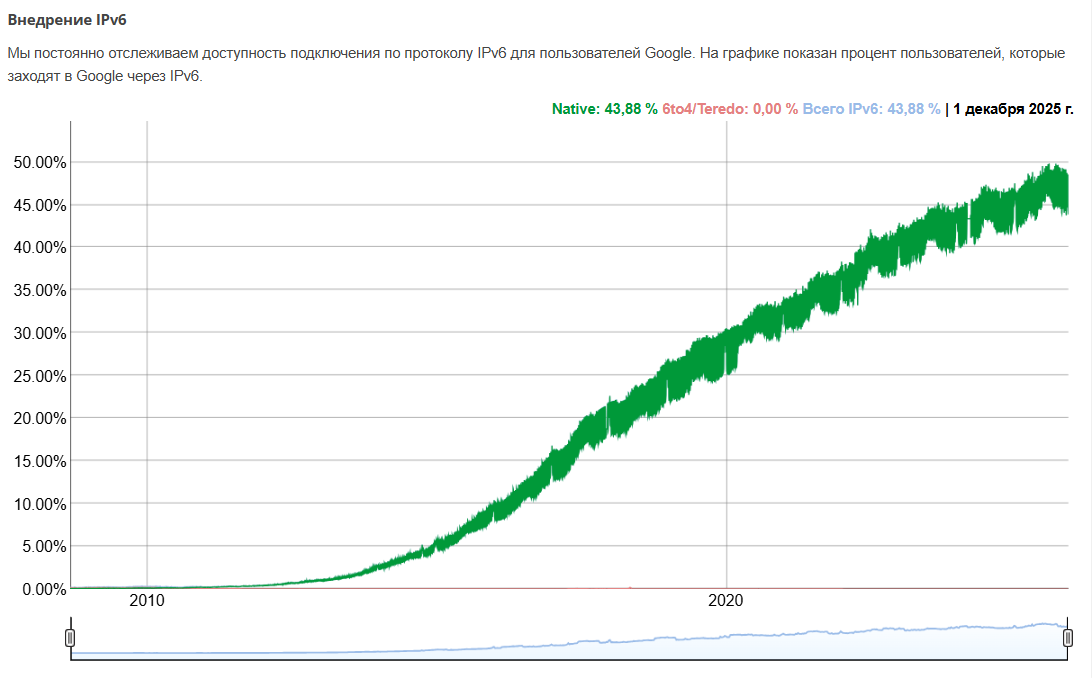
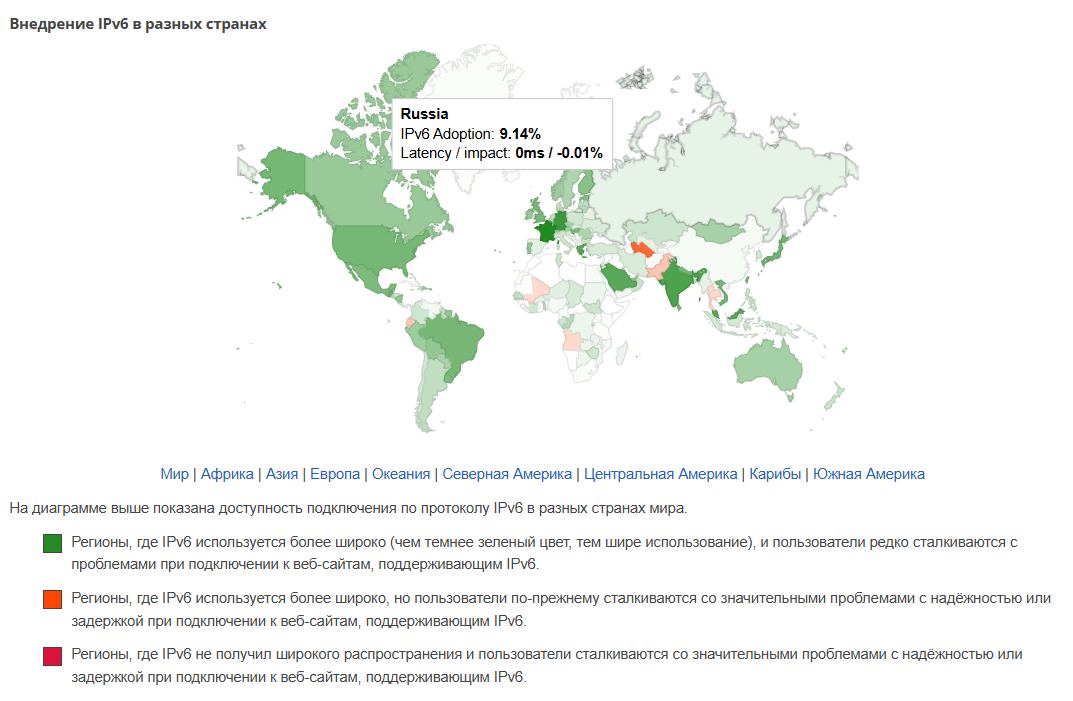
According to Google's statistics, by early 2025 the share of IPv6 in global traffic was 45–49%. The main contributors are India, Germany, and France (60–80% of user traffic). In Russia, only 9.14% of traffic passes through IPv6.
What's Wrong with IPv6
Protocol Incompatibility
IPv6 is incompatible with IPv4 — it is effectively a separate network. A device or website on IPv6 cannot directly communicate with a node using only IPv4. Only cumbersome workarounds exist, such as dual stack, tunnels, or address translation (NAT64, DNS64).
Companies deploying IPv6 cannot disable IPv4, so they must support both addressing schemes. This doubles part of the infrastructure, complicates routing, increases routing tables and firewall rules, and creates additional points of failure.
Economic Incentives
From the user's perspective, a website opens the same way over IPv6 as it does over IPv4. Nobody pays extra for an IPv6 address. Providers have no incentive to spend money on new equipment and staff training if customers aren't demanding changes. For businesses, it's easier to pay for the IPv4 addresses they need than to risk an expensive transition.
Technical Challenges
Full IPv6 support requires compatibility across all networking equipment. If the hardware and software fleet has been assembled over years, there will be bottlenecks: old switches don't support 128-bit addresses, routers need firmware updates, server software expects IP addresses no longer than 15 characters.
Performance requirements increase: older CPUs in routers may not handle traffic when IPv6 filters or encryption are enabled.
Network administrators have spent decades honing their IPv4 skills. IPv6 is a different universe: long addresses, different auto-configuration principles, interaction protocols (Neighbor Discovery instead of ARP, Router Advertisement instead of DHCP).

Regulatory Obstacles in Russia
In Russia, censorship and blocking tools are built around IPv4 addresses. Banned website files contain lists of IPv4 networks, and DPI infrastructure is configured for the old protocol.
Major players are in no rush to enable IPv6 to avoid issues with Roskomnadzor (the Russian communications regulator). If a resource suddenly appears on an IPv6 address not accounted for in the blacklist, the provider faces penalties.

The Slow Path Forward
IPv6 is the future, arriving gradually. Google and Amazon have long been working on IPv6, mobile operators in Asia and Europe have sharply increased their IPv6 share, and new startups build in support from scratch.
A mass shutdown of IPv4 shouldn't be expected anytime soon. Experts believe that at minimum until the end of the decade, both protocols will coexist. The IPv4 address shortage hasn't broken the industry — IoT devices, cloud services, and new markets demand connectivity.
We have to live on two protocols simultaneously, navigating between the old and the new.