The "5 Monkeys" Experiment Was Never Conducted, and the Reference Study Showed the Opposite Results
The famous "5 monkeys and a ladder" story, used in countless corporate trainings, was never actually performed. The real study showed the opposite results.
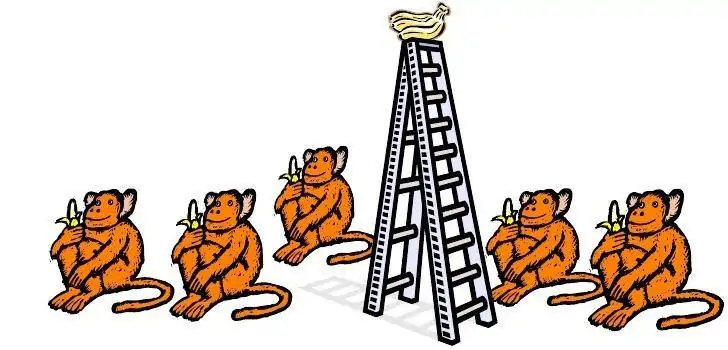
If you're interested in science or have attended motivational trainings, you may have seen or heard about the "Monkey Ladder" experiment, also known as the "5 Monkeys Experiment" or "Monkeys, Bananas, and a Ladder." If you haven't heard of it, here's a brief description: a group of scientists places five monkeys in a room, in the center of which there is a ladder, and on the ladder — a banana. Soon one of the monkeys tries to reach the banana, but as soon as this happens, a scientist enters and sprays all the monkeys with ice-cold water from a hose. If any other monkey tries to reach the banana, the same thing happens, and this continues until all monkeys refuse to go for the banana.
At this point, the scientist replaces one of the wet monkeys with a dry one, who has no idea what's going on in the room and is probably wondering why everyone is so wet and angry. The new naive monkey notices the banana and tries to reach it, but instead of the scientist hosing it down, the other 4 wet monkeys beat it up, preventing it from touching the ladder. One by one, the remaining wet monkeys are replaced with dry ones, and each of them tries to reach the banana but is violently stopped by the other monkeys.
Eventually, it reaches a point where there are no wet monkeys left in the room — only dry ones. But they still don't try to grab the banana, thinking that something bad will happen if they do.
At the end of the story, the researcher supposedly says something like: "If the monkeys could talk, they would say why they don't let anyone climb the ladder — 'because that's how it's always been done.'" In almost every version of this story on the internet, the narrator claims that this is a real experiment studying human behavior through monkeys. They tell us that we're not ready for change and don't try new things because we're afraid of something. Of course, they're trying to make a good point: you should try new things at your job, and all experienced workers should be open to change — but was the monkey ladder experiment real? No, it's completely made up, although there is a reference.
The Real Monkey Experiment
In 1966, a study was published called "Cultural Acquisition of a Specific Learned Response Among Rhesus Monkeys," so at least it's clear why they changed the name in the fictional version. In the real experiment, researcher Gordon Stephenson from the Max Planck Institute of Psychiatry placed monkeys in a cage with an object and made them fear it by directing blasts of air at them. After the fear was established, a naive monkey was placed in the cage.
Guess what happened when the naive monkey tried to touch the object? If you thought the scared monkey attacked them, as in the fictional version, you'd be wrong. The worst thing that happened was that the scared monkey pulled the naive monkey away, and this happened only once. The other 3 times the experiment was conducted, the scared monkeys simply cast frightened glances toward the naive monkeys, as if to say: "You probably shouldn't touch that." When the naive monkeys did touch the object anyway, in two cases the scared monkeys lost their fear and joined them.
The "Five Monkeys Experiment" or "Monkey Ladder" tries to scare us into changing by telling us that our basic human behavior is to reject change and not try new things, but the study that inspired it actually shows the opposite. Maybe we should talk about the original experiment instead of a lie? And maybe we just shouldn't make up scientific experiments and pass them off as truth just to encourage different behavior at work?