How Rhythmic Music Helps ADHD Brains
A developer with a lifelong ADHD diagnosis dives into the neuroscience of why specific rhythmic, predictable music helps brains with attention deficit disorder focus, and shares a pet project born from those findings.
Hi, my name is Andrey and I have ADHD (scattered applause, because all the members of the anonymous ADHD society got distracted by something else).
Not the ADHD people diagnose themselves with after watching reels about procrastination, but an official diagnosis since childhood. The topic is stigmatized: psychiatrists are extremely reluctant to get into it, while psychologists generously hand out diagnoses left and right, simply because they can and bear no responsibility for it. As a result, the real disorder drowns in the noise of self-diagnosis. I was "lucky" in this regard: I've been seeing a psychiatrist who studied this topic closely since childhood.
I've felt its effects my entire life: the inability to concentrate, or conversely, hyperfocus when it's long past bedtime but you can't tear yourself away. And my whole life I've been looking for ways to cope. But all ADHD medications are banned in Russia under Article 228 of the Criminal Code, and those that are allowed don't help at all.
At some point, I noticed that certain music helps me concentrate. Not just any music, but rhythmic, predictable music without sudden tempo changes. I got curious and started looking into what science says about it. Turns out it says a lot, and it's relevant. Let me share the results of years of digging into this topic, explain why it works, and what I did with it.
What's Wrong with the ADHD Brain
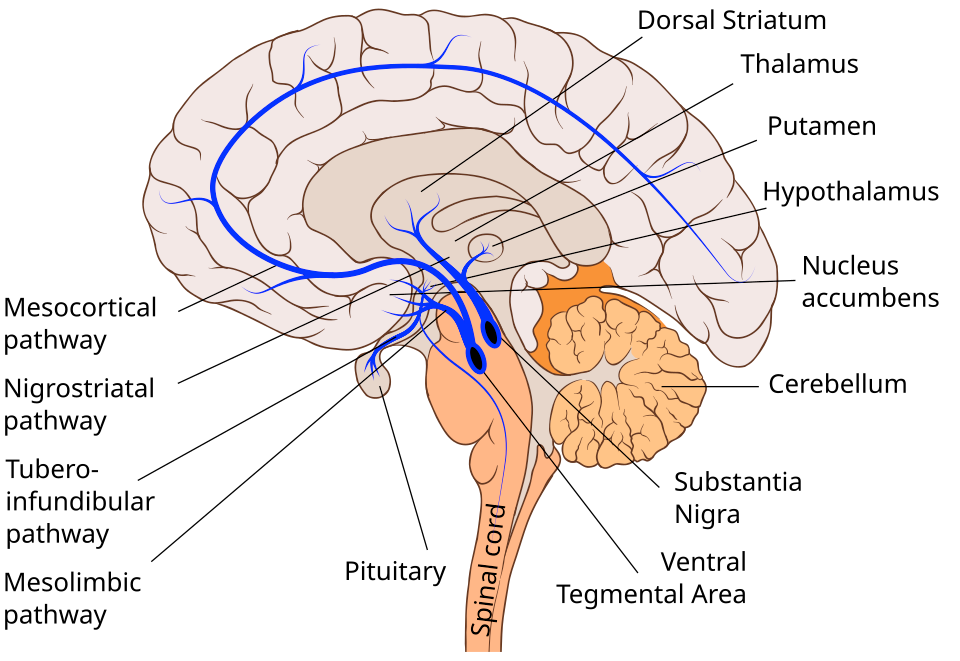
Let me clarify right away: ADHD is not "a habit of clip-based thinking" and not "laziness." At its core lies a dysfunction of the brain's dopamine system. Dopamine is a neurotransmitter responsible for motivation, the sense of reward, and the ability to maintain attention on a task. In ADHD, there simply isn't enough of it.
This is not a metaphor. A 2009 study using positron emission tomography (nearly 100 participants) showed that in key reward system zones of the brain, people with ADHD have significantly reduced dopamine receptor activity [1]. The same authors later demonstrated that this deficit is directly linked to motivation problems — and only in the ADHD group; the control group showed no such correlation [2].
Put simply: the brain's reward system operates at half capacity. The brain doesn't "not want" to work — it simply needs more stimulation to engage at all.
The Network That Won't Switch Off
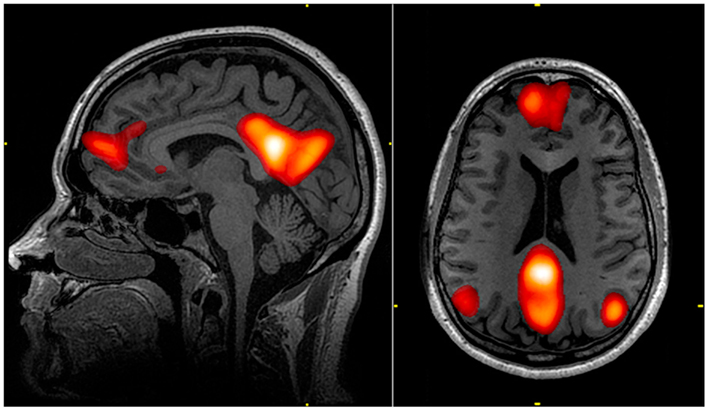
The dopamine deficit leads to another specific problem. The brain has what's called the Default Mode Network (DMN) [6] — a network active during the brain's passive mode. It's active when you're doing nothing: daydreaming, reminiscing about the past, staring out the window on your commute to work. Normally, when you sit down to work, the DMN is suppressed and the brain switches to working mode.
In ADHD, this switching mechanism breaks down. The DMN keeps running in the background, intruding into work processes and causing those "attention lapses" — when you're supposedly looking at the monitor or listening to a not-so-interesting (or even very interesting) speaker at a conference, but your thoughts are already somewhere far away [3]. Research in Nature Neuroscience confirmed: momentary attention lapses are directly linked to the DMN not deactivating properly [4].
Experiments showed that under high motivational stimulation, differences between ADHD and control groups disappeared [5]. In other words, the switch isn't broken — its activation threshold is just elevated. The ADHD brain needs more "fuel" to suppress the DMN and engage working mode.
Music as a Dopamine Key
Now for the most interesting part. Music directly affects the very dopamine system that underperforms in ADHD.
Back in 2001, a group of neuroscientists conducted a PET study and discovered that intense pleasure from music — those "chills" — is accompanied by a surge of activity in the brain's reward regions. The very same ones that respond to food, sex, and other basic rewards. This paper garnered over 4,000 citations and became the starting point for an entire research direction [7]. Ten years later, in 2011, using more precise PET scanning, it was shown for the first time that listening to music actually releases dopamine in the brain [8]. Music is the only abstract stimulus that triggers the same neurochemical reaction as basic needs.
And in 2019, the final nail was driven in: in a double-blind experiment, some participants were given a dopamine precursor — their musical pleasure increased. Others were given an antagonist — it decreased. Causal proof: dopamine directly governs how we experience music [9].
For the ADHD brain, this means something simple: music can partially compensate for the dopamine deficit. Not replace medication, but give the brain that extra stimulation needed to switch into working mode.
How Music Switches Off "Daydream Mode"
There's also a direct mechanism. A 2008 study showed that listening to music activates a brain network that acts as a "switch" between daydream mode (DMN) and working mode. The musical stream gives this switch a regular rhythmic signal, suppressing the DMN and activating work networks [10].
In neurotypical people, this switching happens without external help. In people with ADHD, it's unstable. Rhythmic music gives the brain an external scaffold to lean on.
What Experiments Show
The theory is solid, but does it work in practice? Yes.
Children with ADHD performed significantly better on tasks with background music than in silence; the control group showed no differences [11]. Music improved reading comprehension in children with ADHD but worsened it in neurotypical children [12]. A 2025 systematic review (20 studies, over a thousand participants) confirmed the overall picture [13].
Here's an important point: the effect is bidirectional. What helps the ADHD brain hinders the neurotypical one. This isn't "music is good for everyone" — it's compensation for a specific deficit, and not everyone will enjoy such a background; some will find it irritating and distracting. The more it irritates you, the more neurotypical you are.
The same pattern holds for white noise: it improves results for people with ADHD but worsens them for the control group [14]. And the famous study about "coffee shop noise" showed that moderate background noise (~70 dB) enhances creativity and abstract thinking [15].
Why Music Must Be Predictable
Here's where my personal pain begins. I've tried tons of things: streaming playlists "for work," lo-fi streams, "focus music." And what frustrated me most was that the music changes unpredictably, and those "changes" seriously disrupt focus. A tempo shift of even a few BPM and that's it — focus lost. Unexpected vocals, a surprise transition, a pause between tracks — every time the brain jolts and pulls away from the current task. And remember the DMN — a very small distraction is all it takes.
Science explains this. People with ADHD have significantly elevated Novelty Seeking — a core trait linked to the very neurobiology of the disorder [16]. And it's a double-edged sword: the brain craves stimulation, but every unexpected stimulus hijacks attention. Predictable music provides stimulation without creating distraction points.
Complex music worsens cognitive outcomes while simple music doesn't [17]. Background music reduces mind-wandering and increases focus, confirmed objectively through physiological response — pupil diameter measurement [18].
Assembling the Formula
In summary, the "ideal" working music for an ADHD brain is:
- Rhythmic — to give the brain an external scaffold for DMN suppression
- Predictable — without surprises that steal attention
- Minimalist — no vocals or complex arrangements
- Continuous — no pauses or jarring mood shifts between tracks
- Mixable with noise — white noise, coffee shop sounds, and similar work through the same mechanism
Ambient is close but lacks rhythm. Minimal techno is close but too harsh for hours of listening. Lo-fi has pauses between tracks and unpredictability. No existing genre fits exactly.
From Theory to Practice
Well, as the saying goes, saving the drowning is the drowning person's own business. Today we have neural networks, and they, under careful supervision (including psychiatrists'), generated multi-hour tracks with exactly the right beat and background. And I packaged it all up nicely and made DevOps Radio.
Absolute minimalism. A calm rhythmic background for work plus the ability to mix in noise: currently mechanical keyboard clicks and coffee shop ambience. The very stimuli that science calls "stochastic resonance" and I call "finally being able to work normally."
I built it for myself, but it unexpectedly resonated with many people. Free forever (it's a pet project), no ads, registration, or SMS. Just music and white noise.
Sources
- Volkow ND et al. (2009). Evaluating dopamine reward pathway in ADHD. JAMA, 302(10).
- Volkow ND et al. (2011). Motivation deficit in ADHD is associated with dysfunction of the dopamine reward pathway. Molecular Psychiatry, 16.
- Sonuga-Barke EJS, Castellanos FX (2007). Spontaneous attentional fluctuations in impaired states. Neuroscience and Biobehavioral Reviews, 31.
- Weissman DH et al. (2006). The neural bases of momentary lapses in attention. Nature Neuroscience, 9.
- Liddle EB et al. (2011). Task-related DMN modulation and inhibitory control in ADHD. J Child Psychol Psychiatry, 52.
- Default mode network. Wikipedia.
- Blood AJ, Zatorre RJ (2001). Intensely pleasurable responses to music correlate with activity in brain regions implicated in reward and emotion. PNAS, 98.
- Salimpoor VN et al. (2011). Anatomically distinct dopamine release during anticipation and experience of peak emotion to music. Nature Neuroscience, 14.
- Ferreri L et al. (2019). Dopamine modulates the reward experiences elicited by music. PNAS, 116.
- Sridharan D, Levitin DJ, Menon V (2008). A critical role for the right fronto-insular cortex in switching between central-executive and default-mode networks. PNAS, 105.
- Abikoff H et al. (1996). The effects of auditory stimulation on the arithmetic performance of children with ADHD. J Learning Disabilities, 29.
- Madjar N et al. (2020). Contrasting effects of music on reading comprehension in preadolescents with and without ADHD. Psychiatry Research, 291.
- Anand T et al. (2025). Exploring the intersection of ADHD and music: a systematic review. Behavioral Sciences, 15(1).
- Soderlund G et al. (2007). Listen to the noise: noise is beneficial for cognitive performance in ADHD. J Child Psychol Psychiatry, 48.
- Mehta R et al. (2012). Is noise always bad? Exploring the effects of ambient noise on creative cognition. J Consumer Research, 39.
- Donfrancesco R et al. (2015). Novelty Seeking as a core feature of ADHD. Psychiatry Research, 227.
- Gonzalez MF, Aiello JR (2019). More than meets the ear: how music affects cognitive task performance. J Exp Psychol: Applied, 25.
- Kiss L et al. (2024). Music in the eye of the beholder: a pupillometric study on preferred background music. Psychological Research, 88.