It's complicated about simple things. Everything you would like to know about SFP modules. Part 1. Evolution of modules and basic concepts
Greetings, colleagues! It's again @ProstoKirReal . In the last series of articles, I discussed with you how the Internet works ( Part 1 , Part 2 , Part 3 , Part 4 , Part 5 ), but I deliberately left out the most important part - how bits of data are transmitted over local network
Editor's Context
This article is an English adaptation with additional editorial framing for an international audience.
- Terminology and structure were localized for clarity.
- Examples were rewritten for practical readability.
- Technical claims were preserved with source attribution.
Source: original publication
Greetings, colleagues! It's again @ProstoKirReal. In the last series of articles, I discussed with you how the Internet works (Part 1, Part 2, Part 3, Part 4, Part 5), but I deliberately left out the most important part - how bits of data are transmitted over local networks between computers and over the Internet between continents.
I'm starting a new series of articles. In it I would like to discuss SFP modules with you. What is it, what types are there (and how do they differ), what role do optical cables play, and let’s touch a little on the history of their development.
There is a lot of information. I don’t know the exact volume of the articles yet, but I promise to sort everything out as succinctly and clearly as possible.
Important point
It's been on é for a long time article about the evolution of twisted pair networks. I don’t want to repeat myself and recommend that you read this article at your leisure.
❯ Why is this article needed?
We need this article in order to understand the basic concepts and understand:
history of module development;
module types and speed hierarchy;
what the modules consist of.
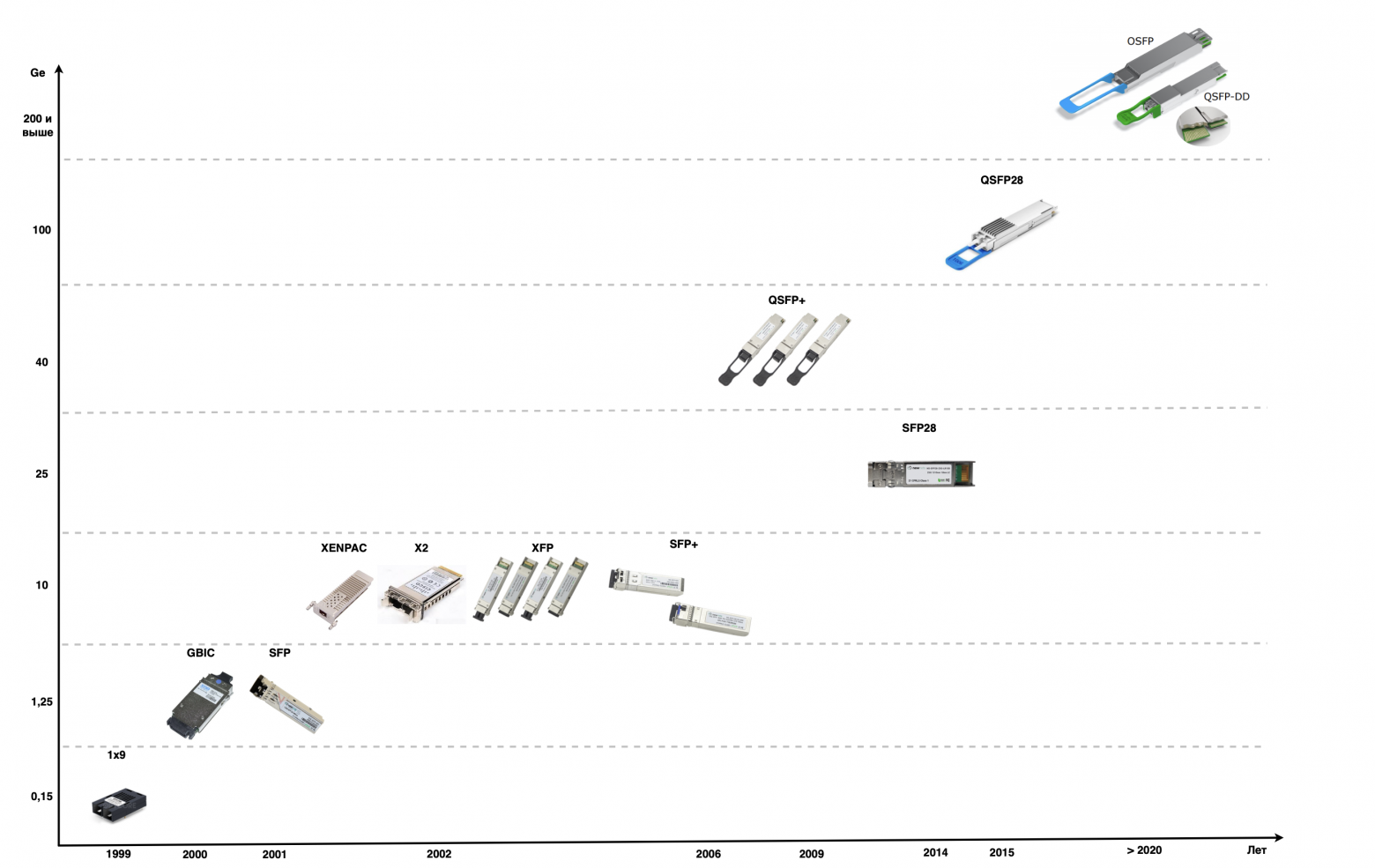
❯ History of module development
The history of the formation of fiber-optic communication lines (FOCL) begins with patent
to an optical telephone system. The patent was received by Norman R. French in 1934, which described speech signals that were transmitted using light through rods of clear glass.
In 1962, a semiconductor laser and photodiode were created, which were used as a source and receiver of an optical signal.
In 1966, "Dielectric-Fiber Surface Waveguides For Optical frequencies" was published in Proc. IEE, proving that attenuation in glass can theoretically be reduced to 20 dB/km (we'll talk about attenuation in optical fiber in another article). They also introduced optical filaments made from ordinary glass, which had an attenuation of 1000 dB/km.
In 1970, Robert Maurer, Donald Keck and Peter Schultz created the first fiber with an attenuation of 17 dB/km (1970). The fiber was multimode for transmitting a signal at a wavelength of 633 nm (more about single-mode/multi-mode fiber, and about wavelengths a little later). By 1972, 4 dB/km had been reached. By comparison, today's best fibers have an attenuation level of less than 0.18 dB/km.
Later in the 1970s there was a lot of experimentation with fiber, which was used in the commercial telephone networks of AT&T and GTE, as well as for military purposes (the US Navy implemented fiber optic on board the USS Little Rock.)
10 years later, the technology was used in telecommunications networks.
❯ 1990s: First generations of transceivers and first hot-swappable solutions.
Transceiver 1x9
In the 1990s, the first solution of optical transceivers appeared - 1x9. Transceivers (if you can call them that) 1x9 are the earliest representatives of optical modules. They were aimed at speeds up to 1Ge. Currently, modern fiber-optic lines do without 1x9 transceivers, but there are still clients in the industrial and video sectors who use these transmitters.
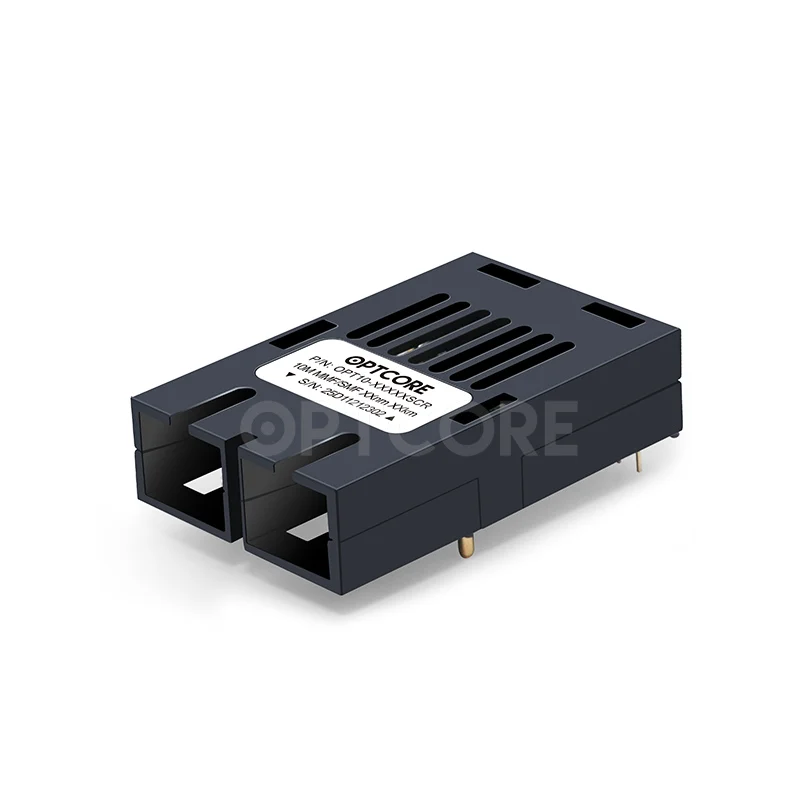
GBIC
The first solution of optical transceivers came to replace 1x9 - GBIC
Gigabit interface converter (GBIC) is one of the optical transceivers that converts serial electrical signals into hot-swappable optical signals (Hot Swap) It is sometimes called a GBIC converter. Its data transfer speed is 1Ge, transmission range is from 550m to 80km, depending on models.
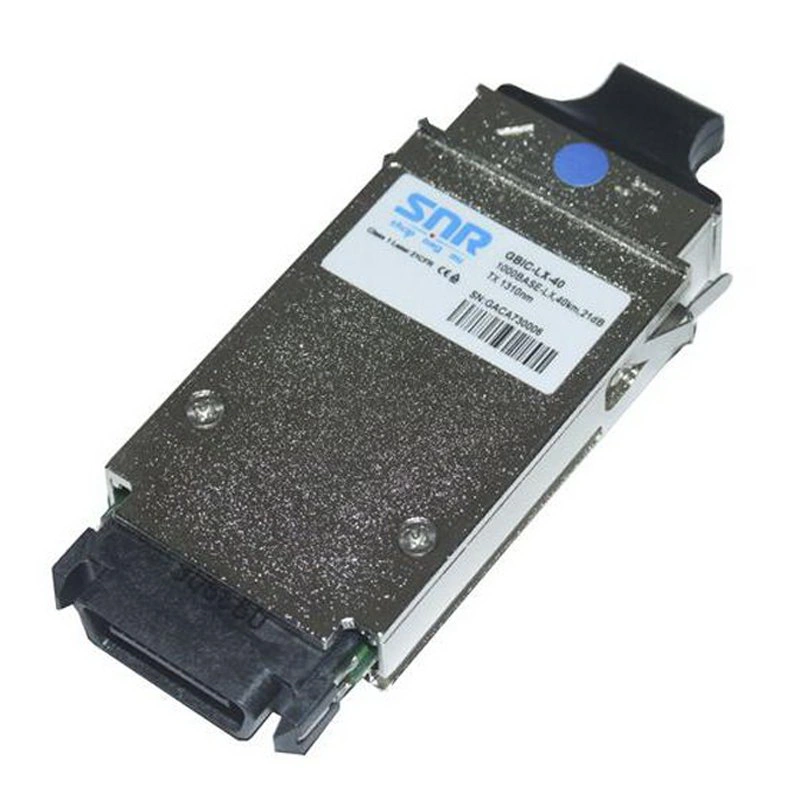
GBICs come in both optical, with an SC connector, and copper, with an RJ-45 connector, for twisted pair.
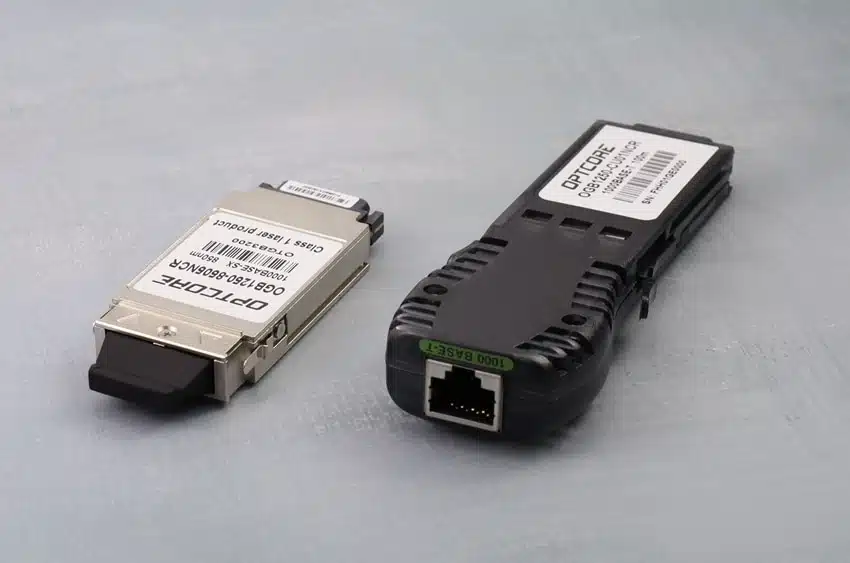
The following types of GBIC modules exist:
GBIC Copper - stands for copper transceiver, usually at 1000BASE-T speed, and transmits a signal over a distance of up to 100 meters via Cat 5 cable;
GBIC SX — means short reach, connection up to 550 m on OM2 fiber optics;
GBIC LX — means long reach, connection up to 10 km on OS2 fiber optic;
GBIC EX — means extended range, communication up to 40 km on OS2 fiber optics;
GBIC ZX - stands for approximately extended long distance (extend long reach), communication up to 70 km on OS2 fiber.
Also still exist CWDM GBIC, BiDi GBIC and DWDM GBIC, but the principles of their operation coincide with similar SFP/SFP+, more on them later.
At the moment, GBIC is obsolete. It is larger than its SFP successor in size and takes up a lot of space in the switch, reducing its throughput. Network equipment with GBIC interfaces also stopped being produced, as they were replaced by modern switches with SFP ports.
❯ Early 2000s: Long live the king! SFP
Due to the large size of GBICs, switches had a small number of interfaces. Therefore, the development of a fundamentally new optical module with a smaller size and power consumption, as well as higher speed, began - SFP (Small-form factor pluggable).
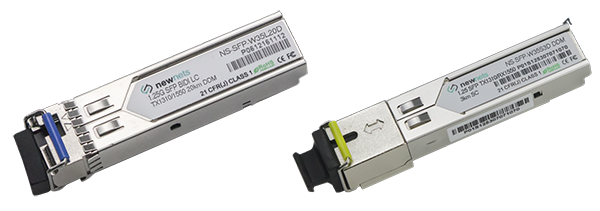
SFP was also previously called mini-GBIC due to its similar form factor and operation, but at the moment most network engineers are not aware of GBIC and the term mini-GBIC has become obsolete.
SFP supports Hot Swap and provides a large number of interfaces in switches. Often 1RU switches (Rack Unit) can be equipped with up to 48 SFP interfaces, which is much more than previous switches with GBIC interfaces.
❯ Mid-2000s: 10G format war (XENPAK, X2, XFP vs SFP+)
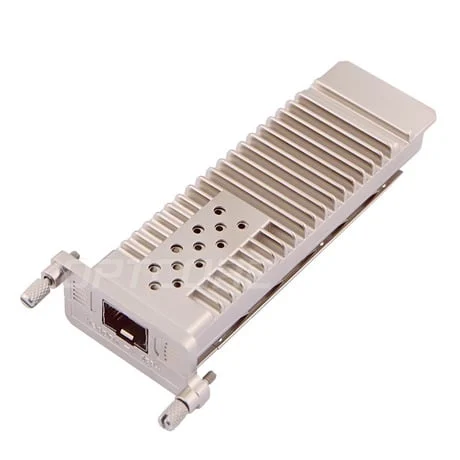
XENPAK
XENPAK - This is one of the first serial optical modules that operated at 10Ge speeds. It was developed as a direct development of the GBIC standard.
For the first time, the technology began to be used on a large scale CDR (Clock Data Recovery) – clock signal recovery circuit.
Another advantage of this standard was its support for a wide range of technologies (SR/LR/ER/LX4, DWDM).
But XENPAK took the main disadvantages from GBIC - large size, taking up a lot of space in the switch, high power consumption and high cost (compared to the future SFP+)
X2
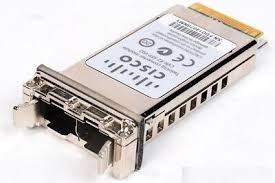
X2 module was developed by the same group of vendors as the evolution of XENPAK. The size has become smaller, while maintaining the built-in CDR and support for all key 10Ge optical standards. Energy consumption has been significantly reduced.
Cisco actively promoted X2 as a module to correct the shortcomings of XENPAK, but it was still quite large compared to its successors.
XFP
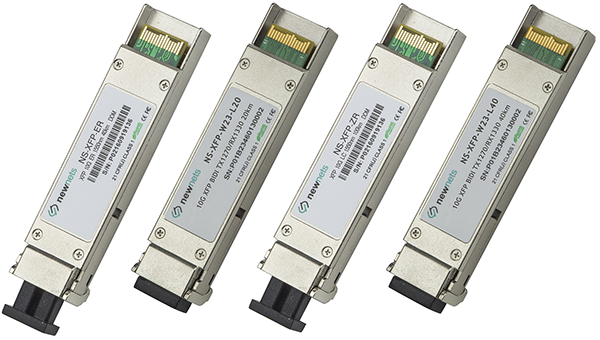
XFP (10 Gigabit Small Form Factor Pluggable) became the first truly compact form factor for 10Ge, it was much lighter and smaller than XENPAK and X2. It supported all major optical standards and had low power consumption.
It began to be used as a universal solution where size and power consumption were critical.
XFP could become the dominant standard, but it had two critical disadvantages - the lack of CDR and the price more than SFP+.
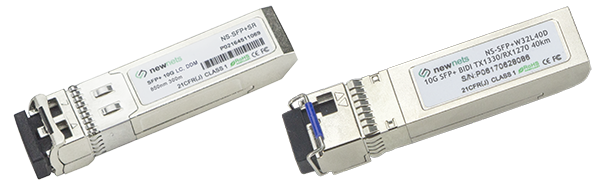
SFP+
SFP+ was an evolution of the extremely successful SFP.
At the start, SFP+ had a number of disadvantages - support for simple standards (SR and LR), more complex ones (ER/ZR, DWDM, LX4) required XFP or X2, and there was also no CDR.
But there were also undeniable advantages - better energy efficiency and the smallest size compared to competitors, as well as the lowest price.
Since SFP was known and used all over the world, SFP+ became its successor at 10Ge speeds. Equipment manufacturers (Cisco, Juniper, HP, etc.) and telecom operators needed to reduce the cost of a 10Ge port, and easy migration from 1G to 10G in the same form factor promised huge benefits.
Why did SFP+ win?
Saving - The argument of port cost and density proved decisive for the mass adoption of 10Ge in server racks and aggregation layers.
Evolution - continuity with SFP has greatly simplified implementation for equipment manufacturers.
Progress in electronics By the end of the 2000s, it became possible to implement CDR quite cheaply and reliably, eliminating the key advantage of XENPAK/X2/XFP.
Expanding SFP+ Capabilities - SFP+ modules quickly appeared for all major optical standards (including ER, ZR, DWDM), closing functional gaps.
As SFP+ production increased, its price dropped further and its availability increased, creating a self-sustaining cycle of adoption. Leading vendors quickly switched to SFP+. XFP today can still be found in niche segments, but XENPAK and X2 are mostly not supported, although they can still be purchased for legacy systems.
❯ 2010s: Density Revolution (QSFP+, SFP28, QSFP28)
If in the 2000s there was a war for the right to become the main 10Ge standard, then the 2010s became the decade of the density revolution.
The growth of cloud technologies, hyperscale data centers, virtualization, Big Data and huge flows of mobile traffic began to require more bandwidth and transmission speed.
10Ge interfaces could no longer meet the necessary needs and were replaced by 25Ge, 40Ge and 100Ge interfaces.
Telecom hardware manufacturers are faced with a problem. It was necessary to develop equipment with the maximum number of ports in the minimum number of RUs, preferably to fit everything into 1RU. There was an urgent need for a small form factor similar to SFP/SFP+.
And three key form factors emerged: QSFP+, SFP28 and QSFP28.
QSFP+
QSFP+ (Quad Small Form‑factor Pluggable Plus) — became the first “big” standard. The main feature, judging by the name quad (four-channel), was the ability to transmit 4 channels over 10Ge in one module.
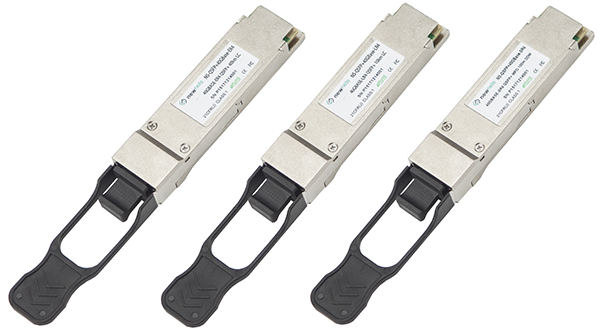
QSFP+ physically occupied only 30–40% more space than a single SFP/SFP+, allowing for 16 to 36 (equivalent to 64–144 10Ge ports) interfaces on a 1RU switch.
The cost of one QSFP+ module was significantly lower than 4 separate SFP+ modules, reducing cost/Gbps.
But the main engine of progress has become breakout cables (in common parlance - hydra).
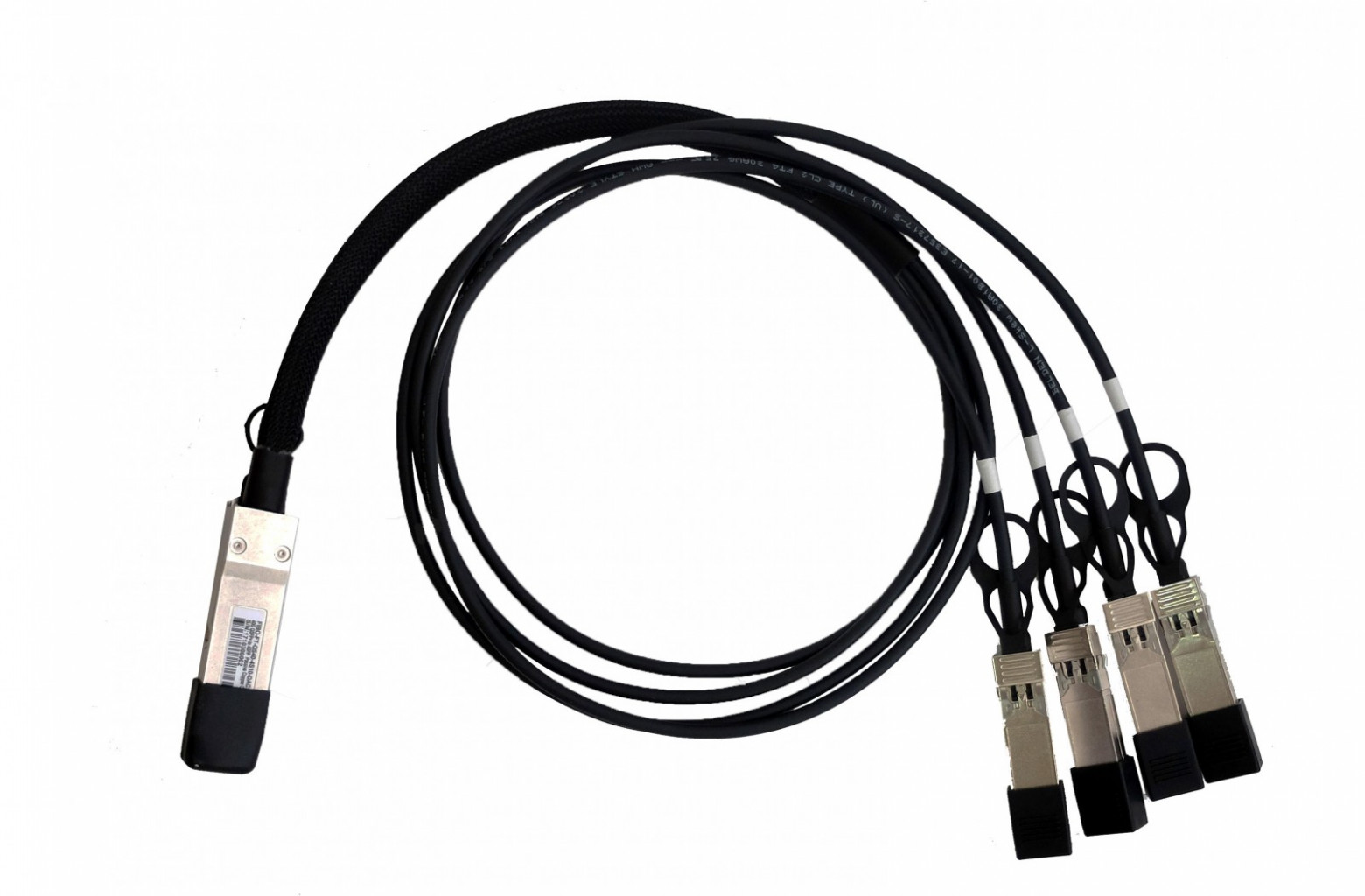
Hydra allows you to connect 4 10Ge server racks to one 40Ge port in the ToR switch. In-rack backbones, aggregation, and early 40Ge deployments became the main drivers of progress in the first half of the 2010s.
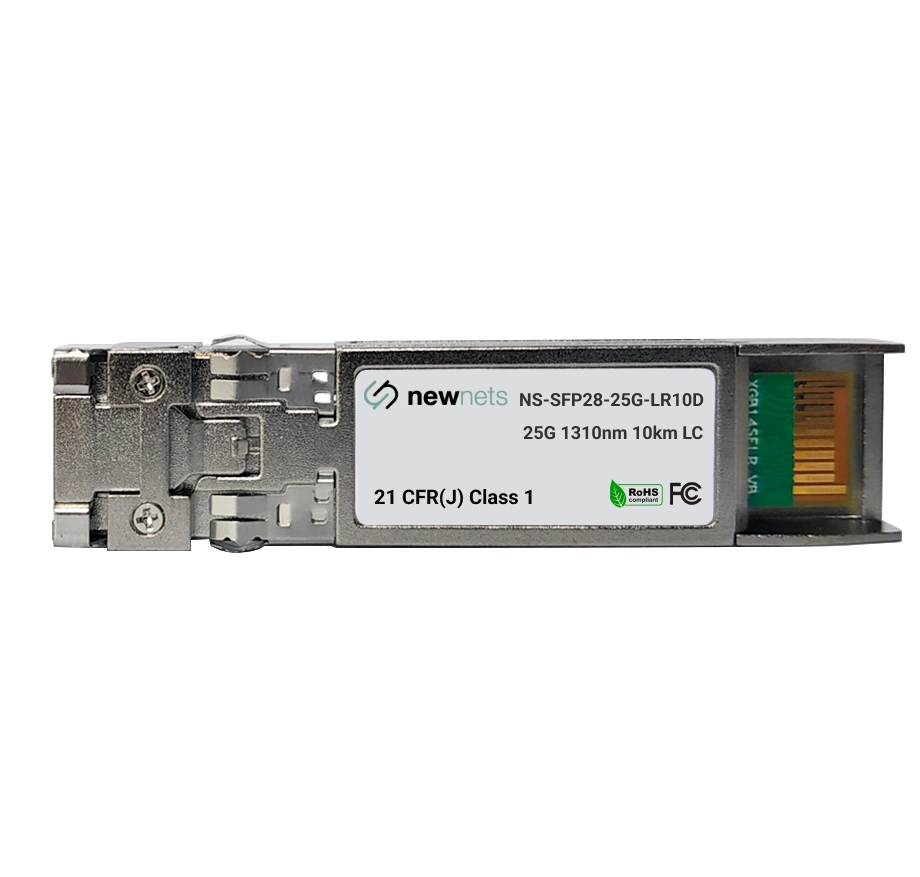
SFP28
SFP28 (Small Form-factor Pluggable 28). If in the early 2010s breakout was connected to ToR switches, then in the late 2010s the speed became insufficient.
SFP28 replaced SFP+ as the standard for connecting servers to ToR switches, and it was also used as an uplink on budget aggregation switches.
SFP28 is the same size as SFP+ but has different hardware components.
Another small revolution was the modulation scheme.
For SFP+ and QSFP, a relatively simple NRZ (Non-Return-to-Zero) modulation scheme was used. It uses 2 signal levels - 1 or 0.
To increase the transmission speed, without increasing the frequency (energy-consuming) and form factor, SFP28 began to use a more complex modulation scheme - PAM-4 (Pulse Amplitude Modulation with 4 levels - Pulse amplitude modulation with 4 levels).
PAM-4 uses 4 signal levels, which allows each character to encode 2 bits of information (00, 01, 10, 11). Thanks to it, it was possible to increase the bit transfer rate without changing the form factor.
SFP28 enabled a smooth, high-density, and cost-effective transition from 10G to 25G in server environments. Proved the effectiveness of a “spot” increase in speed in a compact form factor.
QSFP28
25Ge and 40Ge are, of course, good, but everyone was waiting for something more. 100Ge was just around the corner.
After they began to successfully implement SFP28, they developed a new standard based on the QSFP+ form factor.
If QSFP+ had 4 channels of 10Ge, then QSFP28 already had 4 channels of 25Ge.
QSFP28 (Quad Small Form-factor Pluggable 28) became the peak density. Vendors were able to place up to 32 100Ge ports in 1RU. This was equivalent to 128 25Ge ports or 256 10Ge ports in one unit. The density has become an order of magnitude higher, the dimensions are an order of magnitude smaller than those of earlier solutions.
The cost of the 100Ge port was rapidly falling due to mass production and competition. QSFP28 has become the most cost-effective path to 100Ge.
Mechanical compatibility with QSFP+ slots simplifies migration from 40Ge to 100Ge on some platforms.
QSFP28 began to be used everywhere: data center backbones, aggregation, connecting high-performance servers and storage systems via breakout.
QSFP28 has become the world's main de facto standard for 100Ge. Its flexibility, density and cost-effectiveness ensured mass adoption of 100Ge in data centers by the end of the 2010s. Lay the foundation for the next generations (200Ge, 400Ge, 800Ge).
The 2010s proved that density and economics are the main drivers of network evolution. QSFP+, SFP28 and QSFP28 have become a major revolution, breaking barriers of cost, power consumption and physical space. Their success laid the foundation for subsequent generations of form factors (QSFP-DD, OSFP, SFP-DD), which continued the race for density at speeds of 200G, 400G and beyond, using the same principles of link aggregation and maintaining flexibility. The density revolution of the 2010s made terabit speeds in data centers not a fantasy, but an everyday reality.
If you were wondering why SFP28 and QSFP28 are 28, I wrote a mini article on this topic in my channel.
2020s: QSFP-DD/OSFP and the path to 1.6T
The rise of cloud services, AI, 5G has created a great demand for high bandwidth. By 2020, 100Ge had ceased to be a “backbone”, it had become the standard for server uplinks and rack aggregation. 100Ge was replaced by 400Ge, but even that was not enough. The new frontier was 800G, and the next one was 1.6T. The key players have become two form factors - QSFP-DD and OSFP.
A small note. At the moment, these standards are not very popular in Russia. 2020–2022 were the last years when these standards could still be found in server data centers with foreign equipment, for obvious reasons. At the moment, Russian vendors have learned to develop and provide equipment only with 100Ge ports. Therefore, QSFP‑DD and OSFP are a foundation for the future for us.
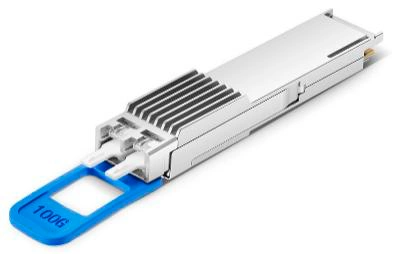
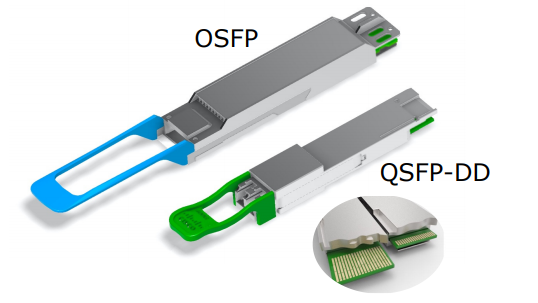
QSFP-DD (Quad Small Form-factor Pluggable Double Density) has a similar form factor to QSFP28, but in terms of data transfer speed, these are two different standards of SFP modules (QSFP-DD is slightly wider and longer), which differ significantly from each other. As we remember. QSFP28 can only transmit four channels at 25Gbs, while QSFP-DD can transmit eight channels at 50Gbs, which is equivalent to 400Gbs.
The main disadvantages of QSFP‑DD are heat dissipation and vendor support. Compared to QSFP28, the heat dissipation is significantly higher, and only large vendors (Broadcom, Intel, Cisco, Juniper) provide support with a corresponding price.
To provide 800Gbs throughput, the QSFP-DD800 was developed.
QSFP‑DD800 uses 8 channels of 100Gbs. With four-level PAM4 modulation, the speed is doubled compared to the previous generation. The next generation of 800Ge transceivers will increase the speed of each channel to 200Gbs, which will create serious problems due to the simultaneous increase in modulation and data rates.
OSFP (Octal Small Form Factor Pluggable) - as the name suggests, provides 8 electrical channels and is more optimized for high power than QSFP-DD.
OSFP has a specific form factor with additional heatsinks and a high-density 80-pin connector. Because of this, it is not compatible with interfaces under QSFP-DD.
While QSFP-DD also operates at speeds up to 800Gbs, OSFP was designed to meet the higher throughput and efficiency demands of today's network environments and ensures uninterrupted data transmission over fiber optics.
OSFP modules can provide transfer rates from 200Gbs to 800Gbs, making them ideal for use in high-density environments or locations requiring high throughput.
Due to the fact that QSFP-DD and OSFP have different form factors, server equipment manufacturers had to make different lines with support for different standards or equipment with expansion cards.
For example, the Arista 7800R3 has a modular structure and supports expansion cards that support either interfaces for QSFP-DD ports or OSFP ports.
Also in QSFP-DD and OSFP they began to use FEC LDPC (Low‑Density Parity‑Check) — Code with low density parity checks) or BCH (Bose‑Chaudhuri‑Hocquenghem codes).
Reed-Solomon FEC, of course, is good, but it requires a lot of redundancy, which is unacceptable at high speeds.
LDPC encoding has low coding overhead and reduces the error rate in the channel, has low latency and power consumption.
BCH encoding is commonly used in fiber optic communications and storage systems. BCH strikes a balance between error correction performance and coding overhead.
Path to 1.6T
The first stage, of course, was 800Ge, becoming the main standard for ultra-modern data centers and backbone lines.
The second stage was testing the first standards supporting 1.6T.
QSFP‑DD1.6T uses 8 channels of 200Ge and PAM-4, but requires huge cooling.
OSFP‑XD is a larger OSFP version for 1.6T (8x 200G or 16x 100G), but also has cooling issues.
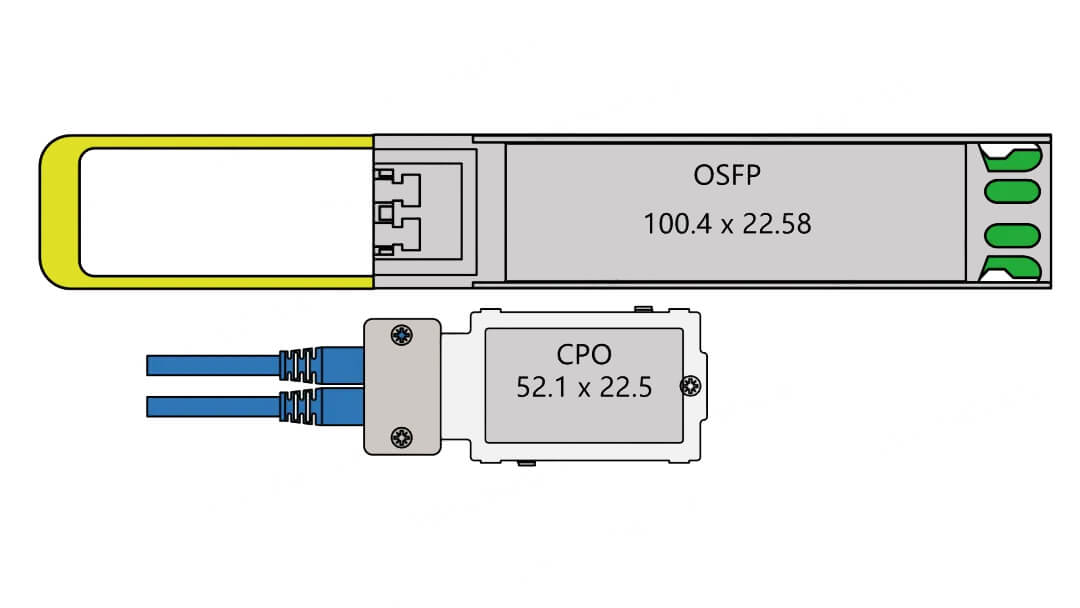
CPO (Co‑Packaged Optics). Traditional optical modules are connected to the main chip of a switch or router system via copper traces over relatively long distances (approximately 150–200 mm). The loss due to this is approximately 0.25 dB/mm.
CPO takes a different approach by integrating the optical module with an ASIC chip. Thanks to the “direct” connection, the distance between connections is reduced and signal loss is reduced.
But there is a main disadvantage - maintainability. Standard modules are always hot-swappable, which allows you to replace a “burnt-out” module, but with CPO this is not so easy.
Who will win the war for 1.6T?
As always, time will tell.
At the moment, the first modules from Broadcom (OSFP-XD) and Intel (QSFP-DD1.6T) are undergoing comprehensive testing. CPO is tested by NVIDIA (Spectrum-4), Arista (7800R3) with AI and supercomputers.
❯ Types of SFP modules
Previously, I described several types of GBIC modules, but did not touch upon SFP at all. In this section I will provide only dry data.
SFP 1Ge
SFP‑Copper - a copper transceiver designed for connection to a twisted pair cable with an Rj-45 connector and transmits a signal over a distance of up to 100 meters via a Cat 5 cable.
SFP‑SX (from some manufacturers SFP‑SR) - multimode optical transceiver for short reach, connection up to 550 m on OM4 optical fiber;
SFP‑LX — single-mode optical transceiver for long distance, connection up to 10 km on OS2 fiber optic;
SFP‑EX — single-mode optical transceiver with extended distance, connection up to 40 km on OS2 fiber;
SFP‑ZX - single-mode optical transceiver for maximum distance (ZX is an unofficial standard, this name was invented by manufacturers for modules that exceed LX and EX in distance), connection from 80 to 120 km on OS2 fiber optic.
In addition, there are some special models:
SFP‑BiDi — the module type is equipped with a simplex (about simplex and duplex, as always, later) LC or SC connector, which is used with one fiber for reception and transmission;
SFP‑CWDM/DWDM - a type of module that has multiplex technology and performs high-throughput transmission over several wavelengths simultaneously.
❯ SFP+ 10Ge
SFP+Copper — the copper transceiver is intended for connection to a twisted pair cable with an Rj-45 connector and transmits the signal over a distance of up to 30 meters via a Cat 6a cable.
SFP+SR — multimode optical transceiver for short reach, connection up to 300 m on OM4 fiber;
SFP+LR — single-mode optical transceiver for long distance, connection up to 10 km on OS2 fiber optic;
SFP+ER — single-mode optical transceiver with extended range, connection up to 40 km on OS2 fiber optic;
SFP+ZR - single-mode optical transceiver for maximum distance (ZX is an unofficial standard, this name was invented by manufacturers for modules that exceed the distance of LR and ER.), connection from 80 to 120 km on OS2 optical fiber.
In addition, there are some special models:
SFP+BiDi — the module type is equipped with an LC connector, which is used with one fiber for reception and transmission;
SFP+ CWDM/DWDM - a type of module that has multiplex technology and performs high-throughput transmission over several wavelengths simultaneously.
SFP+ DAC and AOC - a low-cost alternative to 10G modules that connects switches over a short distance, within a rack, server room or data center (for AOC).
Interesting fact, as some of you may have noticed, GBIC and SFP standards are called SX/LX, etc., and SFP+ SR/LR, etc.
But why is that?
The term "SX» was already familiar from 100BASE‑SX and early 1000BASE‑SX GBICs. It has become the de facto standard for SFP and GBIC modules, although some manufacturers sometimes label SFP as SR.
When the smaller SFP and SFP+ appeared, the IEEE working group standardized it as “SR” (Short Range) as more logical and consistent (contrasting it with “LR” - Long Range for single mode fiber). This was after “SX” was assigned to GBIC.
Although IEEE standardizes the physical layer and protocols (“BASE‑SX”, “BASE‑SR”), the module names themselves (GBIC‑SX, SFP‑SR, SFP‑SX) are often shaped by manufacturers and the market, leading to variations.
SFP28 25Ge
The most common SFP28s are:
SFP28-SR — multimode optical transceiver for short reach, connection up to 100 m on OM4 fiber;
SFP28-LR — single-mode optical transceiver for long distance, connection up to 10 km on OS2 fiber optic;
SFP28-ER — single-mode optical transceiver with extended range, connection up to 40 km on OS2 fiber.
Less common SFP28s are:
CWDM SFP28 — single-mode optical transceiver with wavelength division multiplexing (up to 9 channels), connection up to 10 km on OS2 fiber optics;
DWDM SFP28 — single-mode optical transceiver with wavelength division multiplexing (from 40 to 80 channels), connection up to 10 km on OS2 optical fiber;
MWDM SFP28 — single-mode optical transceiver with wavelength division multiplexing (up to 12 channels), connection up to 15 km on OS2 fiber optics;
LWDM SFP28 — single-mode optical transceiver with wavelength division multiplexing (up to 6 channels), connection up to 30 km on OS2 fiber.
QSFP+ 40Ge
QSFP+SR4 — multimode optical transceiver for short reach, connection up to 100 m on OM4 fiber. An MPO/MTP connector is used;
QSFP+LR4 — single-mode optical transceiver for intermediate reach, connection up to 2 km on OS2 fiber. LC connector is used;
QSFP+LR4 — single-mode optical transceiver for long distance, connection up to 10 km on OS2 fiber optic. LC connector is used;
QSFP+LR4-PSM — single-mode optical transceiver for long distance, connection up to 10 km on OS2 fiber optic. An MPO/MTP connector is used;
QSFP+ER4 — single-mode optical transceiver with extended range, connection up to 40 km on OS2 fiber. An LC connector is used.
QSFP28
QSFP28-SWDM4 — multimode optical transceiver, connection up to 100 m on OM5 fiber optics (~ 70 m on OM4) LC connector is used. Sometime later we will analyze this interesting module separately;
QSFP28-SR4 — multimode optical transceiver for short reach, connection up to 100 m on OM4 fiber. An MPO/MTP connector is used;
QSFP28-PSM4 — multimode optical transceiver for short distance, connection up to 2 km on OM4 fiber. An MPO/MTP connector is used;
QSFP28-CWDM4 — single-mode optical transceiver with wavelength division multiplexing, connection up to 2 km on OS2 optical fiber. LC connector is used;
QSFP28-LR4 (LWDM) — single-mode optical transceiver with wavelength division multiplexing, connection up to 10 km on OS2 optical fiber. LC connector is used;
QSFP28-ER4 (LWDM) — single-mode optical transceiver with wavelength division multiplexing, connection up to 40 km on OS2 fiber using FEC or up to 30 km on OS2 fiber without using FEC. An LC connector is used.
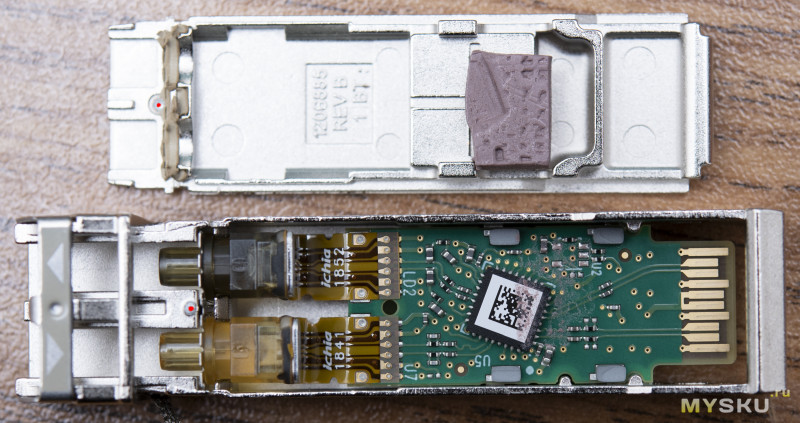
❯ What do SFP modules consist of?
At the end of this article I would like to look at what SFP modules consist of.
PCB:
- receiver and transmitter. Contains a laser diode (VCSEL for multimode, DFB/EML/FP for single-mode) for transmission, and a photodiode (PIN or APD) for reception of the optical signal;
— laser/LED driver. Controls laser/LED current;
— amplifier-limiter (TIA - Transimpedance Amplifier). Amplifies the weak current from the photodiode and converts it into voltage;
- control chip (CDR - Clock and Data Recovery, sometimes with a controller). Recovers clock frequency and data from the incoming signal. Often includes EEPROM to store information about the module (type, wavelength, manufacturer, serial number, calibration parameters - DDM/DOM);
- passive components. Resistors, capacitors, inductors;
- connectors. Pads for connection to the SFP socket on the device (host) and, sometimes, internal connectors for connection to optical components.Cast body:
- the main structure of the module, inside which the printed circuit board is fixed. Precisely shaped for insertion into the SFP interface of a switch/router. Provides basic component protection.Mounting (Screws/Clips):
— screws are necessary to secure the printed circuit board to the case;
— clips/latches are necessary for attaching the metal casing (item 6) to the body.Optical interface:
is a duplex or simplex connector (LC, SC, etc.) containing a precision ferrule that holds the end of the optical fiber for alignment with the laser or photodiode inside the module.Latch:
- is a metal (usually) or plastic lever/loop. When lifted/pulled, it retracts the locking tab inside the module, allowing it to be pulled out of its socket. The shape of the latch (bail latch, pull tab) depends on the type of module (SFP, SFP+, XFP, etc.).Metal casing:
- Covers a significant portion of the main body and PCB (especially the area of optical components and electronics). Serves for:
a. electromagnetic shielding (EMI). Protects internal circuits from external interference and prevents interference from being emitted from the module;b. protection against static electricity (ESD);
c. mechanical protection;
d. heat sink. Helps dissipate heat from the laser and electronics (though the main heat dissipation goes through the contacts to the host).
Plastic or rubber plug:
— necessary to protect the connectors when the module is not in use or is being transported.
❯ Conclusion
So, in the first part of this series, we examined the history and evolution of optical transceivers - from the first experiments with light in glass rods to modern high-speed modules.
We have analyzed the hierarchy of module types and speeds - from the familiar SFP/SFP+ to powerful QSFP-DD and OSFP, ready for terabit speeds. We saw how even within the same form factor (SFP, SFP+, SFP28) there is a variety of types (SR, LR, ER, ZR, CWDM, DWDM, BiDi). For now, I have deliberately avoided the topic of how all this variety of modules allows you to solve various problems.
And finally, we looked inside the SFP modules and found out what key components this little technological masterpiece consists of.
What's next?
In the second part we will look at:
what is simplex and duplex;
fiber types: SMF (single mode) vs MMF (multi mode);
classes MMF: OM1-OM5, SMF: OS1-OS2 - distance and speed;
connectors: how to connect SFP modules to each other.
For those who read to the end
Some important information
I created a Telegram channel from a networker for networkers.
If you are a network engineer, system administrator, developer, student, or just a networking enthusiast, you here.
What awaits you?
Analysis of global failures and unexpected network problems.
Mini-articles with useful tips and explanations of complex topics in simple language.
Stories from the life of networkers, including from subscribers.
News, product reviews and competitions from the team Timeweb.Cloud — in our Telegram channel ↩
Why This Matters In Practice
Beyond the original publication, It's complicated about simple things. Everything you would like to know about SFP modules. Part 1. Evolution of modules and basic concepts matters because teams need reusable decision patterns, not one-off anecdotes. Greetings, colleagues! It's again @ProstoKirReal . In the last series of articles, I discussed with you how the Internet works ( Part 1 , Pa...
Operational Takeaways
- Separate core principles from context-specific details before implementation.
- Define measurable success criteria before adopting the approach.
- Validate assumptions on a small scope, then scale based on evidence.
Quick Applicability Checklist
- Can this be reproduced with your current team and constraints?
- Do you have observable signals to confirm improvement?
- What trade-off (speed, cost, complexity, risk) are you accepting?
FAQ
What is this article about in one sentence?
This article explains the core idea in practical terms and focuses on what you can apply in real work.
Who is this article for?
It is written for engineers, technical leaders, and curious readers who want a clear, implementation-focused explanation.
What should I read next?
Use the related articles below to continue with closely connected topics and concrete examples.