Solar Eclipses from 36,000 km Away, or Why We Know More About Their Space Than Our Own
How Russia's Elektro-L weather satellite captures stunning 120-megapixel images of Earth and solar eclipses from geostationary orbit — and why almost nobody knows about it.
I was choosing between two titles for this text, but then decided to combine them. Many are already used to me writing about Curiosity or, at the very least, about some NASA achievement. Today I'll break from tradition, and we'll talk about a sore subject close to home — Russian space research. No, I'm not talking about how they steal and nothing flies. On the contrary, some things do fly, and there's even something to be proud of, though not as much as we'd like. I'm talking about the incredibly incompetent and often failed work of the public relations departments of our space science.
(If you're not interested in the problems of Russian cosmonautics and just want to see solar eclipses, you can skip the text and go straight to the end of the post).
The text of this post was prompted by a chain of several events and random thoughts. First, an announcement caught my eye with the headline "Interesting results of the early scientific program of the RadioAstron observatory." Hmm, probably worth reading. If anyone doesn't know yet, RadioAstron (also known as Spektr-R) is a Russian space radio telescope. It flies along an elongated elliptical orbit and at its farthest point is almost at the distance of the Moon. Together with a ground radio observatory, it can work as one giant dish spanning from Earth to the Moon.
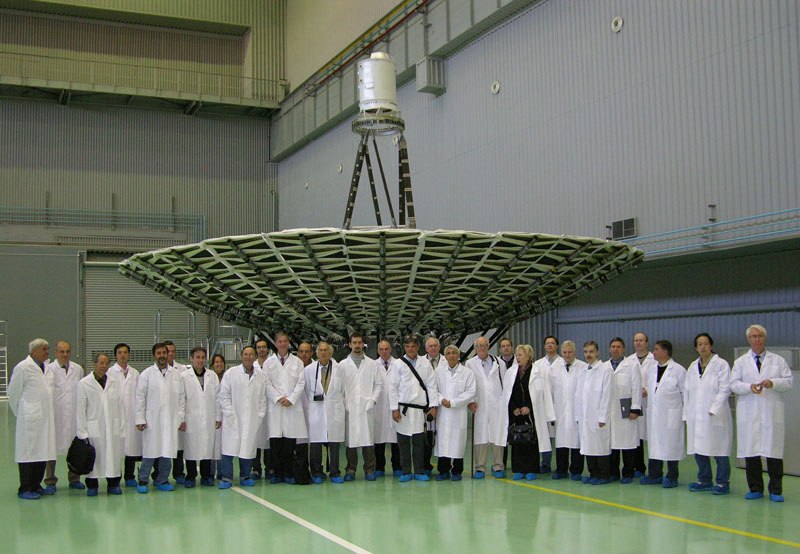
The news on the NPO Lavochkin website stated:
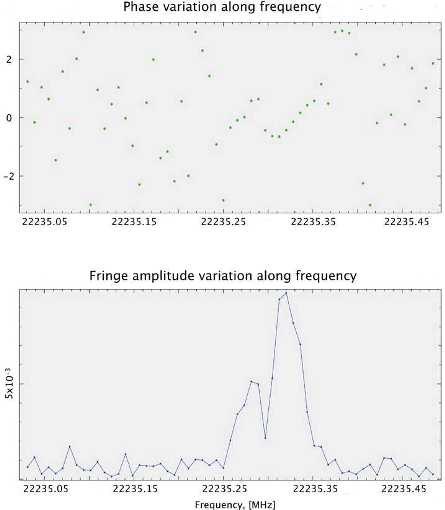
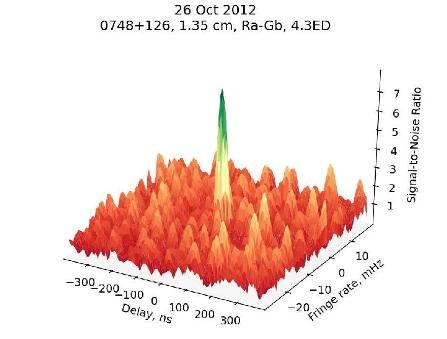
The ground-space interferometer RadioAstron continues to explore uncharted territory — studying the nuclei of active galaxies with ultra-high angular resolution. The interferometer has successfully detected the nuclei of BL Lacertae galaxies, as well as objects in the constellations of Camelopardalis, Cancer, Hydra, etc. at baselines of 6 to 11 Earth diameters in the 6 and 18 cm bands. For many of these objects, brightness temperature estimates give values of about 10 trillion Kelvin (10 to the 13th power), which exceeded the parameters expected by astronomers — this is extremely important for studying the physics of radiation in galactic nuclei. Such discoveries may in the future force scientists to reconsider their understanding of the physics of the Universe.
...Everyone got that? Interesting? It took me about the fourth reading to start understanding what it was about. The news was accompanied by equally captivating illustrations:
The color picture has no relation to the news at all and had already been published in October. Apparently, without it, the material looked completely dreary. Full news article.
What is this, anyway? Is this a report on the work of a phenomenal device that truly has no analogues in the world? Who did they write it for? Do they even know that astronomy is only an elective subject in schools in the country? And they're telling us about galactic nuclei at baselines of 11 Earth diameters. At least they're still telling us something. Meanwhile, on the very same NPO Lavochkin website, on the "Current Status" page, the latest news about RadioAstron is from March 11, 2011: "Already assembled, now testing." Even though it's been flying for a year and a half.
Alright. In the same news feed, there was another story: "Elektro-L: 2 years of successful operation in orbit."
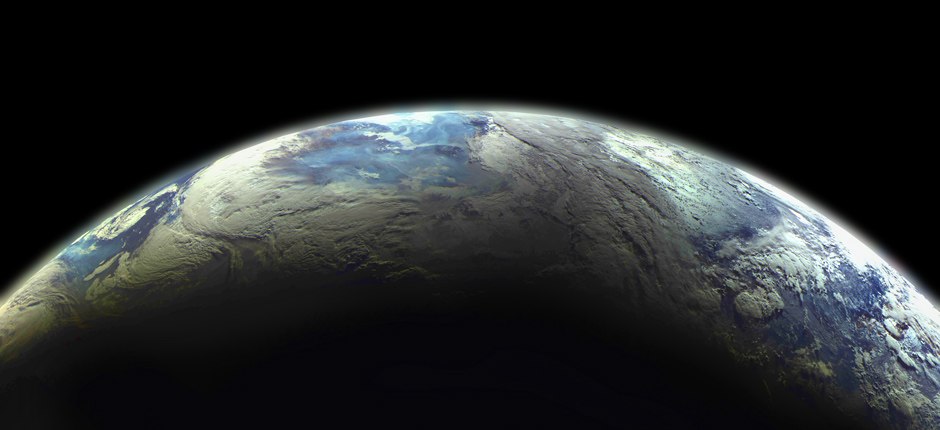
This is a genuinely understandable and pleasant piece of news. For two years now, a Russian meteorological satellite has been hanging in geostationary orbit above the Eastern Hemisphere, which — in the best NASA "Hollywood" traditions — alongside science, takes incredible photographs of Earth.
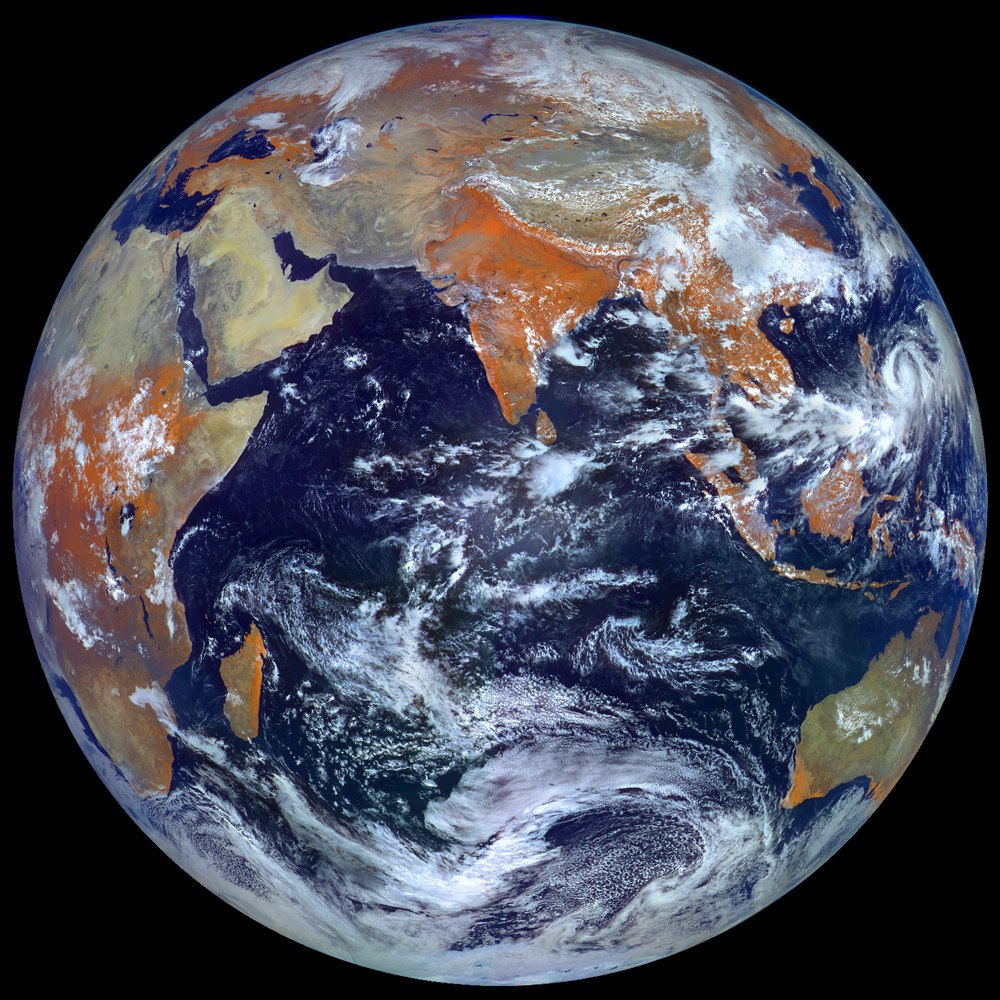
(In the original, the colors are less dramatic, but Photoshop works wonders. And the color doesn't correspond to visible light because it captures the near-infrared range, making all vegetation appear orange, while deserts look somewhat greenish). Full size 120 megapixels on GigaPan. Detail: 1 km per pixel.
The most amusing and simultaneously sad thing is that foreigners wrote about these photos first. That is, first the British and Americans were blown away by our satellite's photos, then Russian journalists were blown away by the fact that foreigners were blown away, and rushed to report about "one single 120-megapixel photograph." Then the excitement died down, while the satellite continued hanging in orbit, diligently taking that "one single" 120 MP photo... every half hour. Most surprisingly, in the context of Russian space traditions, online access to almost the entire photo archive is available. On the official website of the Scientific Center for Operational Earth Monitoring (NTs OMZ), a daily GIF animation of daily shots is posted. And access to the FTP server for 2012-2013 is open. (Just don't start downloading everything at once, or we'll bring it down with the Habr effect). Photos there are organized in folders by year, month, day, and hour. Inside are two archives: one with raw data, the second with large JPEGs. Outside the archives are 800x800 previews in RGB and various spectral ranges.
The image quality is simply stunning:
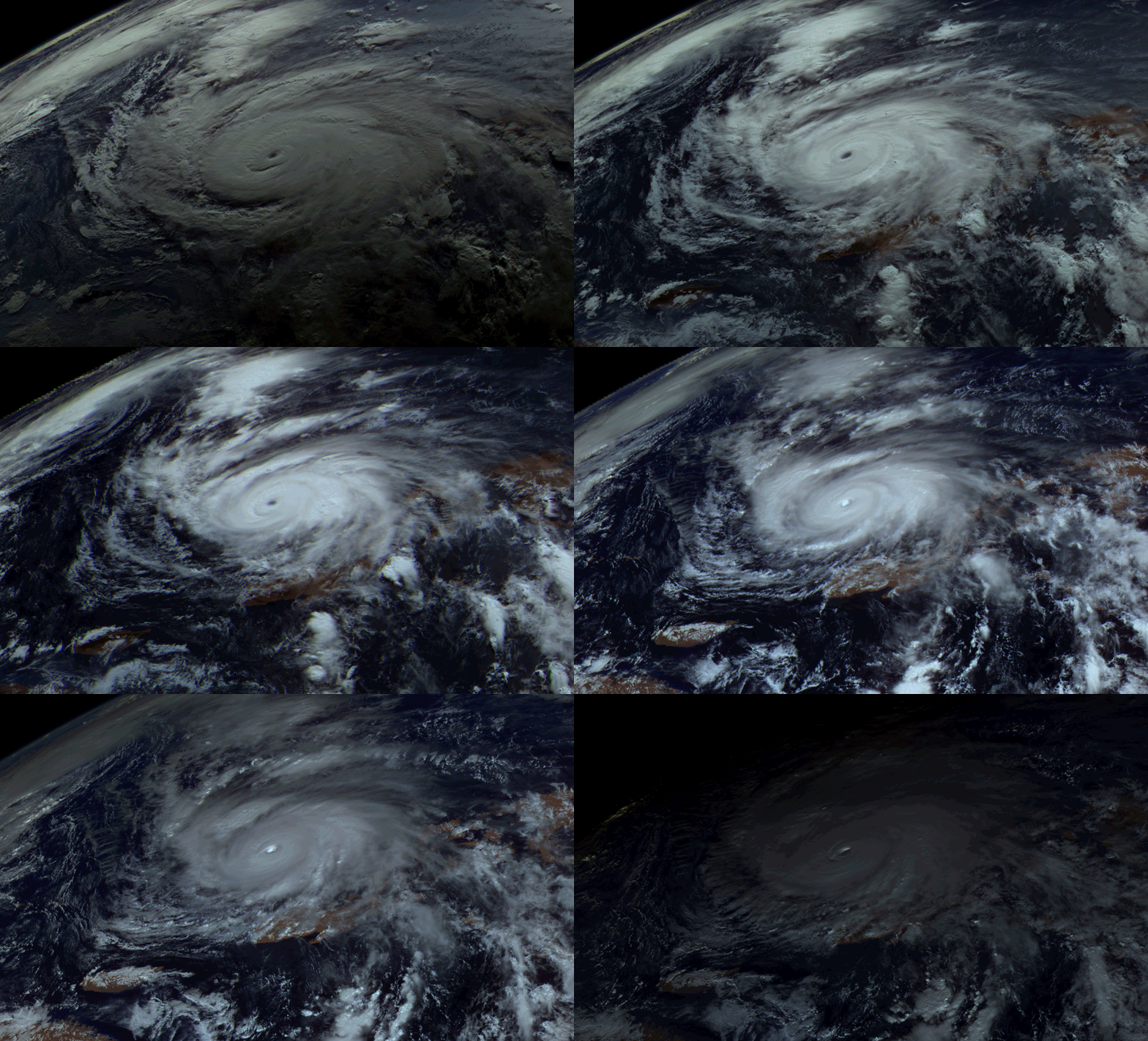
Meanwhile, our media hadn't mentioned the satellite — which has been working reliably for two years — since the publications in Western press. And indeed, what's there to write about — boring: it works and works. Let's instead discuss for the 100,500th time how Phobos-Grunt sank. But the scientists on their side also provided no newsworthy stories for journalists; I think they're not even familiar with the term.
Looking at how our institutes prepare news about RadioAstron or even about Curiosity (in PDF!), one can conclude that our space science has very remote notions of what public relations is, what modern media society is about, and how to attract attention. I fear their biggest problem is understanding why they should attract attention at all.
The problem isn't just their overly stingy or overly boring reports about what's been done, but also the overly loud and bold promises about what they'll do. I would outright ban all official figures of Russian cosmonautics from using future tense in their speech for five years. They've had this problem since GLONASS. Since 2001, they'd been promising that it was just a year away. As a result, 10 years later, when it reached 100% capacity, people only remembered it thanks to Steve Jobs.
Admittedly, Roscosmos has recently started doing some PR work — they opened a YouTube channel, post on Twitter, and even have a VKontakte page. But Russian space science's PR is a complete failure.
Let's return to Elektro-L. After reading the news about its second anniversary, I suddenly realized that our esteemed scientists had valiantly missed at least three opportunities to remind the Russian and global public about themselves and their work. Solar eclipses are a free global media show, and our satellite has a unique ability to photograph the lunar shadow passing over Earth from a distance of 36,000 km.
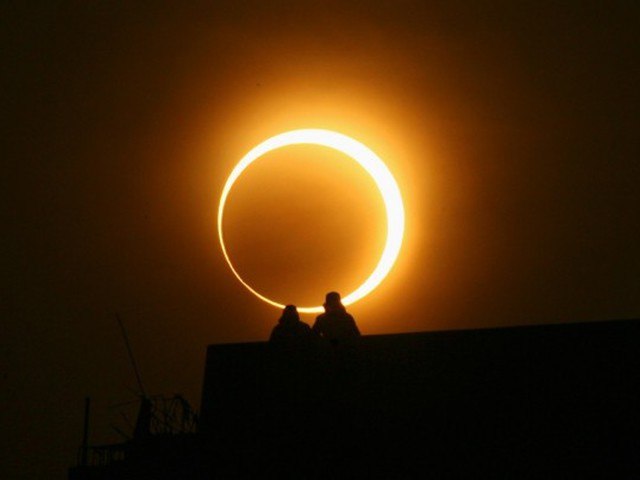
In 2012, there were two solar eclipses that caused a frenzy in the foreign press: in May in Japan and in November in Australia. And both were within Elektro-L's field of view. Unfortunately, the Australian one couldn't be captured due to some technical glitch — all frames for half a day were black. But another one was found — a partial eclipse that almost nobody saw, since it occurred over the South Pole: November 25, 2011. But we can see it — not from the pole, but from space. Watch: after noon, a shadow races across Antarctica.

(Unfortunately, source images for 2011 are not available, so you can only watch in animation from previews).
And here's the "Japanese" rare annular eclipse in all its glory:

And finally, the most important thing — the reason it was actually worth launching the satellite: a desktop wallpaper with an eclipse.
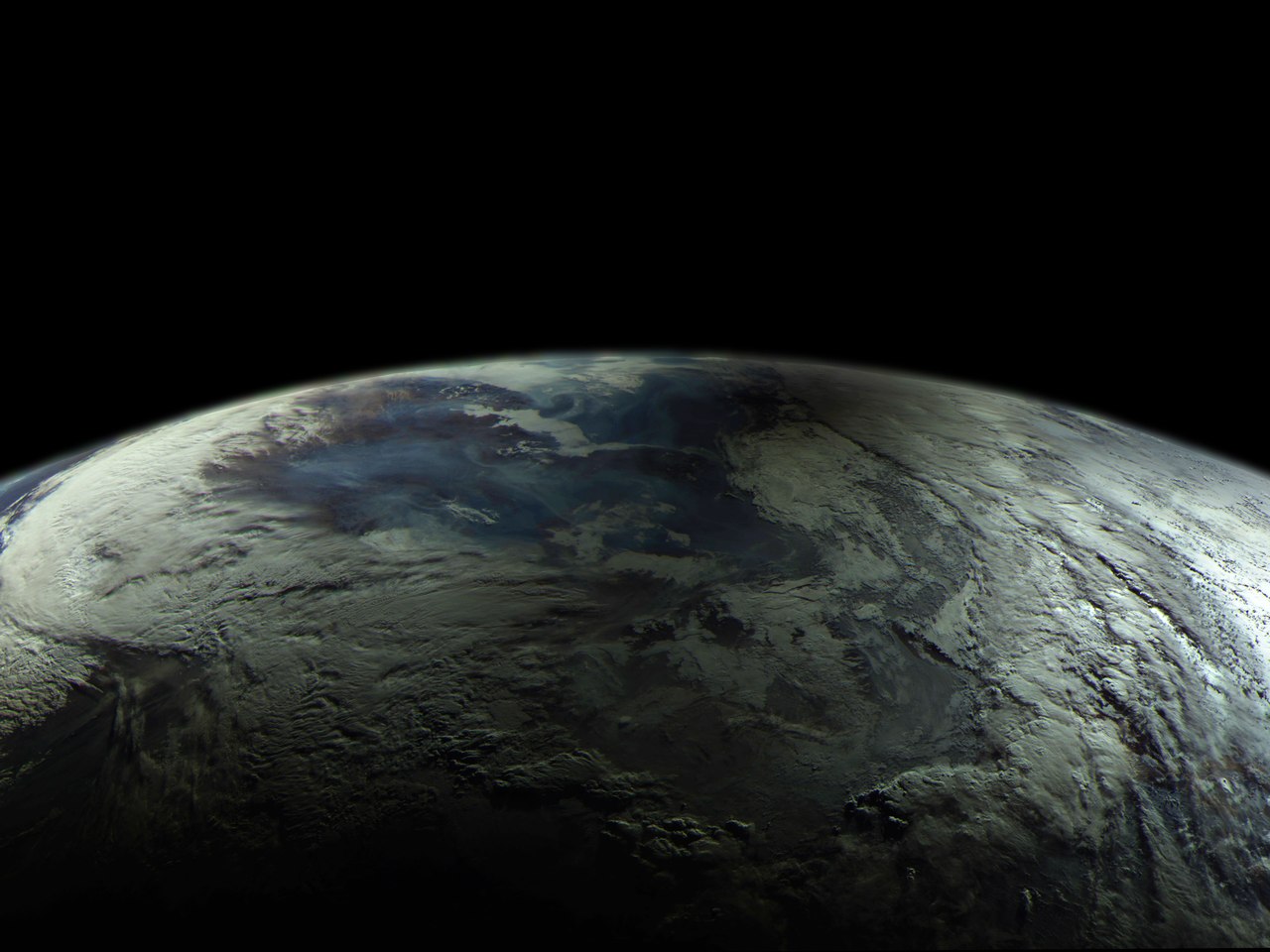
3200x1920 2560x1920, 1920x1200, 1920x1080
The satellite always hangs above the same point on Earth, so the shooting angles don't change. But the subject changes. Typhoons, cyclones, dust and snow storms, volcanic eruptions, forest fires — everything ends up in its images; you just need to find it. Elektro-L now has its own VKontakte page, and I'll try to post here as interesting materials accumulate.