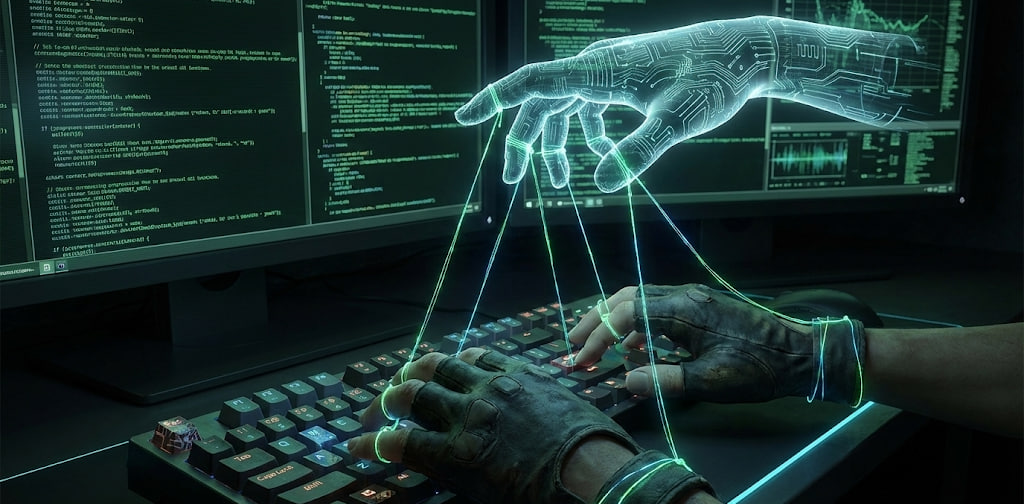
Stop Vibe Coding: Why 'Chill Development' Will Kill Your Career
An in-depth critique of 'vibe coding' — the habit of mindlessly approving AI-generated code instead of thinking — and how it leads to career stagnation, production crises, and loss of engineering skill.
1. The "Vibe Coding" Phenomenon: A Substitution of Concepts
In IT culture, the concept of "flow state" (Deep Work) has long been established. This is when a developer loads the complex context of a task into memory, disables distractions, and spends several hours working on complex logic. After such a session, a person feels exhausted but gains a result and a complete understanding of the system.
"Vibe coding" is a degraded analog of flow. It is a state where development becomes an effortless activity. The developer sits comfortably, music is playing, and the code "writes itself." The programmer's role is reduced to approving IDE suggestions — pressing Tab or Enter to accept the assistant's proposal.
The substitution of concepts is this: productivity (lines of code per minute) is confused with effectiveness (the number of problems solved and the reliability of solutions).
Vibe coding offers an illusion: programming no longer has to be difficult. No documentation needed, no struggles with architecture, no need to keep module relationships in your head. You can just "catch the vibe" and let autocomplete lead the way.
This is a mistake. Real engineering is always about resistance of the material, making decisions under uncertainty. If it's "too easy" to write code for a complex system — you're not writing a system, you're generating text. You're not a driver watching the road; you're a passenger with a toy steering wheel, thinking you're in control.
Vibe coding is the dopamine fast food of the profession. You get instant pleasure ("the function wrote itself in a second!"), but you skip a critical stage — reflection. The habit of skipping thinking becomes the first step toward losing your qualifications.
2. You're Not Writing Code, You're "Approving" It
Take an honest look at your workflow. How often in the last month have you written a complex algorithm line by line, thinking through every variable?
Vibe coding has imperceptibly replaced the developer's role. It used to be a Writer, creating from scratch. Now it's often an Editor (and usually a mediocre one).
The process looks harmless: you type a function name or a comment about the desired result. The IDE suggests a gray block of code. Your eyes skim over it: loops are in place, variables look logical, syntax is correct. You hit accept. Done.
At that moment, a "Black Box" is born.
The problem: the code you approve doesn't pass through your cognitive filtering. You didn't "arrive" at the solution. You didn't think: "Maybe a Map instead of an array?" You agreed with the first probable variant from the machine.
Your project becomes someone else's. The code works (for now), but you don't own it. You know what it does, but you lose understanding of how and why.
Where does this lead? To loss of control. When you need to optimize or perform complex refactoring, you hit a wall. You stare at your own code (formally written by you) like an archaeologist at ancient inscriptions.
The telltale symptom is fear of the blank page. Without plugins, without the internet, alone with a text editor, a vibe coder freezes up. The skill of synthesizing solutions atrophies. All that remains is the skill of validating someone else's suggestions. An engineer who can't create ceases to be an engineer.
3. The First Failure Crisis
Vibe coding works excellently on the "happy path." Prototypes assemble like a construction set, demos work, tasks get closed at record pace. It seems like you've hacked the system: development no longer requires sweat and blood.
Then reality hits. The code goes to production.
The crisis begins when a bug appears in a system built from half-understood snippets and AI suggestions. Not a typo (the compiler will catch that), but a logical error at the intersection of business logic, asynchronicity, and edge cases.
Here the vibe coder meets a cruel truth: "You cannot effectively debug what you don't understand."
Code from a probabilistic model often suffers from "silent diseases." It looks flawless but contains vulnerabilities, memory leaks, and suboptimal database queries that will "fire" under load. The author of such code keeps a map of weak spots in their head. A vibe coder doesn't. For them, it's a monolithic wall of text that "somehow doesn't work."
Then begins "Divination by Prompts."
Instead of a debugger, stack trace, and execution logic, the vibe coder solves the problem the same way they created it. They copy the error into a chat with a bot: "Fix this."
This isn't engineering — it's superstition. The developer is like a gambler at a slot machine: pulling the lever (generating code) and hoping for three sevens and the error's disappearance.
Sometimes it works. More often, it leads to layers of "crutches." The system becomes overgrown with meaningless checks that suppress the error without addressing the cause. The result is fragile, unreadable spaghetti code. Technical debt becomes a mortgage at predatory interest rates.
4. Career Dead End: The Market Wants Problem Solvers, Not Text Generators
The cost of boilerplate code is rapidly falling to zero. CRUD operations, forms, configurations — these aren't skills that command high salaries. They're commodities that algorithms produce cheaper and better.
If your job is to translate tasks into language syntax, you're competing with free, scalable neural networks. You will lose.
The market has changed. The era of "hire anyone who knows where the semicolon goes" is over. The demand isn't for Code Generators but for Problem Solvers.
The difference: a code generator celebrates a closed ticket. A problem solver thinks about the impact of the solution six months down the line.
- An engineer's value lies in the ability to make architectural decisions
- The ability to refuse to code if a process can solve the task
- Understanding why this database was chosen and what risks it carries
- Responsibility for the result, not the process
The "Eternal Mid-Level" trap: A vibe coder quickly reaches the Middle level thanks to AI. They close tasks fast, PRs look solid. But growth stops.
They can't become a Senior or Tech Lead — roles that require contextual thinking. You need to hold the project structure in your head, understand connections, and foresee bottlenecks. A vibe coder thinks in fragments — functions and files. Their brain wasn't trained to build complex models, only to choose from what's offered.
The interview test: Interviewers less and less ask to "write an algorithm on the whiteboard" and more and more ask "in depth": "Why this method? What if the load grows 10x? How does this work under the hood?"
A vibe coder falls apart. No fundamental knowledge, only surface-level erudition from the IDE. In a market where coders are replaced by scripts, only those who understand the essence are worth paying for.
5. How to Regain Control
This is reversible. Automation tools aren't evil if they serve you rather than replace you. What's needed is a mode of "conscious resistance."
1. The "Zero Trust" Rule
Break the Tab reflex. Impose a veto: "I don't commit a line if I can't explain how it works down to the last comma."
Generated code is a draft. The work begins after generation. Read it. Find the error. Ask: "Why this method and not another?" If you don't know — go to the documentation (official documentation, not a chatbot). Defend every line at code review without saying "the IDE suggested it."
2. Read Source Code Instead of Generating It
A vibe coder only writes. An engineer reads a lot.
Get "under the hood" of the libraries you use. Open the framework's source code. See how others solve architectural problems without AI.
This develops taste and pattern recognition. You see patterns, understand the logic of others' thinking. Neural networks learn from code — why have you stopped?
3. Turn Off the "Exoskeleton"
AI is an exoskeleton. It makes you stronger and faster. But without breaks, your muscles atrophy.
Set up "rest days" or hours. Solve a complex task with the assistant turned off, using only documentation and your brain. It will be painful, slow, and you'll feel stupid. That's normal. That's the "creaking of the brain" — the process of growing neural connections.
Complexity is a blessing. Don't avoid it by hiding behind prompts. The ability to handle complexity, hold context, and understand deep abstractions is what makes you an expensive specialist who can't be replaced by a script. Take back control of your profession.