Story of a Game: Wheel of Fortune
A personal memoir about creating the legendary Russian computer game 'Pole Chudes' (Wheel of Fortune) in the early 1990s at a closed Soviet nuclear research city, and its unexpected journey across the world.
It happened in a city closed off from spies. Or open to them, depending on how you look at it. Arzamas-16, the Russian Federal Nuclear Center (VNIIEF). Founded in 1946 to build atomic bombs. One of ten closed cities in Russia. Now it's called Sarov, and a couple of years ago President Medvedev waved his hand and said the city would become an innovation center (an interesting claim, given that in the previous decades the only innovation allowed was in atomic weapons).
A Brief Note About the 1980s
The best students in the closed city had a predetermined path: excellent grades at school, admission to a prestigious university (Moscow State, Moscow Engineering Physics Institute, or similar), return to the "system," a state apartment, candidate and doctoral dissertations — with material rewards measured in modest increments. Free thinkers and troublemakers were quietly neutralized — and in a closed city, that was especially easy.
Brilliant mathematicians who were born in this city (or brought there as children) spent their entire careers within its boundaries. Some of them could have competed with the world's best minds, but their talent was channeled exclusively into weapons development. It's impossible to know how many potential Fields Medal winners worked their whole lives on classified calculations that would never be published.
Teaching Programming at MSU's Faculty of Mechanics and Mathematics
I studied at MSU from 1979 to 1984. Programming was taught on BESM-6 mainframes using Fortran punch cards. You'd write your program on paper, punch it onto cards, submit the deck to the machine room, and wait a day for results. If you had a bug, you'd fix the card and wait another day. Two or three runs per week. This was considered advanced.
There were also ES EVM machines (Soviet IBM System/360 clones). The terminals were something out of a movie — green phosphor screens in dark rooms, with students hunched over keyboards. But the real revelation came later.
IBM PC/XT
In the late 1980s, two IBM PC/XT computers appeared at the institute. One was placed in the terminal room, accessible to everyone. The other — by an incredible stroke of luck — ended up in my office, room 632A. The machine had MS-DOS, a 20 MB hard disk, and a CGA monitor with 3-color graphics at 320x200 resolution.
All programs were written in Turbo Pascal by Borland — a compiler that fit on a single floppy disk and was nothing short of revolutionary. The code compiled almost instantly. After years of punch cards and overnight batch processing, this felt like teleportation.
The first thing we did, naturally, was play games. Digger, Cats, and whatever else could be found on the handful of floppy disks circulating around the institute.
IBM PC/AT
Then the AT machines arrived — 286 processors, EGA graphics with 16 colors at 640x350. This was a qualitative leap. You could actually draw something resembling real graphics. The creative urge was irresistible.
Wheel of Fortune
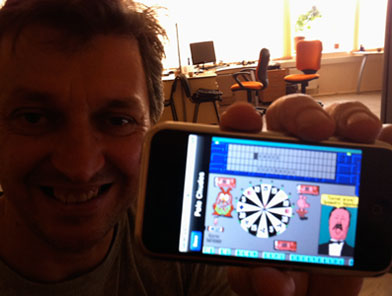
The game "Pole Chudes" (the Russian version of Wheel of Fortune) was created in approximately one week — one day for the graphics, two days of coding, and three days of testing with women from a neighboring department. They were an invaluable test audience, uncovering interface issues that a programmer would never notice.
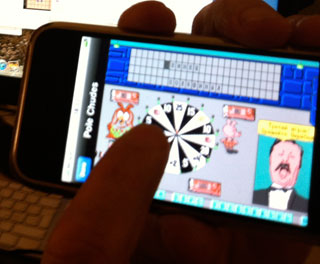
The word database needed to be populated. I filled it with what was at hand — specifically, the secret telephone directory of institute employees. This directory listed everyone by full name and department, providing a rich source of surnames and associated clues. The game would give hints like "Soviet physicist" or "Nuclear engineer" — which, given the context, was almost everyone in the city.
A Little Bit of Code
Graphics on the IBM PC worked through direct memory access:
var scr: array[0..63999] of byte absolute $A000:0000;
scr[0 + 320*47] := $FF;
This would set pixel (0, 47) to white. Assembly language was about twice as fast for graphics operations — critical when you're pushing pixels at CGA resolution with an 8 MHz processor.
The game's visual design was modest by today's standards but impressive for its time and context. The wheel animation used simple trigonometric calculations, and the letter board was drawn character by character using direct screen writes.
Around the World
The game spread across the former Soviet Union entirely through floppy disk exchange — the original social network. There was no internet, no app store, no distribution platform. Someone would copy the game onto a floppy, give it to a friend, who'd give it to a colleague, who'd take it on a business trip to another city.
Within a year, the game had reached Russian-speaking communities in Israel and the United States. I had included my email address (bashurov@vniief.su) and home phone number (5-92-73) in the game's about screen. I started receiving calls from players around the world, including one from a radio station host in Tel Aviv who wanted to discuss the game on air.
The Newspaper "Pole Chudes" Editorial Office
In January-February 1993, I visited Moscow and went to the editorial office of the "Pole Chudes" newspaper, hoping to commercialize the game. The editor-in-chief received me warmly and showed genuine interest. His assistant, a man named Semanov, struck me as somewhat slippery. I gave them the source code on a floppy disk, receiving only vague promises in return.
When the October 1993 constitutional crisis hit Moscow (tanks firing at the White House), the newspaper's progressive publishers fled to Spain for three months. When they returned, they claimed ownership of the game — after all, they had the source code. Nothing ever came of it, and I chalked it up to experience.
Lamport, eHouse, and Ulendeyev
A colleague named Slava Ulendeyev bumped into me in Moscow. When he heard about the game and its distribution problems, he unexpectedly gifted me $400 and a new computer. This was an enormous sum at the time — it funded a family vacation to Crimea, where a good hotel room cost one dollar per night.
Yakubovich: Yes, Yes, No, Yes
While staying at a hotel in Nizhny Novgorod, I found myself in the elevator with Leonid Yakubovich — the famous host of the TV show "Pole Chudes" (the Russian Wheel of Fortune). He was in town for a live show.
When I introduced myself as the creator of the computer game, his expression changed dramatically. It turned out that the TV station had been flooded with letters from viewers who, after playing my game, believed they had won prizes and were writing in to claim them. Two entire rooms had been filled with such correspondence over two years. Yakubovich wasn't exactly threatening legal action, but he made it very clear that my game had caused considerable headache for the show's production team.
California
By 1995, I was working as a contractor for Intel on 3D graphics engines (the 3DR project). I traveled to E3 in Los Angeles and visited major game companies in Silicon Valley — UbiSoft, Parallax Software (makers of Descent), Electronic Arts.

At Electronic Arts' campus, I was struck by the contrast with my institute in Arzamas-16. Here were people making games professionally, in sunlit offices with foosball tables, earning good salaries. Back home, I had been making games in stolen moments between nuclear calculations, on borrowed equipment, distributing them for free on floppy disks.
Even years later, I would occasionally receive emails from people who remembered the game. "Are you the one who made Pole Chudes? I played it as a kid!" — messages like these kept arriving well into the 2000s.
Conclusion
For a Russian engineer, programming is not just a profession — it's a source of deep personal satisfaction. The game "Pole Chudes" was written in a week, distributed for free, brought me no fortune but considerable adventure, and is remembered by an entire generation of Russian-speaking computer users. It was born in a closed nuclear city, traveled the world on floppy disks, angered a TV host, and led me to Silicon Valley. Not bad for a week's work in Turbo Pascal.