Technology for Verifying Banknote Authenticity
A deep dive into the technical systems used to verify the authenticity of banknotes, covering human-readable security features, machine-readable markers, detection devices from simple UV lamps to advanced sorting machines, validation algorithms, and future technologies including RFID tags and quantum money.
Human-Readable Security Features
An enormous number of methods to protect against counterfeiting have been invented. But unfortunately, not all of them are suitable for automatic validation. Either the protective element is difficult to read and represent digitally, or there are no clear "pass/fail" criteria, or both. So the best validator remains the sharp eye of an expert.
Human-readable features are very diverse, interesting, and new ones are invented every year. Properly speaking, their description warrants a separate article, but since we'll be focusing on equipment, let's limit ourselves to a brief list.
- Watermark. Images created by areas of paper with different density, visible when held up to light.
- Security thread. A metallic or polymer strip embedded in the body of the paper.
- Microprinting. Tiny symbols, usually denomination or bank designations.
- Security fibers. Fragments of multi-colored threads scattered throughout the paper mass.
- Micro-perforation. Tiny holes drilled by laser, forming an image or inscription.
- Embossed printing. Inscriptions and designs distinguishable by touch.
- Kipp effect. A ridged surface area with an image on the lateral facets.
- Registering images. Designs on different sides of the sheet that align when held to light.
- Orlov printing. Fine lines whose color changes without visible interruptions.
- Foil stamping. A design made with metallic foil.
- MVC (Moire Variable Color). Moire bands of different colors visible when tilted.
- OVI (Optically Variable Ink). Ink that changes color depending on the viewing angle.
- Hologram. An element with a three-dimensional holographic image.
Machine-Readable Features
So what do machines examine and verify? The set of machine-readable authenticity features is considerably more modest.
Banknote Dimensions
The overall dimensions of a banknote, strictly speaking, are not security features, but most detectors check them first. Primarily, this allows immediately filtering out junk: torn banknote fragments, foreign objects, stuck-together and folded bills. Secondly, it's a simple but fairly reliable way to identify the currency and denomination of a banknote.
Dimensions are checked optically, by scanning in transmitted light. If the device doesn't have a full-size scanner, it can determine only one dimension by measuring the time the banknote blocks the sensors as it's pulled through the mechanism. Also, by the attenuation of light flux, the device detects doubled banknotes.
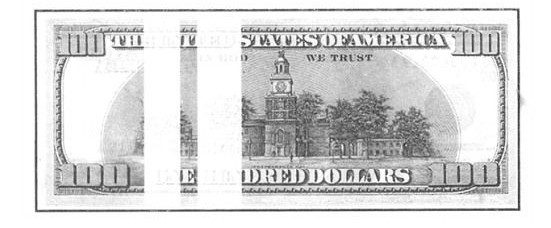
Visible Image
The banknote image in visible light is obtained by scanning, either in transmitted light, reflected light (each side separately), or both. The device may check not the entire surface but only several characteristic zones. In that case, individual sensors suffice, each consisting of an optocoupler: LED + photodiode.
For reliable validation, a complete image is required, and in this case photodetector arrays are used, similar to those in regular scanners. The resolution of these arrays can range from 10 to 200 DPI, and higher resolution doesn't always lead to better recognition quality.
Scanning may be done in a single color (usually red, less often white) or in full color. In the latter case, the scanner contains several color channels. These are not always the standard RGB. The base colors are chosen based on the ink spectra of the currency being recognized. There may be more than three colors: for example, red (640 nm), green (525 nm), blue (~450 nm), and dark red (~750 nm, almost at the infrared boundary), which clearly reveals features of the US dollar design.
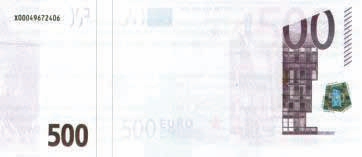
Infrared Image
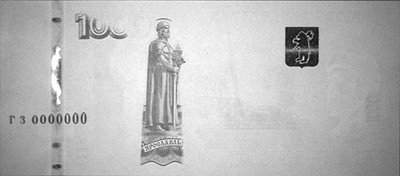
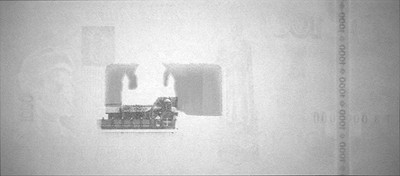
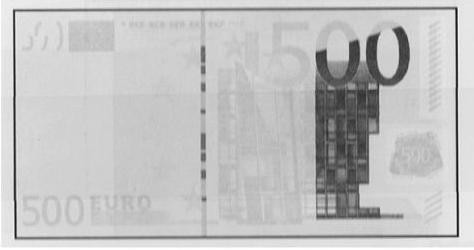
The image in infrared light (880-940 nm) is one of the main machine-readable features. When printing banknotes, special so-called metameric inks are used. Designs made with such inks may look uniform in visible light but have clearly distinguishable dark and light areas in IR.
Additionally, IR scanning in transmitted light reliably recognizes watermarks, security threads, and metallized elements of the banknote. IR scanning allows determining the optical density of the paper, using it as yet another verifiable feature, or simply for rejecting doubled sheets.
Ultraviolet Markers
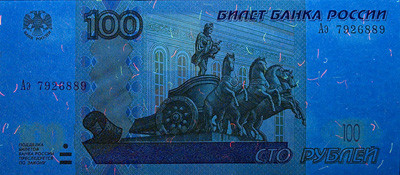
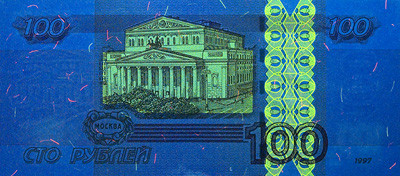
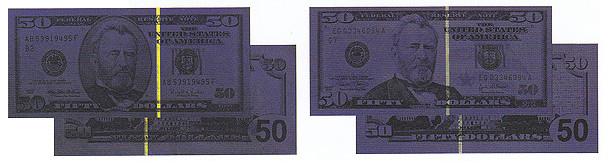
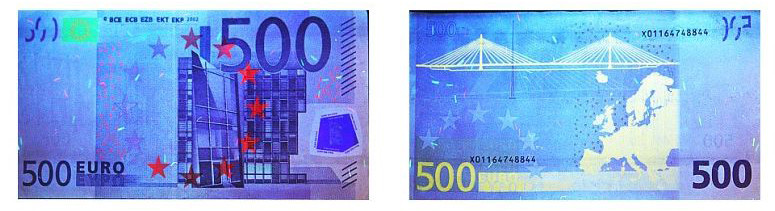
As one of the security features, banknotes contain marks made with luminophores that glow in the visible spectrum when irradiated with ultraviolet light. Luminophores exist in all colors of the rainbow, so a banknote under UV looks very beautiful.
Security fibers also have luminescent properties (for RUB and EUR), with different fibers having different glow colors. In woven fibers on rubles, one thread glows while the second doesn't, making the fiber appear dotted. Another security feature is the absence of background paper luminescence. Ordinary writing paper contains optical brighteners that cause it to glow blue under UV. Money is printed on unbleached paper that produces no background glow.
To check UV markers, the validator is equipped with an ultraviolet lamp or LEDs (360-380 nm). The glow of markers is captured by visible-spectrum photodetectors covered with filters that block the primary ultraviolet. The simplest detectors check only the absence of background paper luminescence; higher-level devices capture a full scan. The glow of security fibers is practically not checked due to their small size and irregular placement.
Magnetic Markers
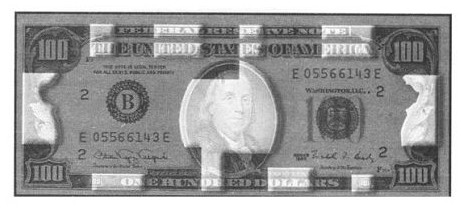
Certain areas of banknotes are printed with ink that has magnetic properties. For example, on Russian rubles of modifications up to and including 2004, the banknote number (in green) is magnetic. On rubles of the 2010 modification, certain image fragments have magnetic properties.
Magnetic markers are divided into "hard" and "soft." The former use magnetically hard materials and can retain their own magnetization. "Soft" markers demagnetize immediately when the external field is removed. Magnetic read heads, similar to regular tape recorder heads, are used to detect magnetic markers. Heads for validators are typically wide (2-5 cm) to capture a larger area. For reading "hard" markers, the banknote is first pulled over a permanent magnet, then over the heads that detect residual magnetization.

Special Element "I" (Anti-Stokes)
Ordinary luminophores emit light with a longer wavelength than the excitation radiation. For example, when illuminated with ultraviolet, visible light is emitted. There is a class of substances called anti-Stokes luminophores for which this law does not apply. The security element "I" is based on the properties of anti-Stokes luminophores.
When the element is illuminated with intense infrared light (wavelength 940-960 nm), it begins to emit in the green region of the spectrum (~520 nm). On rubles, anti-Stokes markers are located on the front side at the bottom left (gray denomination digits) and on the right (gray denomination background).
There are luminescent markers with more complex verification methods, for example, requiring laser irradiation and glowing in the IR range.
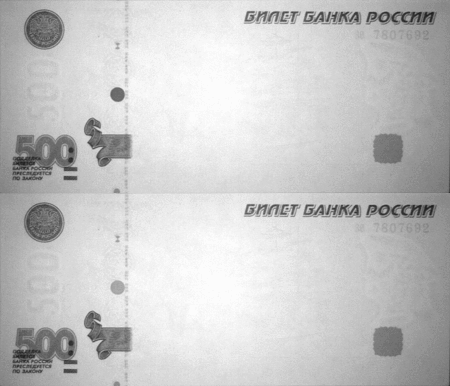
Special Element "M"
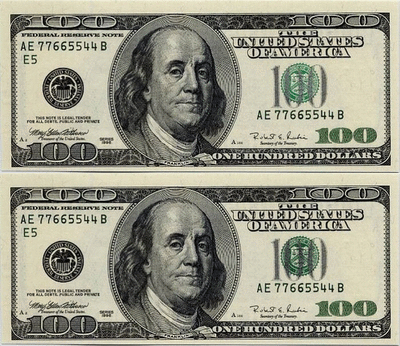
This security element is an ink that has different absorption coefficients at different parts of the spectrum in the IR range. If you illuminate the banknote alternately with 940 nm and 850 nm light, element "M" will appear to blink (when observed in IR light).
On rubles of modifications up to 2001, such an element existed as a dot, strip, or image fragment. There is no reliable data about later modifications.
On US dollars, the Treasury seal has similar properties.
Secret Features
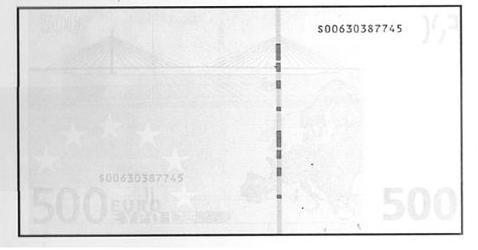
To make life harder for counterfeiters, information about not all security features is published. There are classified security elements unknown to the general public, which are verified only by the Central Bank itself. Patents can serve as an indirect source of information about them. Many interesting things can be used for counterfeit protection.
For example, identification by the ignition and afterglow characteristics of luminophores. Or the use of electroluminophores. Or embedding fibers with magnetic properties into the paper mass. Or metallized elements with strictly defined resonances in the microwave range. Or even nanodiamonds (no kidding!).
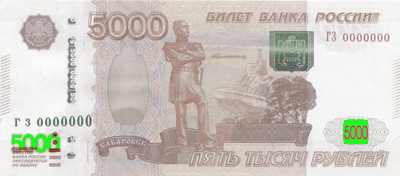
The state mint sells a special device for checking special features to machine manufacturers (produced at the LOMO factory in Saint Petersburg). It works as a USB device. What's inside is unknown — for reliability, the entire device is sealed.
Banknote Processing Devices
Visual Inspection Detectors
A visual inspection detector only visualizes security features, and the decision about whether a banknote is genuine or not is made by the operator. On one hand, the device is as simple and cheap as possible, on the other hand, it requires certain skills to operate.
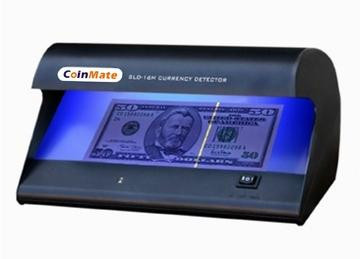
An ultraviolet detector consists of one or more UV lamps, often with a magnifying glass and a scale grid. Luminescence of security elements is checked "by eye."
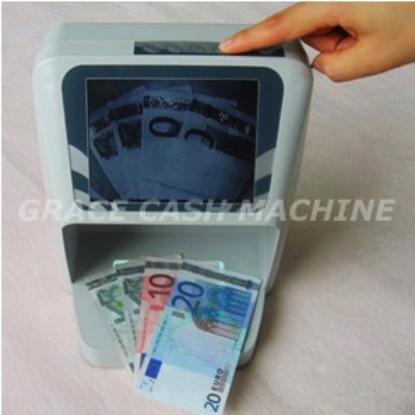
An infrared detector is slightly more complex. It contains IR illumination of the working area, a camera with a corresponding filter, and a display showing the camera image. To monitor the "M" special element, two groups of illumination with different wavelengths are used, which alternate. The special element appears to blink.
Combined (IR+UV) devices exist. Additionally, visual inspection detectors can be equipped with external cameras (for studying suspicious fragments "up close"), magnetic marker detectors, and similar accessories.
Automatic Detectors
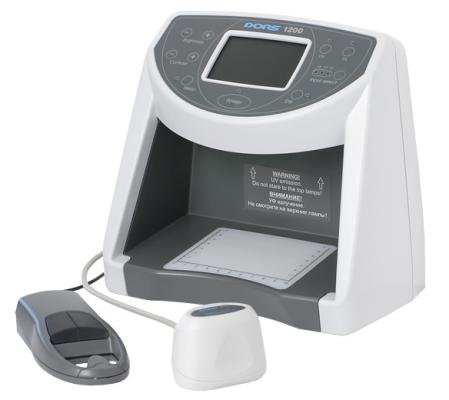
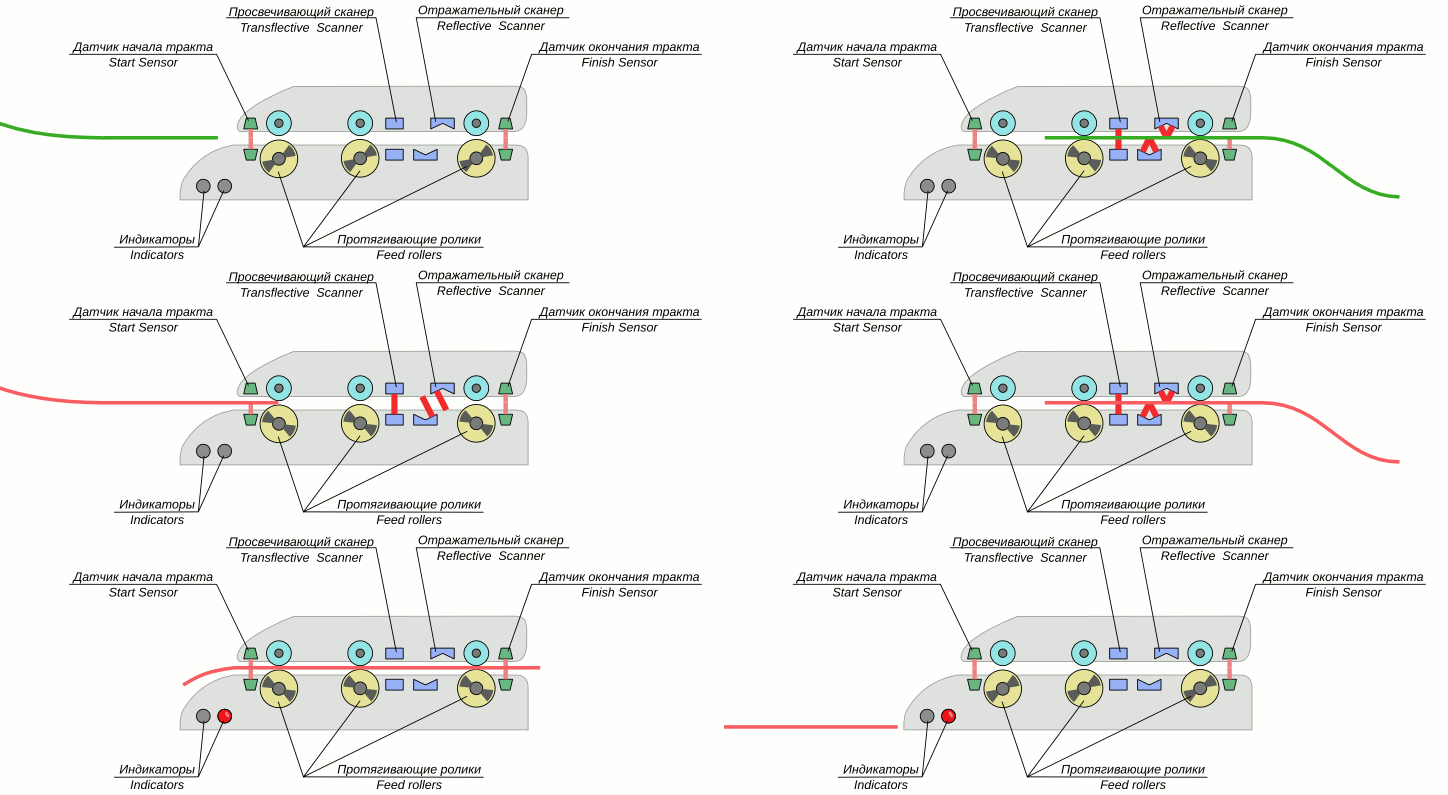
An automatic detector doesn't require the user to have specialized knowledge. You simply insert a banknote, the detector grabs it, pulls it through the mechanism, scans it, analyzes it, and delivers a verdict: counterfeit or genuine.
The simplest detectors have only a few individual photodetectors and thus scan several individual lines of the image, usually in the IR range. More advanced models read the complete banknote image using a photodetector array. Additional magnetic sensors and UV illumination may also be present.
Counters and Sorters
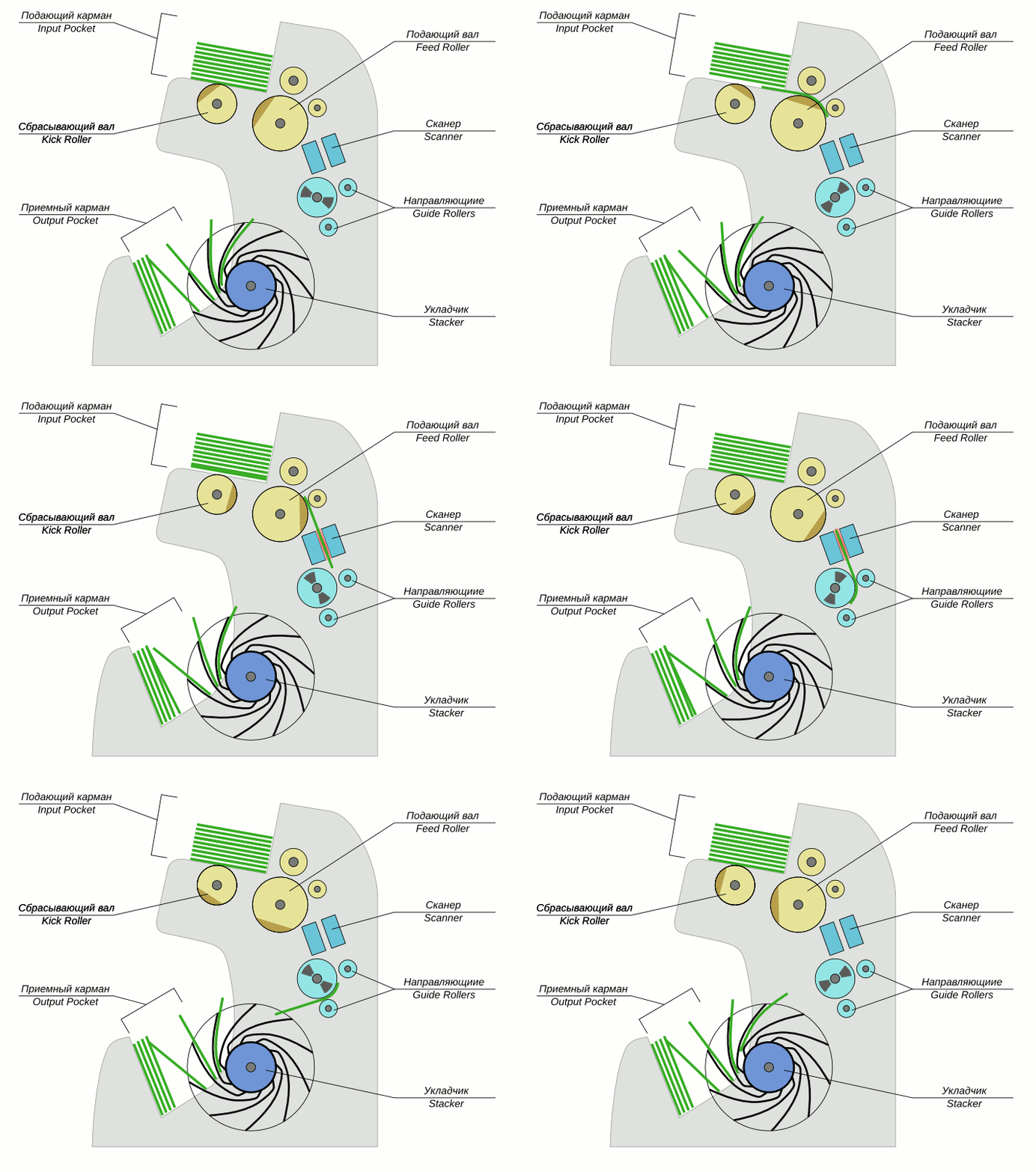
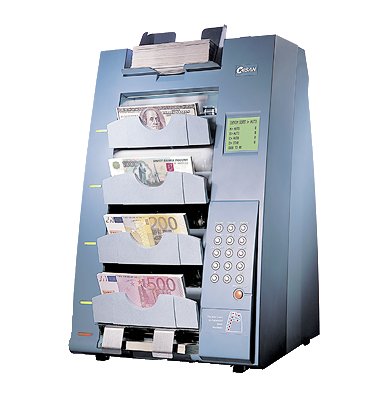
The main disadvantage of automatic detectors is low speed — they accept banknotes one at a time. What if there's a lot of money? For such cases, banknote counters were invented: you load a whole stack into the machine, and it rapidly (at speeds of 600-1,500 bills per minute) flips through the banknotes one by one, neatly placing the counted stack into the output pocket.
There are two main ways to feed a stack:
- Mechanical. In front of the mechanism are rollers made of "sticky" rubber and rollers made of dense rubber. In the simplest case, the stack sits above rollers that push the bottom banknote into the mechanism, and to ensure banknotes enter one at a time, rollers spinning in the opposite direction above the entrance push extra banknotes back.
- Vacuum. The stack is pressed against a perforated belt, reduced pressure is created beneath it, and banknotes stick to the belt, which pulls them into the mechanism.
It's worth noting that not all counters have authenticity verification. The simplest models can do nothing but mechanically count and reject stuck-together banknotes or sheets that differ significantly in size (such as torn fragments).
Higher-class counters already have UV sensors and magnetic marker detectors. Even more expensive machines perform full banknote scanning in the IR range. At this point, the counter is already capable of determining the currency and denomination of banknotes passing through it. You can count a stack of money and immediately find out how many banknotes of each denomination are in it and what the total amount is.
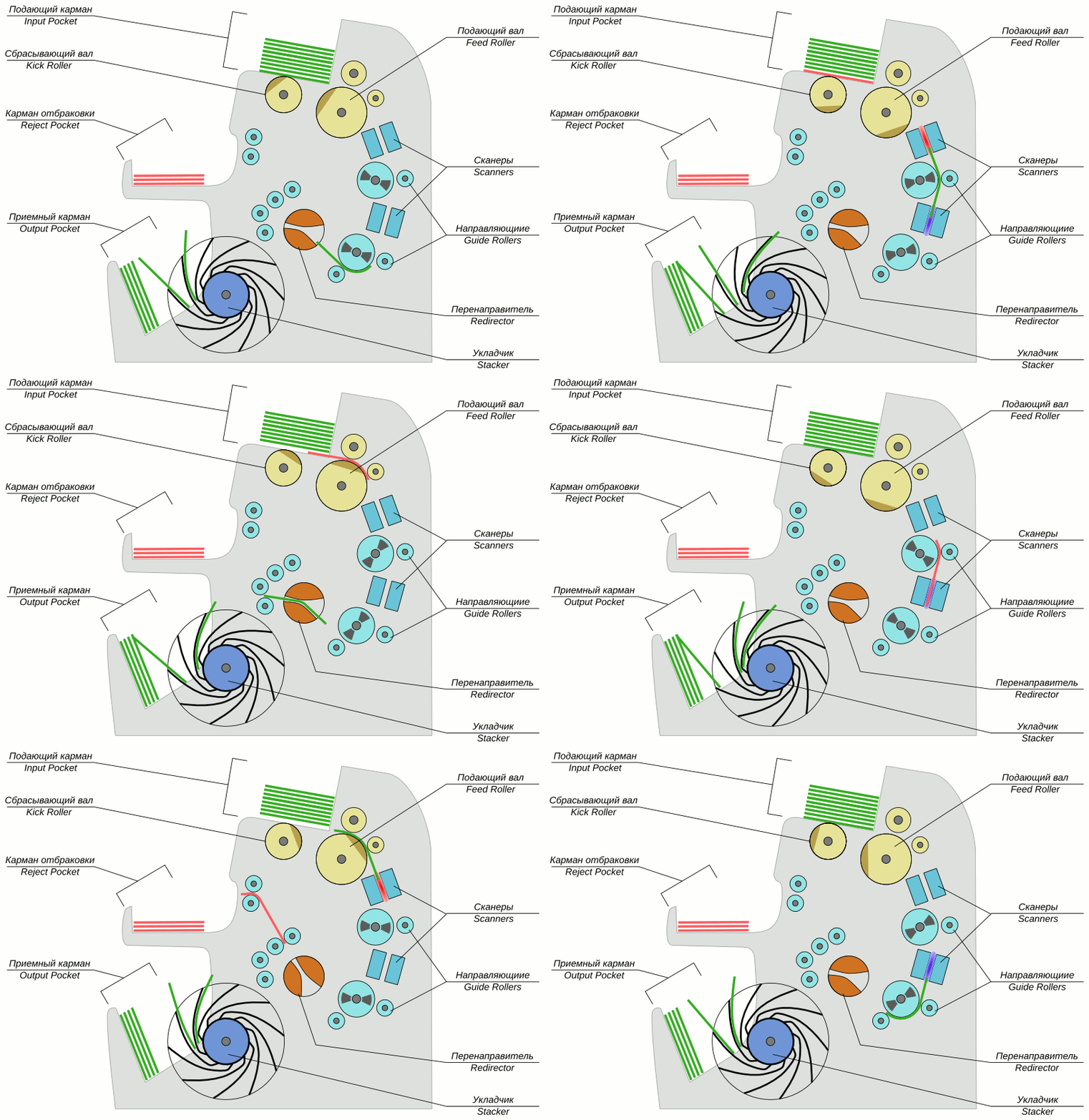
Top-class counters scan in visible, IR, and UV ranges, read magnetic markers, and also measure paper thickness using mechanical or capacitive methods. This last feature allows distinguishing new banknotes from worn, torn, and taped ones. Thus, the counter can sort by currency, denomination, orientation, authenticity, and wear.
Such counters typically have two receiving pockets: a main one and a reject pocket, allowing the counting process to continue uninterrupted when a suspicious banknote is detected.
From the two-pocket counter descend multi-pocket machines, more commonly called banknote sorters. The simplest of these look like a regular desktop counter, slightly "inflated" in height, with several receiving pockets.
And in the highest price segment are true monsters: machines that take up an entire table (or several), with a dozen pockets, expandable, with additional modules for packaging money, with validation of everything possible.
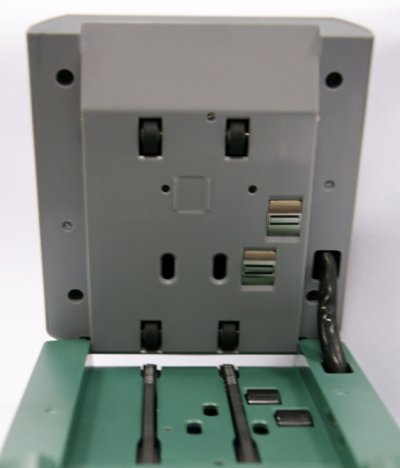
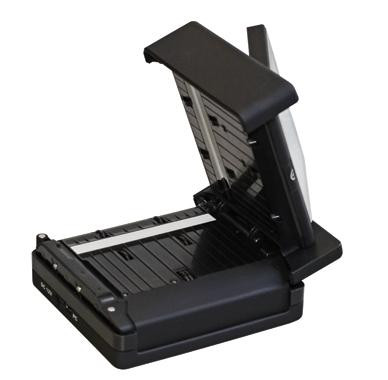
Banknote Acceptors
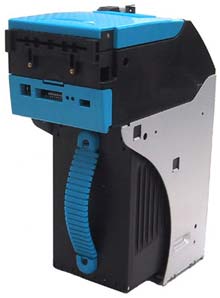
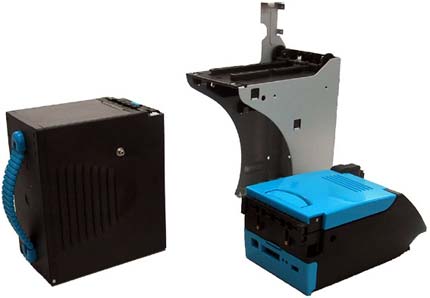
Banknote acceptors are used in vending and gaming machines, payment terminals, ATMs, and other self-service systems. They accept cash, determine the denomination, validate banknotes, and place them in lockable cassettes. Requirements for autonomous validators are quite high: almost always a double-sided multi-channel optical scanner is used, along with UV and magnetic detectors. Banknote acceptors are equipped with various systems that prevent tampering with the mechanism and fraud. For example, a foreign object detector notices the presence of fishing line or tape that could be used to pull a banknote back out. For vandalism protection, banknote acceptors may be equipped with protective shutters.
Acceptance mechanisms are divided into single-note and batch types. The former "eat" one banknote at a time, fed narrow side first. Batch mechanisms accept a whole stack of banknotes at once, count them, determine denominations, and validate. Such acceptors are installed primarily on ATMs, although adapters exist for regular single-note acceptors that allow accepting a batch (up to 20 banknotes) and then feeding them inside one by one.
Accepted banknotes, after passing through the validator, enter the escrow compartment. The volume of this compartment can vary: from 1 banknote to the entire deposited stack. If the transaction is canceled, banknotes from escrow are returned. If the transaction is confirmed, banknotes are placed in the cashbox — a lockable and sealed box. The acceptor mechanism can no longer retrieve money from the cashbox. Cashbox volumes can range from several hundred to several thousand banknotes. Sorting by denomination is usually not performed; all banknotes are pushed into the cassette in sequence.
Recyclers deserve special mention — devices capable of both accepting and dispensing cash. A recycler should not be confused with a pair of separate devices: acceptor + dispenser. In the latter case, separate cassettes are used for accepting and dispensing, and deposited banknotes can only reach the dispenser through collection.
A recycler accepts money, sorts by denomination, and places them in separate cassettes. From these same cassettes, it can dispense banknotes or, for example, count out change. Requirements for validators in recycling systems are the most stringent. For example, no more than two dozen models have passed testing at the Central Bank of Russia.
Validation Algorithms
Before discussing the algorithms used, it's worth noting that the hardware in different device classes varies greatly. The simplest detectors run on 8/16-bit controllers, and implementing complex checks or processing large data arrays is difficult. High-level detectors, banknote acceptors, and counters are typically controlled by ARM controllers or something similar. DSP coprocessors and FPGAs are used to accelerate specific operations (image processing, frequency transforms). Manufacturers of large bank sorters usually put some kind of industrial computer inside running Win CE, Linux, or QNX.
To simplify the software's work, data from all scanners (visible, UV, IR, magnetic) is combined into a single multi-channel file. If necessary, image alignment and normalization are performed.
Data processing occurs in three stages:
- Currency and denomination identification.
- Authenticity verification.
- If required, wear assessment of the banknote.
Manufacturers of banking equipment carefully guard their algorithms and know-how, so we can only discuss the most general aspects. Naturally, simple pixel-by-pixel comparison of a banknote scan with a reference would yield nothing useful — noise, feed irregularity, varying degrees of wear, and much more all contribute.
Most validation algorithms are based on checking individual characteristic features that have good repeatability. For example, several carefully selected zones of the scan are analyzed, and image parameters in these zones are compared with references and with each other. The checked parameters may include:
- Overall brightness and contrast of the zone
- Image histogram characteristics
- Statistical moments
- Image moments
- Correlation functions
- Frequency characteristics obtained through Fourier and wavelet transforms
In the first stage, using the simplest and fastest algorithms, the validator determines what banknote it's dealing with: what currency and what denomination. That is, in a short time most possibilities of what this banknote isn't are eliminated. If no candidates remain after filtering, the banknote is rejected as unrecognized.
After the most likely candidate (or several, depending on implementation) is selected, the actual validation begins. The system checks a set of features specific to that particular denomination of that particular currency. There are "hard" features, where the first mismatch rejects the banknote, and "soft" features that lead to rejection "by total score."
Match/mismatch thresholds are usually tuned to exclude Type I errors — false acceptance of a counterfeit banknote. The rate of Type II errors (false rejection of a valid banknote) ranges from 0.3% (for counters) to 6% (for automatic detectors and acceptors).
Descriptions of all verified features are stored in a currency database: a separate entry for each denomination and each modification of a banknote. Banknotes from different years may look similar externally, but the placement of security features is completely different. There are single-currency and multi-currency validator versions. In the latter case, the currency can be selected by the user or determined automatically.
Modern validators support database updates over the network, when connected to a computer, or from a flash card. Through updates, you can add support for other currencies, new banknote modifications, and improve recognition of existing ones. To prevent analysis and reverse engineering of algorithms by unauthorized persons, databases are transmitted and stored on the device in encrypted form.
Prospects and Predictions
Serial Number Tracking
Many bank-level counting and sorting machines have the ability to recognize banknote serial numbers. In most cases, this capability is not used. At least no unified number tracking system currently exists. Several years ago, the Central Bank of Russia began an experiment to register the numbers of cash passing through it. Equipment for reading serial numbers is being installed on a trial basis in cash processing centers.
Serial number tracking pursues three main goals:
- Fighting counterfeits
- Investigating thefts
- Assessing the rate of money wear
There are currently no plans to mandate equipping commercial banks with registrators. But when such a system starts working everywhere, it will effectively mean the end of cash anonymity. It will be possible to track the movement of every individual banknote; "blacklists" of numbers will appear, for example, of stolen banknotes. Like credit cards, cash could be "blocked" with a call to the bank.
RFID Tags
The European Central Bank is conducting research on the use of RFID (Radio Frequency Identification) tags. Similar research is being conducted in Japan. Tags are planned to be embedded in banknotes primarily as an anti-counterfeiting measure. Indeed, modern cryptographic RFID tags are quite well protected against hacking and copying. The technology currently faces the relatively high cost of tags (it's only cost-effective to equip large denomination bills) and their low durability.
Universal RFID-ification of banknotes would theoretically allow organizing a global cash tracking system, similar to serial number recognition, and even more effective. However, various side effects are possible, like pickpockets who would choose their victims using portable scanners. Paranoid people have already stocked up on foil wallets.
Non-Reproducible Markers and Cryptographic Money
All modern anti-counterfeiting methods are based on the technology of manufacturing the marker being secret. That is, the bank knows how to print a protected banknote, while the counterfeiter doesn't. Such a system, like anything based on security through obscurity, cannot be considered 100% reliable. Information leaks occur, and criminals find ways to counterfeit increasingly complex markers.
There is a fundamentally different approach based on the use of non-reproducible markers. Each copy of the marker is unique by its nature; not even the issuer itself can manufacture a duplicate. If the marker carries some information, each banknote can be identified by it. It's then sufficient to create a database storing the identifiers of all genuine banknotes. Whoever isn't in the database is a counterfeit.
Even more convenient is the use of asymmetric cryptography. After manufacturing the marker, the bank reads it, encrypts it with its private key, and prints it on the banknote as any machine-readable message (for example, a barcode or magnetic recording). For validation, it's sufficient to decrypt the identifier using the public key and compare it with the marker data. A duplicate banknote cannot be manufactured due to the non-reproducibility of the marker, and issuing another is impossible without knowledge of the bank's private key.
The main difficulty with this technology is that the marker must be created based on random processes, yet it must be reliably and repeatably readable. One possible mechanism is the use of speckle scattering patterns. A suspension of glass beads in epoxy polymer or even just the paper surface can be used as a marker. Currently, this technology is used to protect works of art, but its use for banknotes can be expected soon.
Quantum Money
A further development of the non-reproducible marker concept is quantum money. The marker consists of a set of particles in specific quantum states. Cloning the marker would be impossible due to fundamental laws of quantum mechanics (the no-cloning theorem).
Today, such protection belongs to the realm of science fiction. Ways to reliably store quantum states for extended periods have not been found even under laboratory conditions, let alone embedding them in banknotes. Furthermore, recent research in weak measurements calls into question the very impossibility of copying quantum markers.
P.S.
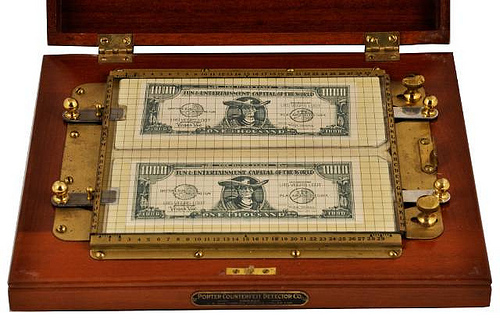
The attention-grabbing picture shows a Porter Counterfeit Detector, a device for detecting counterfeits that was manufactured in the 1920s-40s in the USA. The banknote being checked was placed under the glass alongside a known genuine one, and comparison was carried out using rulers and a scale grid.
The author extends gratitude to user ice2heart for valuable comments and additions.