The "Import Substitution" Movie (Let's Grumble)
A critical review of Russia's attempts to replace popular Western platforms over the past 2.5 years, examining the failures of Rossgram, Rutube, VK Video, and other domestic alternatives.
So, it's been more than 2.5 years since the servants of the people decided it was time to create domestic alternatives to services, apps, and platforms popular among the public.
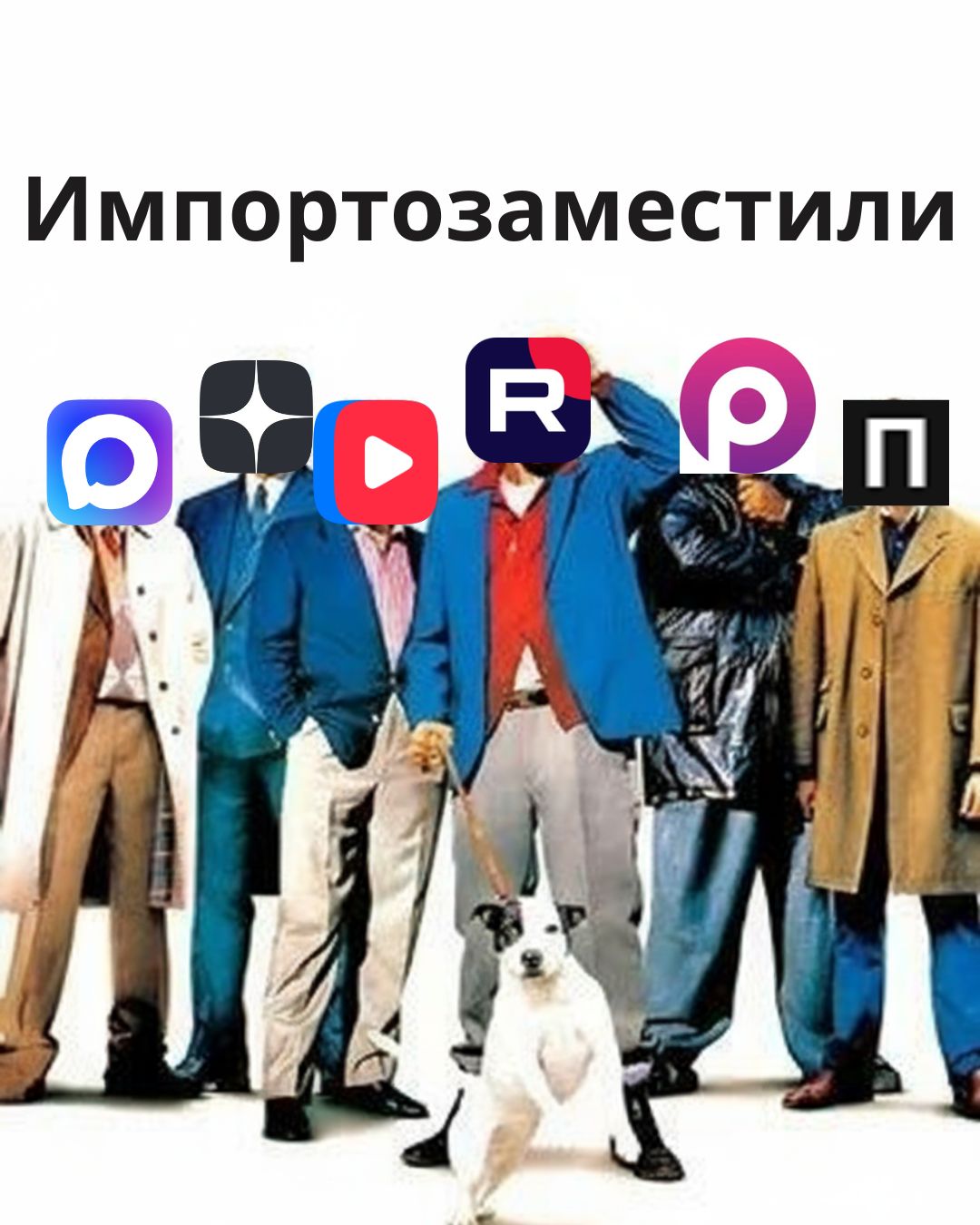
The decision was, of course, correct and necessary, but the execution, as always...
For those who don't understand what I'm talking about, let me be blunt — we had popular services taken away from us (naturally, exclusively for our own good, so that the fragile minds of perfectly sane 20-30-40-50-year-old residents wouldn't be damaged by watching, listening to, or reading certain material that supposedly can't be found anywhere else except on the blocked platform), with promises to replace them with Russian alternatives that would be just as good, if not better.
I'd like to conduct a modest audit of what was promised and what we actually got (this will be a purely subjective opinion of an average user):
The Idea — How to Catch Up and Overtake Platforms Considered Icons in Their Niche?
For some reason unknown to me, the people making decisions about blocking various resources completely and utterly understand just a tiny bit (absolutely nothing) about the internet and how things work there.
Logically, here's how it should work (healthy person's import substitution):
- You come up with a product.
- You conduct research (study the market, competitors, target audience).
- You build an MVP.
- You release the MVP to the public.
- You run a marketing campaign to attract new users.
Along the way, you refine and polish your MVP to a quality level, without stopping marketing efforts.
This is a greatly simplified algorithm. But here's how the import substitution we got actually works (the smoker's import substitution, as they say):
- You see a successful product.
- The successful product starts to irritate you.
- You ban the product.
- You say that soon we'll make an app even better than the banned product.
- You find a contractor (either a friend, or a friend of friends — I think the scheme is clear).
- You give the contractor a ton of money for development.
- The contractor puffs out their cheeks.
- The contractor runs a marketing campaign telling everyone what an awesome product they'll make.
- A year passes.
- Everyone forgets that anything was promised.
- Everyone accepts that the platform is blocked and it's no longer something strange.
- The contractor moves on to step 6, but with a different product.
The scheme exists as long as there are apps left to substitute.
Let's look more specifically at what platforms we ended up with.
A History of Import Substitutions
Naturally, I won't conduct a super-investigation. I'll go through things emotionally, hitting the highlights. The stuff that was really in the public eye and left a mark on my emotional state.
So, before it became mainstream, VK was created in Russia — a real and the most honest analogue of Facebook. Nobody banned anything, everything followed the standard path I described above — money in the morning, chairs in the evening.
A small caveat though — VK was built by different people than those who own it now, so maybe that's the secret, who knows.
So we have VK, meaning we can now ban the Western platform that's most similar to it — banned! Here everything is proper and neat — there's a genuinely popular platform, with a real audience, and there's something to offer the ordinary user!
Personally, I have absolutely no complaints about this ban. I don't use VK or the banned platform. But! The banned platform, as bad luck would have it, has a bunch of subsidiary platforms that automatically fall under the axe:
- Instagram*
- WhatsApp**
Rossgram — The Little Engine That Couldn't

We'll come back to the second point later. For now, let's talk about the platform with photos. So when it was being banned, out of nowhere its killer appeared! It literally positioned itself as the "Instagram* killer," and even, if my memory serves me right, didn't put a disclaimer label, but that's not certain — I just don't remember (or maybe back then no label was even required).
So Rossgram appears, kicking the door open into the world of photos without even having an MVP behind it. They didn't even bother making some kind of MVP, Carl!

What next? This killer starts spamming aggressively everywhere possible — we'll catch up and overtake, some publications appear, audience warm-up is underway — but still no MVP. A month passes, they launch pre-sales of usernames.
Now let me repeat:
- We don't have a product;
- We have a description of what the product should look like;
- We're selling usernames in our nonexistent product.
Doesn't this feel like something we've seen before?
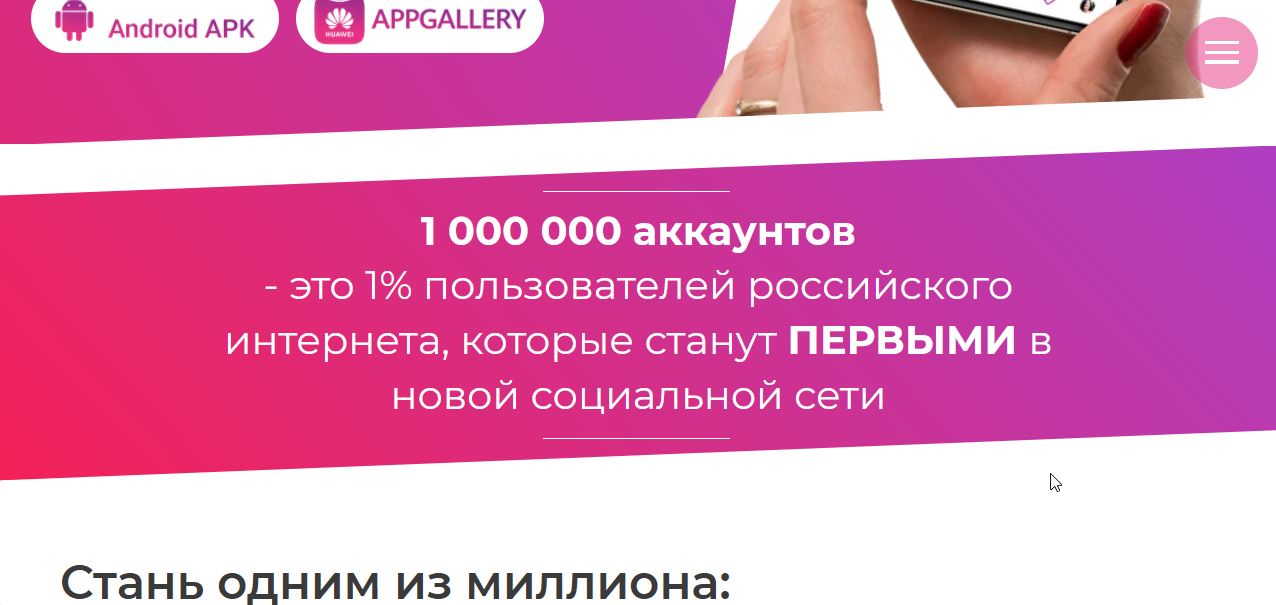
As of 2025, this is still what the killer's homepage looks like (they're still calling on people to be the first, after 2 years).
In the end, they launched the username sales, people actually bought these usernames, and the price wasn't exactly 200 rubles either — there were lots going for 50k and 100k.
The social network was eventually launched, there's definitely an Android app, I even downloaded it and registered an account, but a slight aftertaste remains. I don't particularly want to use it, and judging by the feed, I'm not the only one. Maybe I'm wrong, but for now I only have one phrase in my head when I open the service — "What is dead may never die."
The Russian Chainsaw Massacre of Video Services
Moving on to the next lot — video platforms. I won't name it, since I'm not sure if a disclaimer is needed or not. I think everyone will understand what I'm talking about. The one that got throttled.
How video service import substitution was supposed to look, according to the initiators:

How it actually looks:

Honestly, does anyone really think they managed to substitute the popular video hosting?
How they tried:
- Rutube;
- VK Video;
- Zen;
- Platform.
Let's save Rutube for dessert — I have something specific to say about it. Let's start with VK.
Quick note: I have my own several accounts with videos and I know firsthand how everything works there — been there, tried that, didn't make it :(
VK Video
VK initially seemed like the most logical replacement for the popular video service, but the deeper I got into it, the more I understood — this doesn't work for new creators at all. The recommendation system, convenience, monetization system — it's all a complete disaster. Have you noticed that shows that left for VK, like ChBD and others, started returning to the throttled service? Even though they made such a big deal about it — "Watch us exclusively on VK Video."
There's probably some reason, but we don't know about it. Purely a layperson's opinion — VK Video is garbage. The videos didn't even try to get any reach, so I couldn't even tell if my videos are complete trash or somewhat watchable (the audience simply never saw them).
Connecting monetization on VK Video is quite the puzzle — the main requirement is having a community with at least 10,000 subscribers. What? A community? What does a community have to do with my attempts to grow as a video creator? Anyway, I lasted about a month.
Zen
Zen is a more liberal platform, it gave video reach, videos got watched, and since I have monetization enabled there, they even brought in some income. But the platform revised its policy and no longer prioritizes or monetizes video content. So Zen remained a platform for text content.
Platform
Platform — this is the service I would gladly call a bright successor to the Rossgram legacy. With a few caveats, though. There are some signs of movement there.
Platform appeared just like Rossgram, kicking in the door, pushing the narrative that they are the killer of the popular video hosting. Although they still don't have a mobile app, but that's a trivial matter — who in their right mind in 2025 would watch video on a mobile device, let alone through a mobile app? Don't be ridiculous!
I registered on Platform too, even set up automatic video migration, but nothing went beyond that. In the six months I spent there, I saw no changes. Recommendations didn't exist before and still don't, there's no mobile version, videos are promoted as if we're in 2015 and just discovered that these video services exist — watch each other's videos, help each other with promotion, so to speak.
I still get notifications every week about some new feature or update. It's starting to feel like auto-generation. Just a neural network making up what and how they changed. But they still haven't added a mobile version.
Rutube
And the biggest disappointment — Rutube. This one genuinely had a shot at the killer title, and I say this without sarcasm or jokes. It launched a long time ago, changed several owners, already had its own decent-sized audience, plus after the throttling, people flooded in. But... oh, that notorious "But"...
I was a member of Team R — a system for content creators. You could get in by submitting an application, official registration, signing a bunch of papers (you need a sole proprietorship or self-employment status), basically a lot of hassle, going through which you expect to get something cool on the other end.
So once again — you get into Team R, they promise you great promotion for your videos, support, various perks, etc. You're excited, you start uploading videos and waiting for results from your efforts. But then enlightenment gradually starts to dawn.
How video promotion works internally — there's no recommendation system, you send your personal manager a link to one video per week, and they manually place your video at the top of some thematic section.
And what if I make more than one video? Nobody cares, there are many creators and few managers, and there aren't that many sections either, competition you know, so the rest of your videos will be promoted through the system's recommendations.
Here's a puzzle for you: if videos that the manager placed in prominent spots got 5-10K views in a couple of weeks, how many views did videos that Rutube promoted through its recommendations get? To put it briefly — go watch the interview with a certain classic figure who will give you a clear and concise answer to this question.
Well, I won't undersell it too much — they got something, approximately 30-60 views, compared to 5-10K for promoted ones. Do you understand the level of these recommendations?
Gradually, the time a video stayed in the top spot of a popular section kept shrinking (as more creators joined Team R), and eventually Rutube shut down this promotion format. As they say — the cat abandoned its kittens.

The wording was: the recommendation system has developed enough for your videos to be promoted automatically from now on :)
Want me to hint at the outcome of Team R's closure? If anything — the answer is right there, just above.
Now let's summarize — here's how the killer of the Western video hosting works: videos from creators who manually send them to their manager get pushed to you as "recommendations," and all of this is called a smart recommendation system. Sounds really cool, doesn't it?
This is QUALITY!
Messenger
Honestly, I made this subheading purely as an open-ended finale to the article. I don't want to discuss how good or bad the domestic killer of WhatsApp** is. It's just that when they first kill the competitor and then place something on its bones and say — now this replaces what's underneath it — there's a certain unpleasant aftertaste.
The idea of making something of your own is magnificent and beautiful in its pristine form, and I fully support such impulses. But offering the user something not very pretty and foul-smelling on a stick and saying — look how cool — well, that's just...

The scheme is as old as the world itself; any decent marketer knows it. Just hire someone who at least somewhat understands product promotion. And a proper development team, of course. Make a product and compete fairly for the market, without all this elimination of competitors.
* The social network Facebook is banned in the Russian Federation.
** WhatsApp belongs to Meta Platforms Inc., which is recognized as extremist in the Russian Federation.
FAQ
What is this article about in one sentence?
This article explains the core idea in practical terms and focuses on what you can apply in real work.
Who is this article for?
It is written for engineers, technical leaders, and curious readers who want a clear, implementation-focused explanation.
What should I read next?
Use the related articles below to continue with closely connected topics and concrete examples.