The Most Understandable Explanation of Special Relativity
A visual, intuitive explanation of Einstein's Special Theory of Relativity using spacetime diagrams, cats, and interactive visualizations — covering time dilation, length contraction, the twin paradox, and why magnetic fields are just relativistic electric fields.
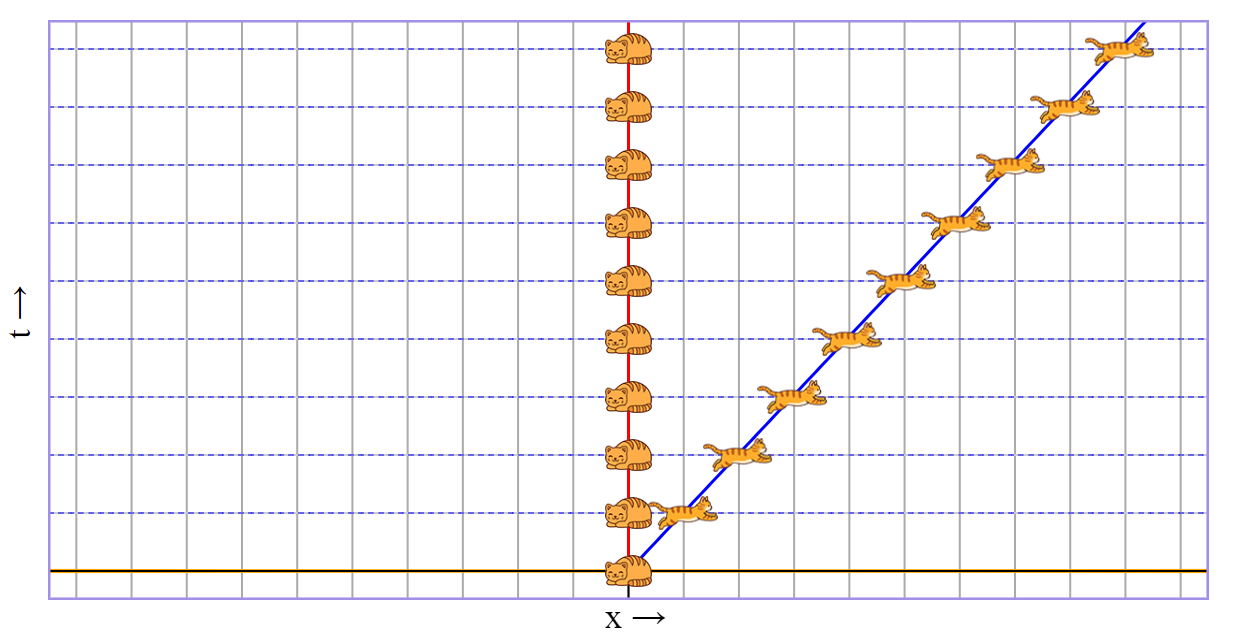
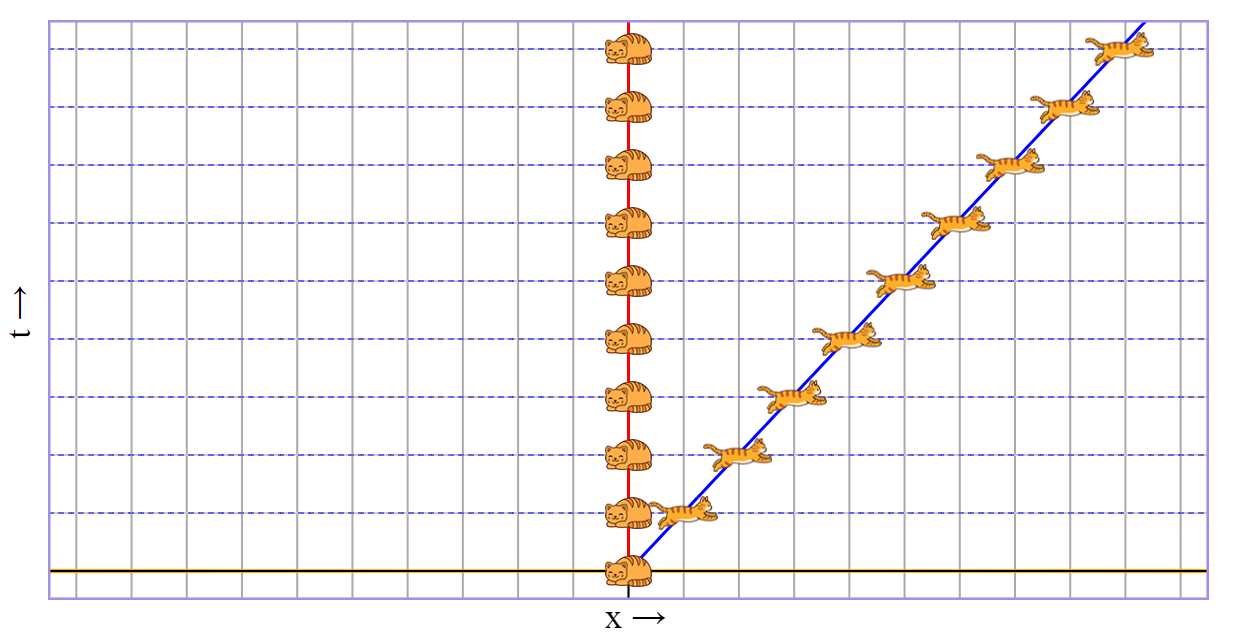
Let's start with a spacetime diagram. The horizontal axis will be position in space in meters, and the vertical axis will be time in seconds.
In the middle is some origin of coordinates, where I am as the observer.

Let's take two cats that we'll begin observing at the zero moment of time. One of them is sleeping. He is stationary relative to us, so his worldline is simply a vertical straight line.
The other cat starts running to the right at some speed. The angle of the blue line is determined by the cat's speed. You can see the angle is 45 degrees, meaning he's running at exactly 1 m/s.
Every second we essentially photograph the positions of the cats, which corresponds to their images on the worldlines.
Everyone knows that motion is relative. The running cat moves relative to us just as we move relative to him. There is no absolute motion that is better than any other. This is called the Galilean principle of relativity, and it's already 400 years old.
Let's try to catch up with the running cat and see how this diagram will look in his reference frame (in which the running cat is stationary, and the sleeping one moves in the opposite direction). To do this, we simply need to shift all points of the diagram to the left along horizontal lines so that the running cat's line becomes vertical (stationary). The distances between cats at each moment in time must remain unchanged.
So far so good, no devilry is happening. This transformation is called the Galilean transformation. It's intuitive, logical, and we used it without a second thought for many hundreds of years.
The Problem
And then at the end of the 19th century came sudden news: Experiments showed that the speed of light is the same in all reference frames. No matter how the light source moves relative to the observer or the observer relative to the source, in which direction or which way — the measured speed of light is always the same and equals 299,792,458 m/s.
That is, the speed of cats, the speed of sound, the speed of anything is different in different reference frames, but the speed of light is not. Galilean transformations simply don't work on light.
Such information is hard to accept, because it contradicts basic intuition and all physics known at that time. Many scientists tried to find an error, but it was all in vain.
There was nothing left to do but spit on all of this and reinvent physics from scratch.
Such physics where the speed of light would be constant, and at the same time other physical laws wouldn't break.
How to do this? Well, let's open our spacetime diagram and try to come up with something.

First, let's draw a cat running at the speed of light. But this speed is so enormous that the cat's line would be practically horizontal (since speed is determined by the line's angle of inclination). So let's squish the diagram horizontally by 300 million times. This way, the horizontal grid lines will measure not meters, but light-seconds.
At this scale, the line of a cat running at the speed of light will be at a 45-degree angle (1 light-second per second). And for clarity, I've drawn another cat that also runs at the speed of light, but in the opposite direction.

If we start moving relative to the stationary sleeping cat, the lines of the light-speed cats will change their angle of inclination, which doesn't work for us, since it contradicts experiment.
So now our task is to do the impossible. Modify the Galilean transformations so that three conditions are satisfied:
- The whole reason we started this: the lines of the light-speed cats must not change their angle. This will mean that the speed of light will always be the same for us, regardless of how fast we move relative to the source of that light.
- The new transformation must be compatible with the old one. That is, at ordinary speeds everything should work as it did before.
- And ideally, straight lines should remain straight (for example, the worldline of a cat running at constant speed should remain straight), otherwise the law of conservation of energy would be violated.
And then Einstein and friends come along and announce:
"We came up with something. But we'll have to sacrifice the Euclidean nature of our spacetime."
To understand what they came up with, we need to say a few words about Euclidean space.
Euclidean Space
In any space you can place two points. Whether it's the familiar "spatial" space with X-Y-Z axes, or spacetime as on our diagram with X-t axes, or any other. And between these two points you can measure a distance.
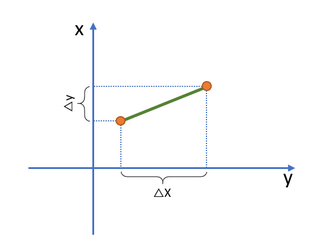
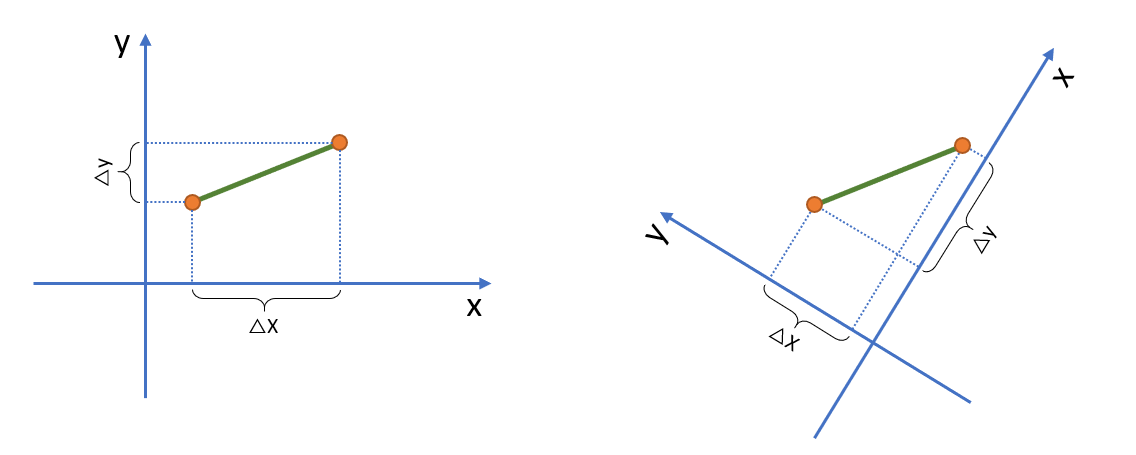
To measure distance we're accustomed to using the Pythagorean theorem. On a two-dimensional plane it looks like this:
The square of the length of the green segment equals the sum of the squares of the lengths of its projections onto the axes.
l² = Δx² + Δy²
The formula that measures distance between two points by their coordinates is called a metric. Spaces with such a metric are called Euclidean. In other (non-Euclidean) spaces the metrics are different.
Importantly, distances between points don't change when the coordinate system is moved or rotated. No matter how we move or rotate our pair of axes relative to the pair of points, the distance computed by this formula won't change.
On our Euclidean spacetime diagram, the distance between points would be:
l² = Δx² + Δt²
Usually the variable t is multiplied by the speed of light for convenience, so that the time coordinate is also measured in meters.
Minkowski Space
So what exactly did Einstein and friends propose? They said:
"Let's replace the plus in the metric with a minus, and instead of shifts, let's rotate points around the origin."
Let's see. We change the plus to a minus in the metric and get the following:
l² = Δx² - Δt²

A new metric means a new space. The space with this metric was named Minkowski space.
Now we need to rotate. But what does that even mean?
Rotation is an operation in which the distance from a point to the center of rotation remains unchanged. But here they're proposing we rotate in a space where this very distance to the center is calculated by a formula with a minus instead of a plus:
l² = x² - t²
(We're rotating around the origin, so Δx = x, and Δt = t.)
If in normal rotation points move along circles, then along what trajectories will they move now?
These new trajectories must be lines of equal distances from the center. For clarity, let's draw dashed lines for trajectories where distances to the center equal whole numbers, just as before we drew horizontal lines marking seconds.
Let's plug this formula into a program and see how it affects the cats:

Strange. It seems everything looks the same as it was originally. Something's not right here. Let's try squishing the diagram horizontally again so that the grid measures light-seconds and we can see the light-speed cats.

It turned out that the horizontal dashed lines, along which cats previously shifted when the observer's speed changed, became curved. But we only noticed this by zooming out the scale so that very high speeds fit in the graph. By the way, these new curved lines are called hyperbolas.
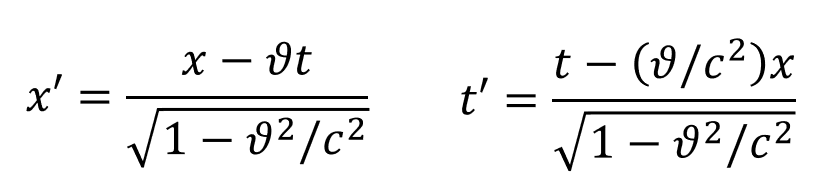
Now let's try rotating. If in normal Euclidean space, to rotate a point around the origin, you need to multiply its coordinates by various sines and cosines of the rotation angle, in Minkowski space it's a bit simpler:

These are called Lorentz transformations. Instead of an angle, here we have the speed relative to the observer. By the way, from these formulas you can see that if you substitute zero speed relative to the observer or infinite speed of light, the denominators become one and the formulas turn into ordinary Galilean transformations.
Let's see how cats will now shift when the observer's speed changes.
Notice that cats located on lines corresponding to the speed of light remain on those lines at any observer speed.
This means that no matter how fast the observer moves, the light-speed cats still run away from him at the speed of light.
It seems we've achieved what we wanted:
- At any observer speed, cats on the light lines stay on them
- At the scale of small speeds, everything works just as it did before
It remains to verify the third requirement: that straight lines remain straight. For this, let's place five sleeping cats at different coordinates and see what happens if we start moving past them at enormous speed.
Notice the cat points. They shift along hyperbolas, but the lines connecting them always remain straight.
Excellent, everything works. We've invented a world in which the constancy of the speed of light doesn't look like nonsense. But this led to catastrophic consequences that changed everything.
So, let's summarize: Previously, when increasing the speed of a running cat, its points shifted along horizontal lines corresponding to the same time. But now these lines have become curved.
It turns out that now points shift not only horizontally, but also vertically. And vertically is where we measure time. This is where the main fun begins.
Time Dilation
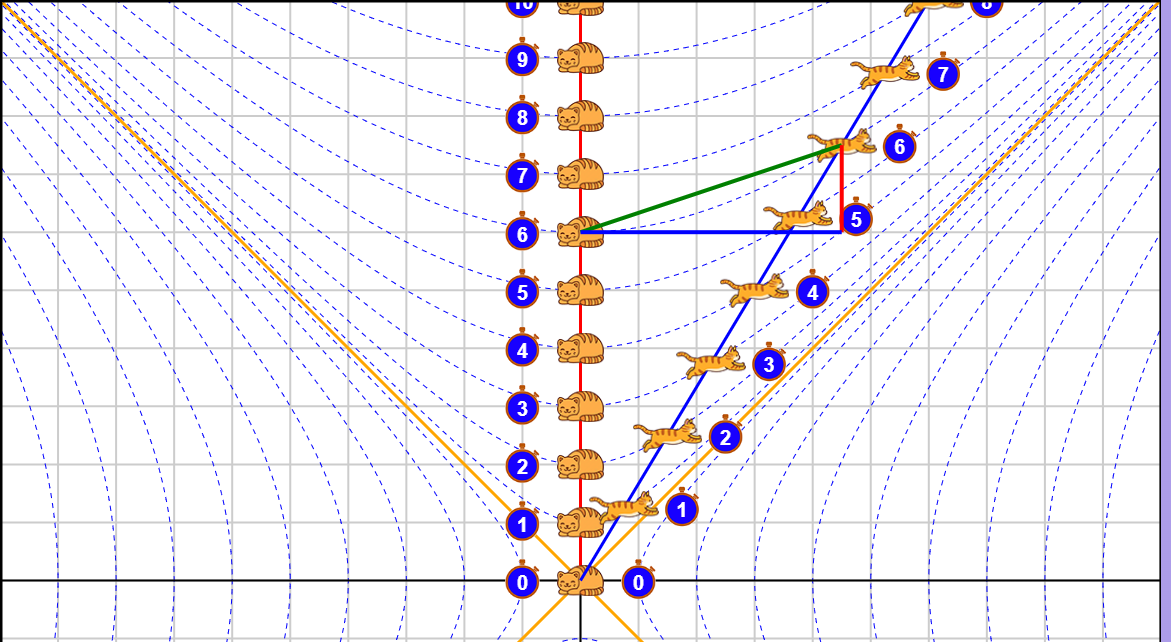
To illustrate the effect of time dilation, let's give our cats clocks and look at the diagram once more.
We are stationary relative to the sleeping cat, so for us the hyperbolas and straight lines are at the same height. His clock ticks normally. But the running cat crosses the hyperbolas less frequently than the horizontal lines. So when our clock has ticked 6 seconds, the running cat's has ticked less than five. It turns out that for us, time for the running cat runs slowly, but he himself doesn't notice it.
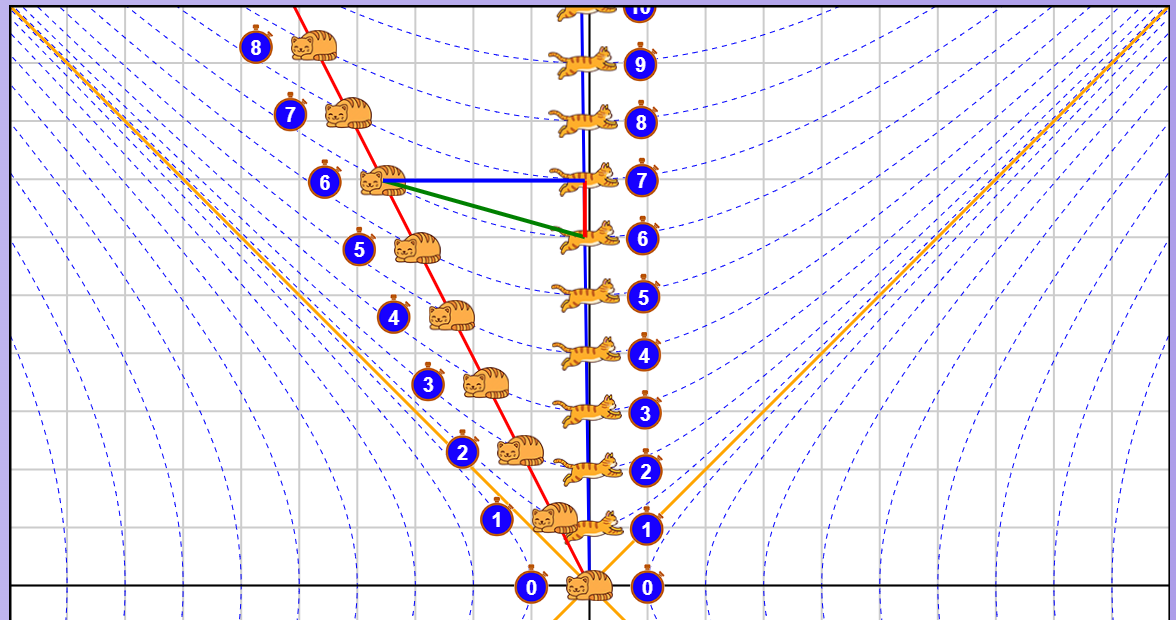
The time difference will be greater the higher his speed (the length of the red segment in the triangle). In exactly the same symmetric way, the same occurs in the running cat's frame. If we catch up with him and look at the sleeping one, we'll see that now the sleeping one's time is dilated:
So the sleeping cat thinks time is dilated for the running one, and the running one thinks it's dilated for the sleeping one.
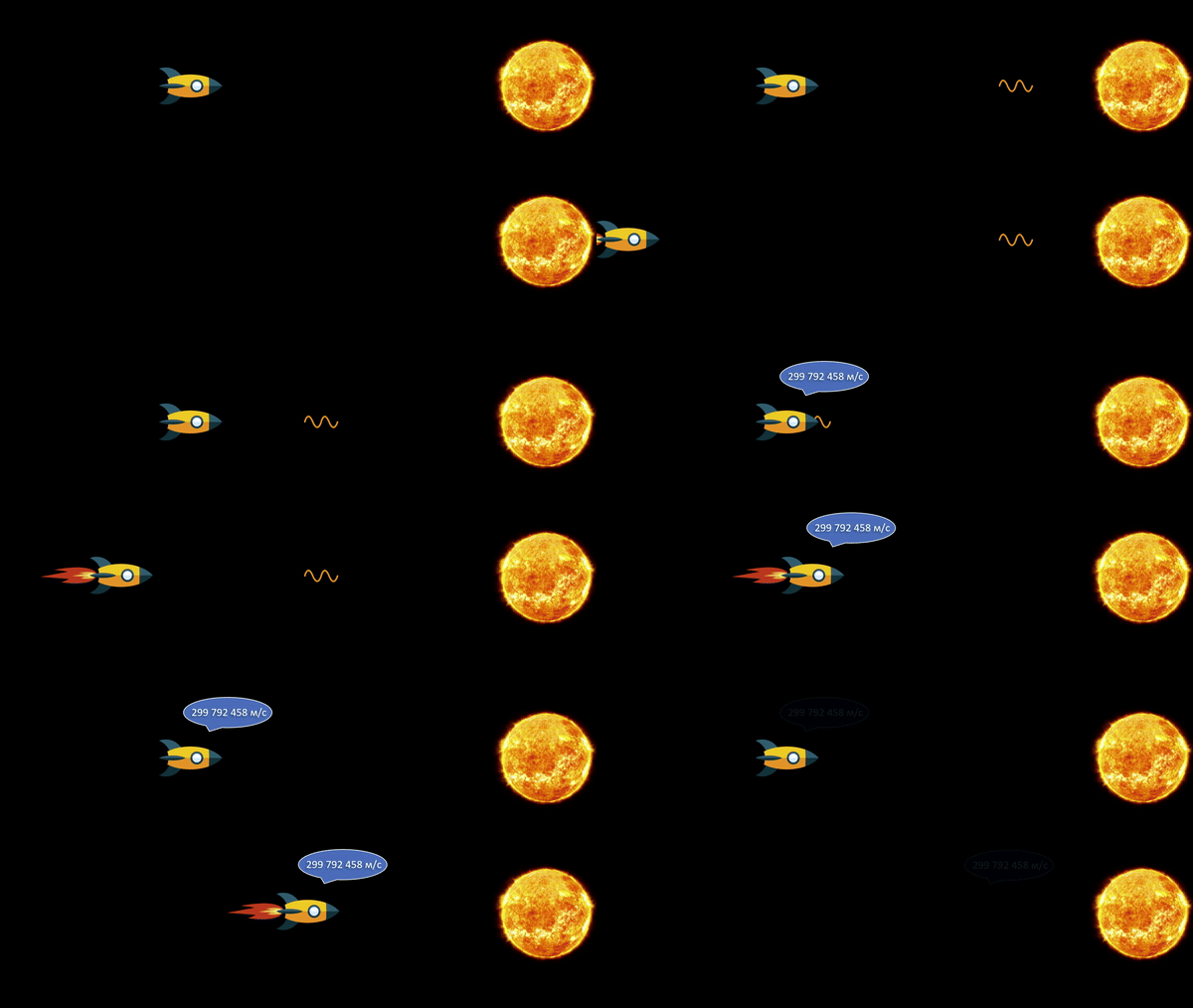
Let's illustrate this with an example of two spaceships, each equipped with identical periodically blinking lights. As soon as one of them starts moving, the other sees that the light on the first one began blinking less frequently. And its color has turned red, because time dilation also causes a decrease in the frequency of the emitted light.
But if we move along with it, we'll see that conversely, it's the stationary ship's light that blinks less frequently and is redder.
It turns out that time is now relative!
Some say that physicists put sticks in their own wheels. They invented some tricky model of space, and then are surprised that oddities arise. In reality, this won't affect anything.
To check whether this is reality or just a mathematical trick, let's ask the running cat to run for a bit (say, 4 seconds on his clock) at two-thirds the speed of light, and then turn around and come back.
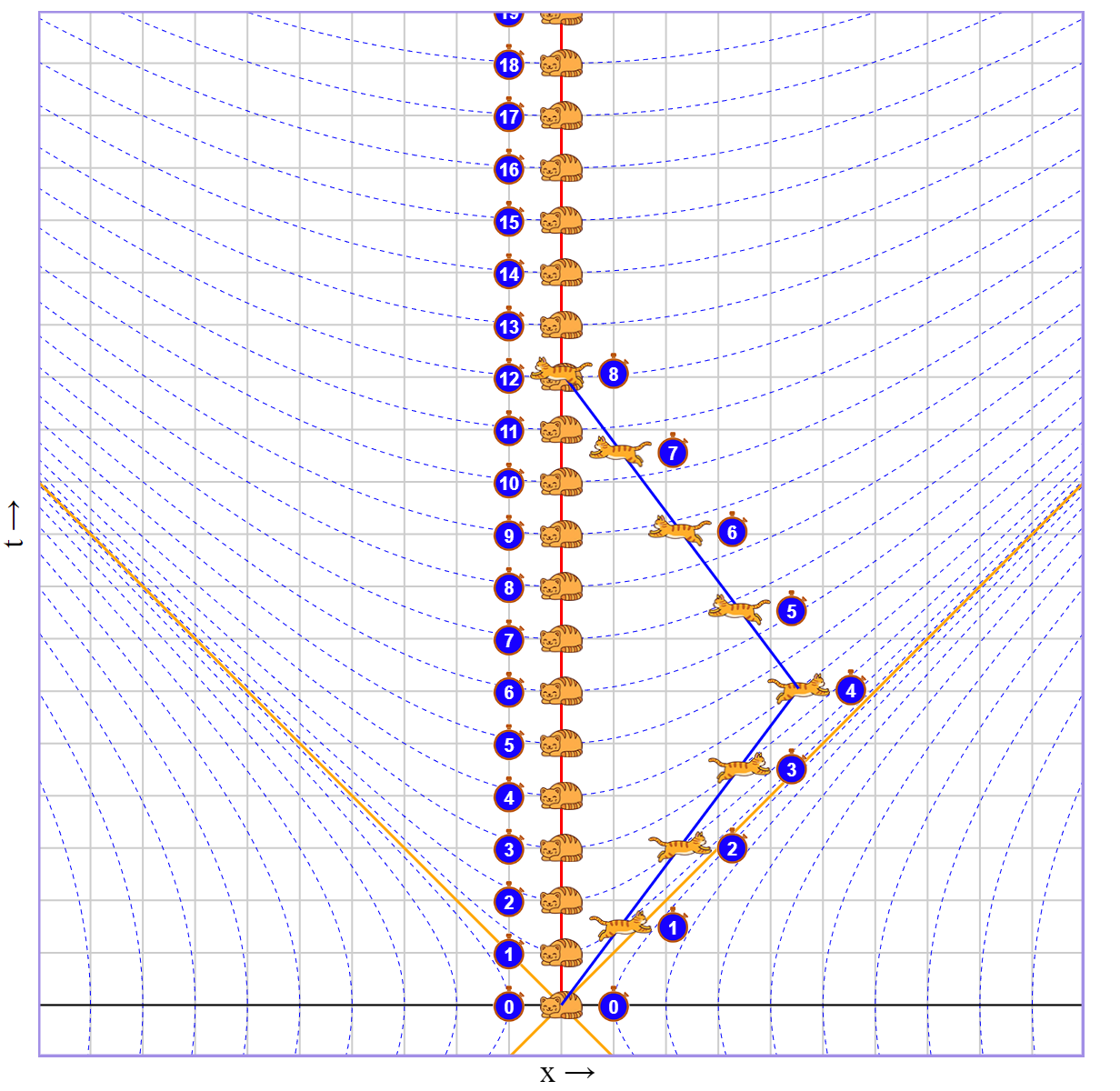
What will we see? While we slept for 12.5 seconds, the second cat ran around, returned, and his clock only ticked 8.
Yes, this is the famous twin paradox. And the faster and longer the second cat runs, the less aged he'll be when he returns.
By the way, this effect was directly verified in 1971 in an experiment by Hafele and Keating. In simplified terms, it went like this: They took a pair of ultra-precise atomic clocks, synchronized them with each other, left one on the ground, and took the other on an around-the-world trip on airplanes, after which they met at the starting point. An airplane flies fast enough that the relative time dilation can be measured, and in the end, the clock that flew on the airplane ticked less time, in accordance with the predictions of the theory of relativity.
But let's return to the twins and the essence of the paradox. Why is it specifically the running cat that remained younger and not the sleeping one? After all, we should be able to switch to the running cat's frame and see a symmetric picture.
The Twin Paradox
In fact, the situation is not symmetric, because it was specifically the running cat that changed direction of motion. Let's break his path into segments of constant speed and look at the situation in the running cat's reference frame. And to convince ourselves there's no trickery, notice that during coordinate transformations the cats shift strictly along hyperbolas.
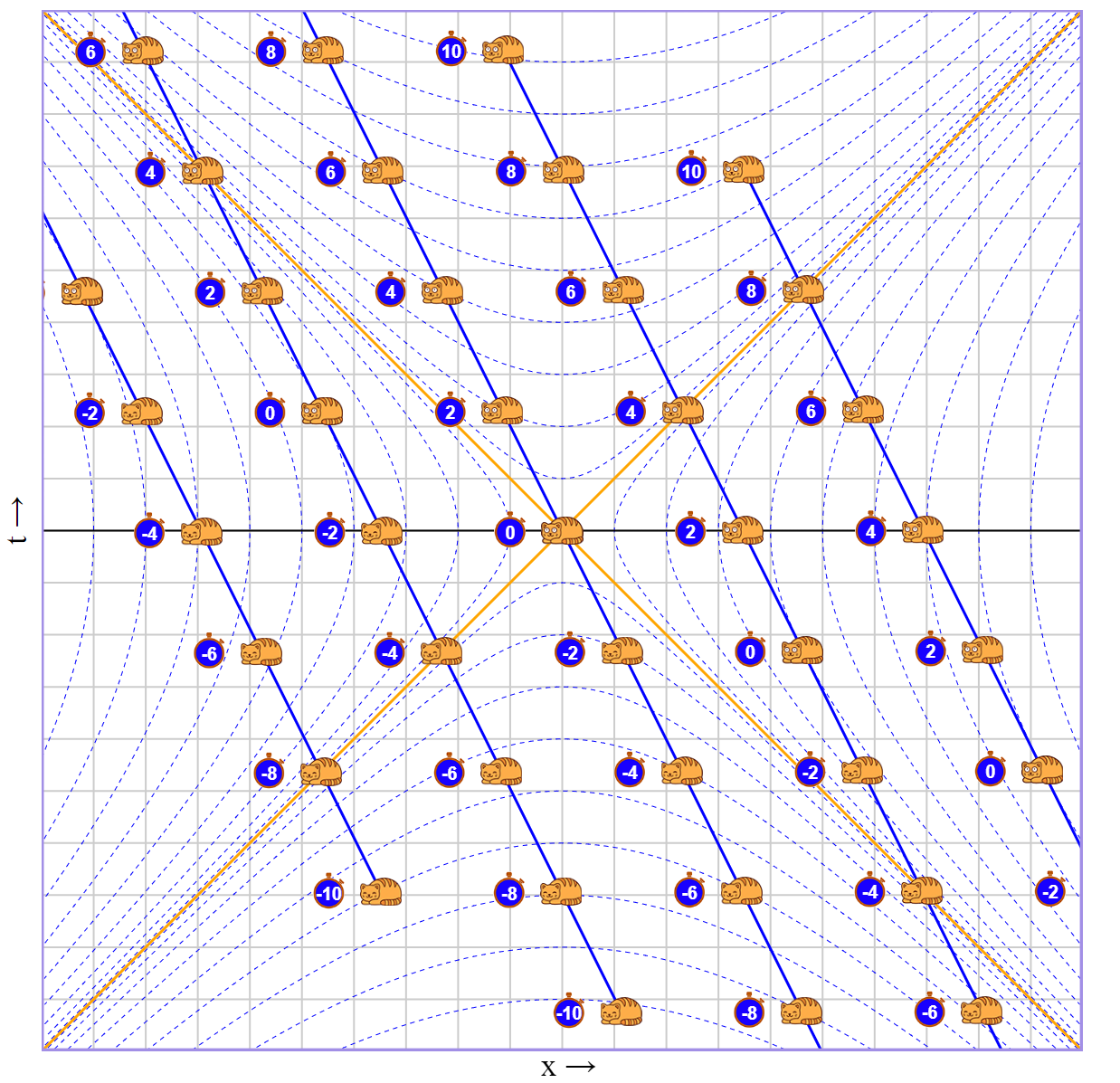
First, let's launch the cat to the right and switch to his reference frame. Then let's jump 4 seconds forward and drop the graph down so the second stage starts from zero. And switch to the stationary frame where the cat turns around, and launch the cat to the left for 4 seconds:
It all checks out! No tricks — the sleeping cat aged more. The faster the cat runs away, the further into the future he'll end up upon return. So if you're really eager for a new season of a TV show or the release of Nintendo Wii, you know what to do.
Relativity of Simultaneity
Let's return to our cat colony.

Suppose all cats at the zero moment of time simultaneously woke up. If we observe this while stationary, everything is fine. But as soon as we start moving, say, to the right at half the speed of light, it turns out that the cats on the left haven't woken up yet, while those on the right woke up long ago.
Simultaneity, it turns out, is also relative.
If we move to the right, then to the left we see the past, and the further away, the earlier. And to the right — the future. It turns out that space and time literally partially swap places (and we haven't even gotten into general relativity yet).
Everywhere you look, everything becomes relative. Maybe at least distances will remain absolute?
Length Contraction
Let's take a very long arrow, lay it in front of us, and hang clocks on both its ends.
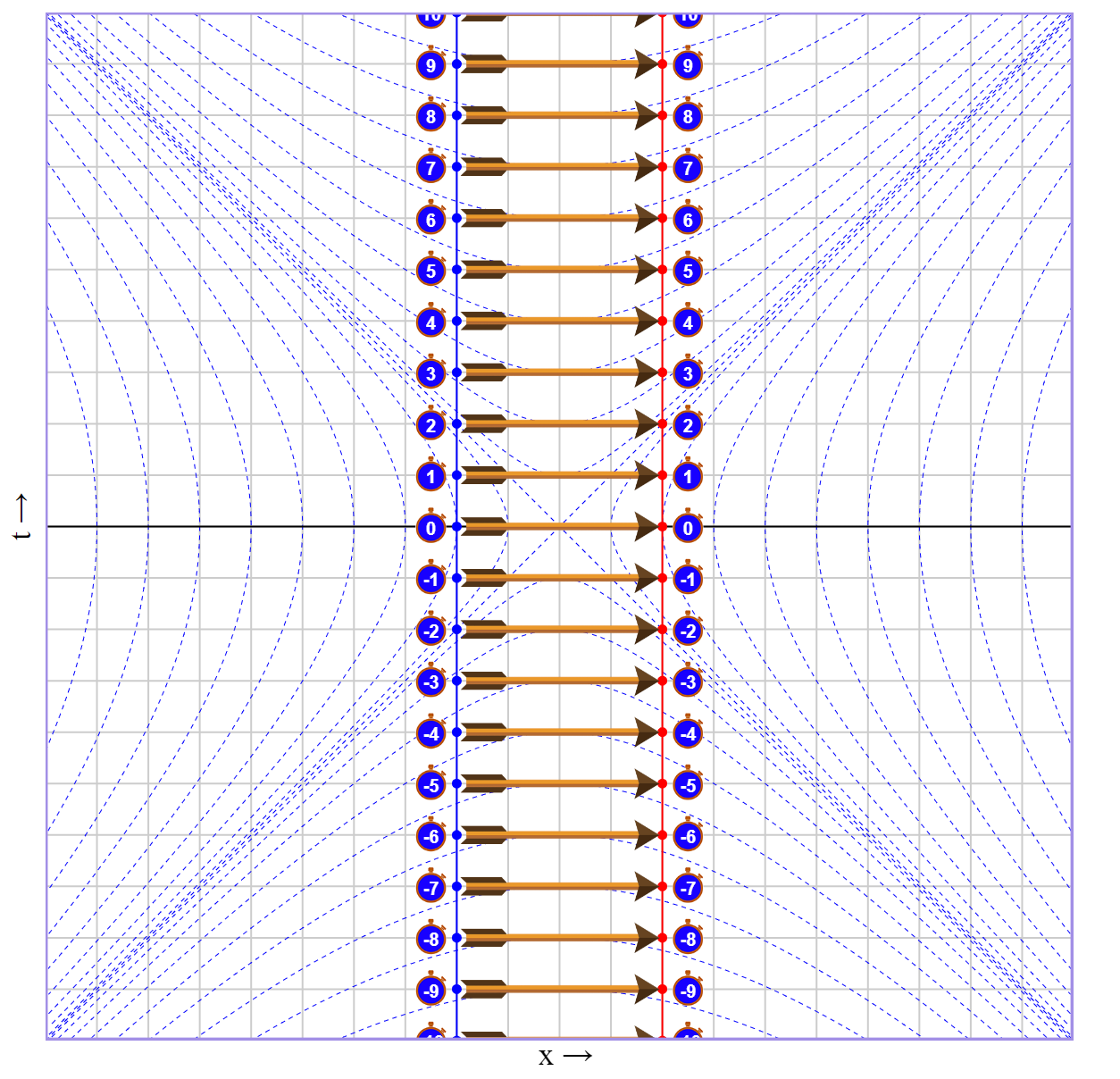
Now let's measure the length of this arrow. What even is length? It's when we simultaneously fix the positions of the ends and measure the number of meters between them with a ruler. I think you've already guessed where the catch will be.
Let's measure the length while it's stationary: Take a ruler and lay it along the horizontal axis. Exactly 4 grid nodes fit along the arrow, so its length is 4 light-seconds.
Now let's launch this arrow to the right at half the speed of light:
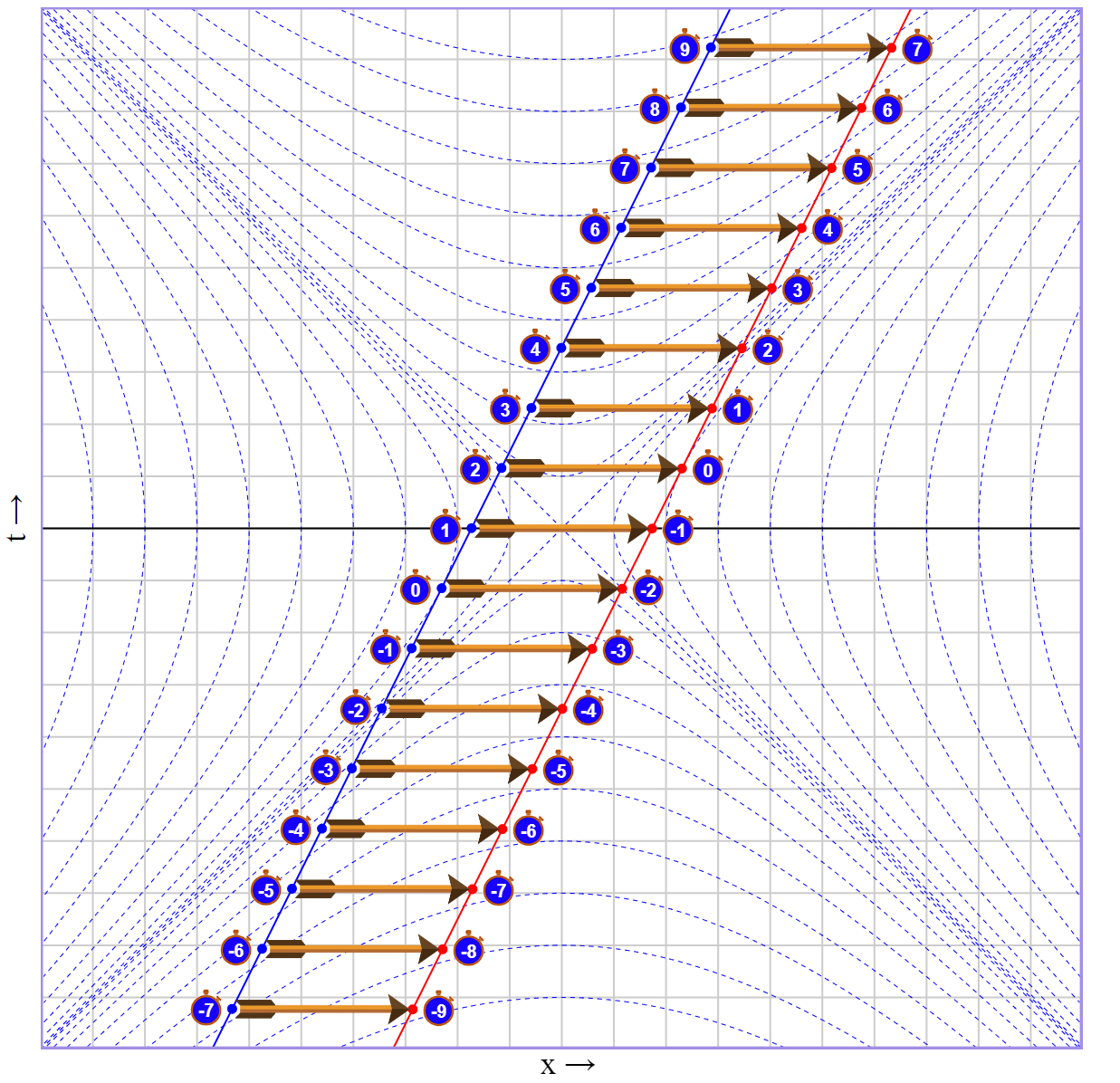
Let's apply the ruler again. This time the length is significantly less than four. But why?
Pay attention to the clock readings. The clock on the right end shows two seconds less than on the left. That is, the right end of the arrow is in the past relative to the left end. It turns out the left end of the arrow literally leads the right end, and because of this the entire arrow becomes shorter. But, again, this is only for the stationary observer. If we were moving with the arrow, its length would be normal.
So length turned out to be relative too. By the way, this is also not a mathematical trick, but a quite measurable reality with many examples.
The Ampere Force Explained
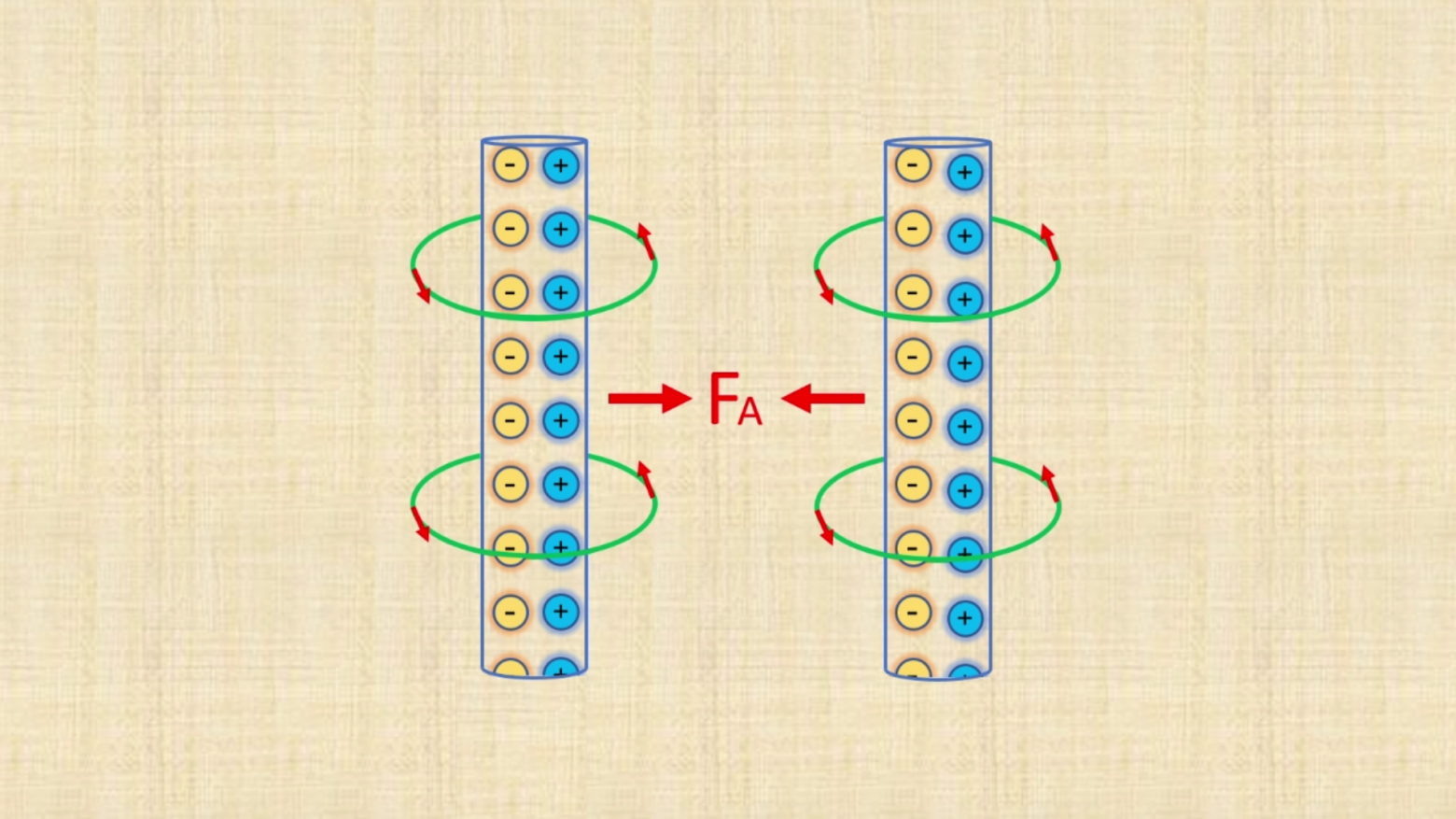
Let's take two wires, place them in parallel, and run current through them in the same direction. In this situation they begin to attract each other. Previously this was explained by the fact that moving electrons in the wire create magnetic fields that interact, creating the Ampere force that pulls the wires toward each other. Or pushes them apart if the currents flow in opposite directions.
But with the theory of relativity it turned out that no magnetic fields, Ampere forces, or any of that are needed. It's enough to know only that charges of the same sign repel, and charges of different signs attract. That's it.
As soon as electrons start moving, for the stationary observer the distances between them contract. The electrons themselves also get squished, but that doesn't matter. Because of this, their number per unit length of wire becomes greater, and the positively charged copper atoms in one wire begin to attract more strongly to the electrons in the other wire. Meanwhile, the repulsion between electrons of different wires doesn't increase, because for them the electron density in the other wire hasn't changed.
Exactly the opposite happens if we catch up with the electrons and look at the downward-flying copper atoms. The electrons think that it's the density of positive copper ions that has increased. And the result is the same — the wires attract.
And if we reverse the direction of current in one of the wires, the electrons will now be moving relative to each other at double speed, and electrons of one wire will see an enormous density of electrons in the other and will repel much more strongly than they attract to the positive ions. In total, it turns out that the wires will repel.
And the equations describing the processes turned out to be exactly the same as before with magnetic fields, only now no magnetic fields are needed. It turned out that this is simply what an electric field looks like for a moving observer. These arguments can be generalized to any system with moving charges and completely eliminate such an entity as the magnetic field.
Faster-Than-Light Travel
And such length contractions also open up possibilities for traveling enormous distances in arbitrarily short times.
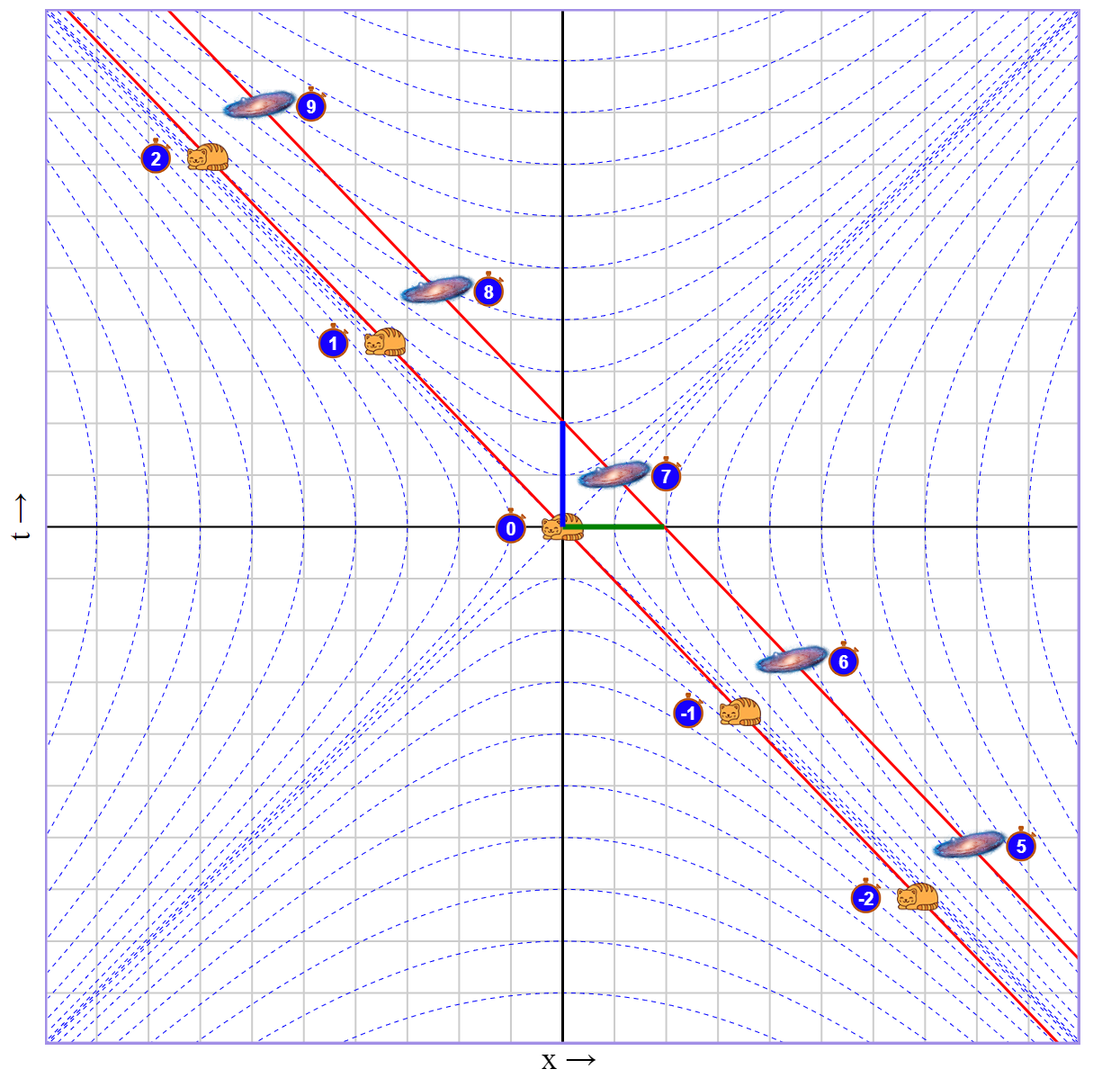
Suppose at a distance of 7 light-years from us there is some alien galaxy that we really want to reach (a very small galaxy). By "normal" logic, if we fly there at half the speed of light, we'll reach it in 14 years. And that's indeed what happens for an observer stationary relative to the galaxy (the sleeping cat).
But what will we experience? Let's consult the diagram.
The higher our speed, the closer the galaxy becomes (because length contracts).
Notice the blue segment. Its length corresponds to the time after which we'll reach the galaxy (the galaxy's coordinate becomes zero, i.e., equals ours). The higher our speed, the shorter the segment. And as we approach the speed of light, its length approaches zero.
The last frame of the animation corresponds to a speed of 96% of the speed of light. At this point the blue segment's length is 2 units (in this case corresponding to two years). That is, we'll cover 7 light-years in just two years. And if we accelerate even more, we could reach it in just one second of our local time.
But there's one "but." We can travel to a galaxy a million light-years away in one second of our time, but a million years will have passed at the galaxy itself, because for an outside observer we'll have been flying for a million years at nearly the speed of light.
This effect explains why short-lived particles from space (for example, muons, which decay a couple of microseconds after birth) are able to fly enormous distances and reach detectors on the Earth's surface without having decayed.
Conclusion
So, let's summarize.
Since the time of Galileo, everything in the world of science was fine and clear, until in the 19th century it was discovered that the measured speed of light doesn't depend on the observer's speed — that is, Galilean transformations simply don't work on light. To solve this problem, they devised performing coordinate transformations not by the familiar shifts, but by rotation in Minkowski space.
This new transformation explained the constancy of the speed of light and didn't contradict experiments at ordinary speeds.
But the side effect in such a space was time dilation, length contraction, and other wonders that not only were confirmed experimentally, but also explained and predicted many things.
To reinforce the material, let's look at an example from life: Take a stationary ship with two lights and ask it to blink them synchronously. And take another identical ship, launch it into flight, and observe all this from Earth.
We see several relativistic effects at once:
First, on the moving ship the lights blink less frequently due to the time dilation effect.
Second, these lights have turned red, because time dilation also causes a decrease in the frequency of emitted light.
Third, the left light on it turns on before the right one, because the left part of the ship is in the future relative to the right part.
And fourth, the length of the ship along the axis of motion has decreased for the very same reason — the left part catches up with the right because it is in the future relative to the right.
And in the reference frame of the moving ship, everything happens the other way around:
The topic turned out to be so interesting for me that I decided to present the material as a YouTube video for those who find it more convenient to absorb information in video format. I even created an experimental channel (this video is the first on it). I'll be glad for subscriptions to motivate me to create new articles and videos.
Visualizer
For illustrations and animations I wrote an interactive browser visualizer where you can move sliders, change modes, and observe Lorentz transformations.
Visualizer: https://dudarion.github.io/Interactive-Minkowski-diagram/
GitHub project: https://github.com/Dudarion/Interactive-Minkowski-diagram
I myself am a hardware/C/Python person, and this project was my first encounter with JS. So please don't kick me too hard for the excessive beauty of the code.
I hope you now truly understand the Special Theory of Relativity. And if you have any questions, I'll be happy to answer them in the comments.
Thank you for your attention!