Time Travel and Programming 2: Paradoxes
The era of time travel hasn't arrived yet, but humanity has long tried to resolve the accompanying paradoxes. We examine three models of how time responds to a traveler's actions, and conduct an experiment with a virtual time machine built on Conway's Game of Life.
The era of time travel has not yet arrived, but humanity has long attempted to resolve the accompanying paradoxes. We will discuss the most obvious one: what happens when you interfere with the course of history? Several models exist for how time's flow responds to a time traveler's actions. These models appear in science fiction films and scientists increasingly discuss them, yet no consensus exists on which is closest to the truth. We are only beginning to penetrate the mysteries of time and lack the ability to experiment with traveling to the past. What can we clarify now? Below you'll find an excursion through the basics of time mechanics; we will reason about paradoxes and conduct a small experiment — testing a virtual time machine built on Conway's "Game of Life" algorithm!
In memory of John Horton Conway
If you haven't heard of the grandfather paradox, here's the essence: a time machine owner travels to the past and prevents their own birth through their actions — for example, by preventing their parents from meeting. In the new version of history, the traveler doesn't exist, the time machine journey never happens — so history shouldn't have changed. But then the traveler will be born, eventually traveling to the past… — a closed circle of mutually exclusive conditions, hence the paradox.
Note
The paradox isn't tied to the grandfather specifically or to self-erasure from history. The traveler might simply ask their younger self not to invent the time machine (sure, they'd listen!). Or send a note five minutes into the past: "don't send the note." The essence is always the same: the journey's result is the cancellation of that very journey.
The paradox exists only as our misunderstanding of how time works. Nature surely forbids paradoxes, but how? Let us examine time's primary models, noting their pros and cons.
Models
Model 1: Impossibility of Time Travel
Essence: Nature's laws forbid movement into the past, completely or with serious restrictions. Several variations exist:
- Past travel is fundamentally impossible
- Past travel, or at least serious alteration of the past, causes spacetime rupture, universe collapse, and total cataclysms
- Traveling one year into the past places you one light-year from Earth, reachable only at your moment of departure — preventing any influence on your past self (closed worldlines become impossible)
Pros: The triviality of the solution. The simplest paradox resolution simply excludes its conditions from the realm of possibility.
Cons: But what about our dreams of a time machine? Seriously though, whether time travel is fundamentally possible is too broad a question to discuss now, so let's examine the remaining options, hoping they're possible.
Model 2: Historical Predetermination
"At that moment he understood he was that very Joe. Joe he'd met before. Like lightning striking, Bob suddenly grasped this wasn't just a similar situation he'd experienced, but that exact same situation. Only now perceived from another viewpoint." — R. Heinlein, "By His Bootstraps"
Essence: Past travel is possible, but nothing changes there since history's pages are fixed. If archaeologists found evidence that you visited ancient Egypt's Akhenaten — that journey absolutely occurs exactly as it happened in the past. You cannot perform different actions or refuse the trip — circumstances will prevent it.
This implies that certain history points might have been created by time travelers. For instance, if you decide to prevent the Titanic's sinking — once aboard the ship, you either encounter obstacles preventing the ship's redirection or horrifyingly realize your actions caused the catastrophe.
Two variants of this model exist: strong and weak. Strong predetermination means no past detail can change. Weak predetermination allows minor alterations but preserves key historical points and the general direction of events.
Clearly, predetermination extends beyond the past to the future. Since the past is fixed and contains arrival events of people from the future, the future is somewhat predetermined — the circumstances of those arrivals must develop. This model allows "history guarantees." For example, if scientists find evidence of people from the XXX century visiting the past — it means humanity not only survives but actively develops science for millennia. Importantly, the absence of such evidence proves nothing. "If time travel exists, where are our descendants?" — unconvincing; countless explanations exist.
Examples: the film "Relic Hunter," Heinlein's story "By His Bootstraps."
Pros: This model possesses elegance. Perhaps because it occupies the middle ground between completely denying travel (Model 1) and describing it with non-trivial concepts (Model 3). Additionally, indirect experimental confirmations exist at the quantum informatics level.
Cons: The idea of predetermination seems strange at minimum. Even weak predetermination leaves it unclear how physics limits human choice to commit (or not commit) actions. We understand this restriction through circumstances. Do all past travelers always encounter circumstances preventing them from refusing the journey? One might imagine this at the quantum particle level, but the macroscopic mechanism remains underdescribed.
Moving from fatalism toward weak predetermination, we face questions of criteria. To what degree can history change? What constitutes key points? We'll return to this.
Model 3: Alternative Realities
"Apparently the temporal continuum has been disrupted, creating a new sequence of events which altered reality.
— Doc, can you make it simpler?
— Right, let me illustrate. Imagine this line represents time — here's now, 1985, the future and the past. Up to this point in time, somewhere back in the past this line bent at such an angle and created a different 1985 — different for you, me, and Einstein, but real for everyone else." — "Back to the Future Part II"
Essence: Altering history creates a new time stream that develops an alternate event scenario. The traveler remains in the reality they've created.
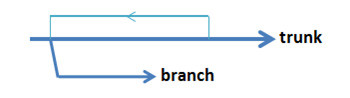
Fig. 1 — Classical reality branching concept
Usually, reality branches only upon serious (there's that criterion again?) interference with history. For instance, you travel to the past while an observer (O) remains at the point of departure. After quiet past tourism, they'll see your return.
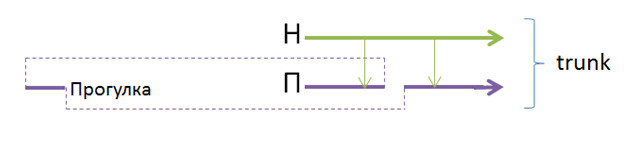
Fig. 2 — Time loop closes
Yet if you commit (or prevent) a revolution, the observer won't see your return since you've become part of a new reality.
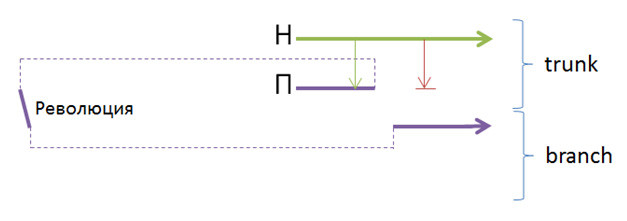
Fig. 3 — Time loop breaks
For non-programmers: The article frequently uses "branch," "trunk," "merge" — don't worry. These concepts from SVN version control aren't necessary to understand:
- trunk — the original, "our" time stream, the course of history.
- branch — an alternate time stream created by interfering with history.
- merge — branch merging into trunk; the alternate history's consequences become part of the main stream (the main/supplementary distinction is conditional; one is the parent, the other branches from it).
Thus, you could rewrite history entirely — but that's its new branch; the old one remains intact. Like forking a GitHub repository from any past revision.
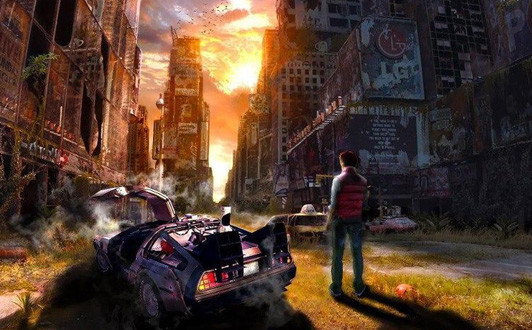
In this model, time ceases being one-dimensional since an event variation axis exists. The resulting Multiverse (a Universe with multiple alternate realities) appears as a tree diagram.
The tree can display in expanded form where nodes are events and branches are possible outcomes (Fig. 4A). For history alteration, taking one tree route as the standard (zero reality, trunk) and displaying it straight while showing the alternate as a branch suits better (Fig. 4B).
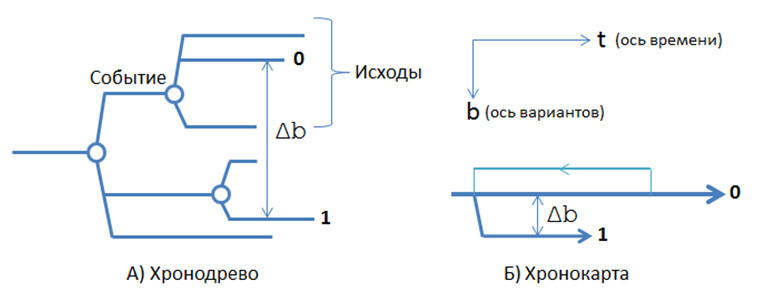
Fig. 4 — Alternate reality tree in two representations
Logically: after past interference, events develop along a new path, tracing another trajectory through variation space. The question remains what this space represents: a theoretical model or physically existing parallel realities? We encounter alternate event concepts not only in the context of past travel. Recall Everett's "splitting universe" theory. Its popular description suggests that each event splits the Universe into realities where each possible outcome occurs. Roughly, a coin flip creates three reality copies: heads in one, tails in another, landing on its edge in a third. We flipped and got heads — what are the other two realities? Potential quantum world states or physically existing parallel worlds? This is one of modern physics' fundamental questions — and we lack answers yet.
Examples: the "Back to the Future" film
Pros: This theory genuinely resolves paradoxes without the problematic restriction of freedom of action in the past. The concept of alternative time streams connects with various theories (Everett's splitting Universe, Sakharov's multileaf Mega-Universe, Bartini's three-dimensional time, etc.), appearing as a logical expansion of one-dimensional time overall.
Cons: While brilliantly solving some questions, this model introduces others. If history branches only upon serious interference, what's the "seriousness" criterion? If branches always form, how exactly does a branch merge back into the main stream to ensure the traveler's return? The reality merger hypothesis isn't new but remains inadequately explained.
Models Summary
One more model exists. It rarely appears in literature and fundamentally differs from the others — you'll understand why now. Same scenario: the traveler erases themselves from history, so they're not born in the new event sequence. This model lacks parallel realities; only the main, singular time stream has changed. Returning to their time, the traveler becomes unrecognizable. Nobody travels backward now — this doesn't mean the traveler will still be born since history has already changed; it simply persists.
Imagine some villain travels in their time machine to the distant past, fundamentally altering human history. We simply vanish from reality; we never existed. Logically, completed events cannot be "nullified" and disappear. Rather, intuition dictates this; logical justification requires thought. I propose treating this as an axiom: history cannot be rewritten. All previous models represent various implementations of this protection:
- Prevents past travel
- Prevents past changes
- Prevents main stream alteration, moving changes to supplementary streams
Humanity's search for paradox resolution models implies following this axiom. Thus we have 3 time models. We've outlined the contours of history protection's first question. What now? I propose excluding the first immediately: if time travel is impossible, all previous and subsequent reasoning is meaningless. Two models remain — which is true? Or are both true, being special cases of a more general model? Before discussing this, we must examine history alteration from another angle.
Was Ray Bradbury Right?
Forget the models for a moment — historical predetermination or parallel realities. Before us is the stream of history; something changes it — and one question interests us: will the consequences of the interference fade, or will the deviation from the primary scenario grow like a snowball?
In Ray Bradbury's "A Sound of Thunder," a crushed Jurassic butterfly causes vast changes in the present. The author develops the theory of high event connectivity, making history extremely unstable: even minimal past changes, especially distant ones, cause serious deviations.
We don't want to change the Future. We're uninvited guests in the Past. The government doesn't approve our excursions. We pay significant bribes to keep our concession. The time machine is a delicate business. Without knowing, we might kill some important animal, bird, insect, crush a flower and destroy an important evolutionary link.
— I don't understand, — Eckels said.
— Listen then, — Travis continued. — Suppose we accidentally killed a mouse. That means all that mouse's future descendants wouldn't exist — correct?
— Yes.
— All descendants of descendants from all that mouse's descendants wouldn't exist! So carelessly stepping, you destroy not one, not a dozen, not thousands, but millions — billions of mice!
— Fine, they're dead, — Eckels agreed. — So what?
— What? — Travis snorted contemptuously. — What about the foxes that need these mice for food? Ten mice fewer — one fox dies. Ten fewer foxes — a hungry lion starves. One fewer lion — countless insects and vultures perish, incalculable life forms vanish. The result: fifty-nine million years hence a cave man, one of a dozen populating the entire world, driven by hunger, hunts a boar or saber-tooth tiger. But you, my friend, by crushing one mouse, have crushed all the tigers there. And that cave man starves. Yet that man isn't just one — he's an entire future nation. From his loins come ten sons. From them come a hundred — and so forth, giving rise to a whole civilization. Destroy one man — you destroy an entire tribe, a nation, a historical epoch. Like killing one of Adam's grandsons. Step on a mouse — you cause an earthquake reshaping the earth's entire face, fundamentally changing our fates. One cave man's death — a billion descendants' deaths, strangled in the womb. Perhaps Rome won't appear on its seven hills. Europe remains forever a dark forest; only Asia flourishes luxuriantly. Step on a mouse — crush the pyramids. Step on a mouse — leave Eternity a Grand Canyon-sized dent. No Queen Elizabeth, Washington won't cross the Delaware. The United States won't appear at all. So be careful. Stay on the path. Never leave it!
Now consider a small example. You leave home for work, taking the metro. Somehow history gets corrected: the metro doesn't work today. You take a bicycle instead and arrive. Another correction: the tire punctures. But you'll walk!
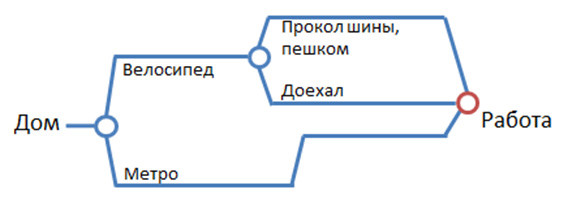
Fig. 5 — Reality convergence tendency
The timeline shows:
- Branch merging occurs at different time moments since reaching the target state (arriving at work) happens via different paths.
- The deformation doesn't completely fade — despite all three cases involving work arrival, minor variations exist (a parked bicycle, dirty shoes, etc.).
Abstracting from specific actors: if a system has a goal, it pursues it under any scenario, possessing a certain stability reserve (against deviating influences). I wouldn't enter the philosophy about material objects', people's, or society's goals, etc. That world events follow physics laws and are somewhat ordered seems obvious. History isn't a collection of coincidences; it has its own conditionality. After primitive communism, capitalism couldn't arrive bypassing slavery and feudalism. If you prevented the 1939 war from starting, it would likely start later since the prerequisites remained. If one scientist didn't make a discovery, another would later, etc. Historical events possess direction, tendency — meaning any deviation from history's course tends to fade.
This hypothesis advances our understanding of time mechanics since it unites the two previously examined models. One discussed history's resistance to change; the other — parallel time streams. By supposing that parallel streams tend to merge into the main one, we extract the unified essence from both models: time stream elasticity.
How Do Realities Merge?
The previous article raised many questions about this. This is extremely complex, so as a clarification of the assumption: events merge, not objects. Consider the familiar light cone, except the variants axis replaces the spatial axes.
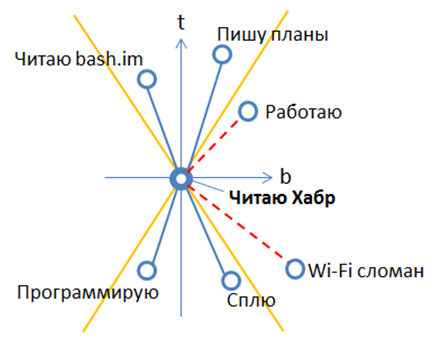
Fig. 6 — Present as a projection of past alternatives and the root of future variants
The upper cone is the future — possible outcomes from the current state. The lower cone is the past — the spectrum of possible preceding states. The cone walls outline reachability boundaries; exceeding them means transitioning to a state unreachable from the current one in the given time interval.
Past cone events merging at the present point means their common result. But how does this occur structurally — how do objects overlay? Perhaps something resembling "Back to the Future," where newspaper headlines visibly change — a "branch merging into trunk."
The Quantum Coin
Two people sit in a room: Alice and Bob. Five minutes ago, Alice flipped a coin and tails appeared; both saw it. We have a time machine and conduct a history correction: five minutes ago, heads appears. We get two realities:
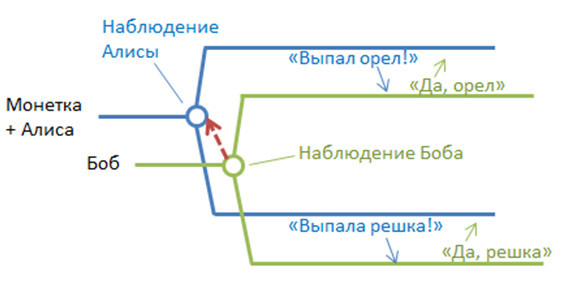
Fig. 7 — Experiment with two observers
Alice and the coin cannot be separated since the coin flip result doesn't exist apart from its observation. Yet we have Bob, who eventually learns the flip outcome with a delay, and they exchange remarks. Two outcomes, two realities — visible in the diagram.
Now change the experiment conditions: Bob doesn't see the result. From Bob's perspective, these realities are identical — in both he sees the flip but doesn't know the outcome. Important detail: Alice doesn't tell Bob the result; then for him the events truly match in both cases. Bob too can split into two branches once Alice reveals the outcome. Let's draw this in 5D:
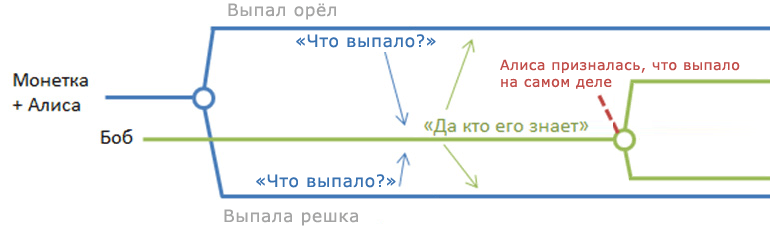
Fig. 8 — Experiment with one observer
Think about it — it's genuinely curious! It's like two Alices conversing with one Bob, yet a single phrase initiates the listener's time stream division.
Here we approach understanding the observer's role in the parallel realities model. Timeline lines aren't reality; they're states of groups of objects, and observing any of them includes the observer in that line. Nature doesn't make full Universe copies; it simply stores difference logs.
So How Does Merging Happen?
First: don't interpret merging literally as worlds becoming identical. Two worlds differ in some aspects and match in others — that similarity represents something like their joint point in variation space. Like the example where three paths still got you to work — at that moment those three realities gained this joint point; partial merging occurred. Certainly, talking of complete reality merger is incorrect since reality itself, as shown in the quantum coin paradox, is merely a cross-section of space states. How different objects exist in different joints, pockets, and streams of variation space — is excellent imagination training!
Common question: why do branches merge? Where does the idea of history elasticity originate? Brief answer: system stability. This is a nearly universal property of any complex system — humans, a country's economy, world politics, etc. Systems have goals (in various senses), and system operation resembles an automatic regulator correcting movement toward the goal. Therefore, disturbances from the past encounter the stability resistance of world systems. Bifurcation points are a different matter; affecting them drastically changes events. Yet difference fading occurs anyway, just on a larger scale.
During discussions, MrSeventh proposed an interesting hypothesis: what if the physical carrier of difference logs is dark matter and/or energy?
Dark energy drives the Universe's accelerated expansion. I'm inclined toward the pulsating Universe theory — after the Big Bang and expansion comes contraction (cyclical pulsation like heartbeats). This means dark energy parameters should change. Alternatively: the young Universe presently has most branches diverging, requiring trillions of years to converge (per decay curves). Various Universe variants will synthesize into one; branches connect; difference logs shrink; dark energy parameters (if this is their physical carrier) change; the Universe contracts toward a singularity where matter, space, time — and all variant streams — merge.
Unified Model
Now let's combine everything stated. The two time models (historical predetermination and branches) have actually merged into one: "branches with merge." Any history alterations (even mere presence in the past) trace alternative paths through variation space, yet time flow possesses elasticity — manifesting as a gradual tendency for the alternative path to merge with the main stream. Meanwhile, the observed world represents a cross-section of complex quantum time stream weaving, where objects in the same space may belong to different time streams (until observation between them occurs).
Mathematical Model
We must model the attenuation of history deviation arising from past interference.
First variant: the simplest — constant-acceleration branch attenuation. Described by the equal acceleration movement formula.
Second variant: more plausible — the time stream compared to springs; force (and thus acceleration) is proportional to the current deviation. The further the history stream deviates, the stronger it returns. Described by the damped sinusoid formula.
Third variant: an interesting story. The first version contained an error that was noticed by readers, yet the erroneous formula turned out to match the observed pictures well.
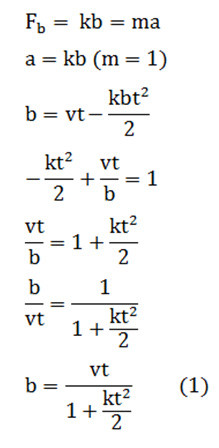
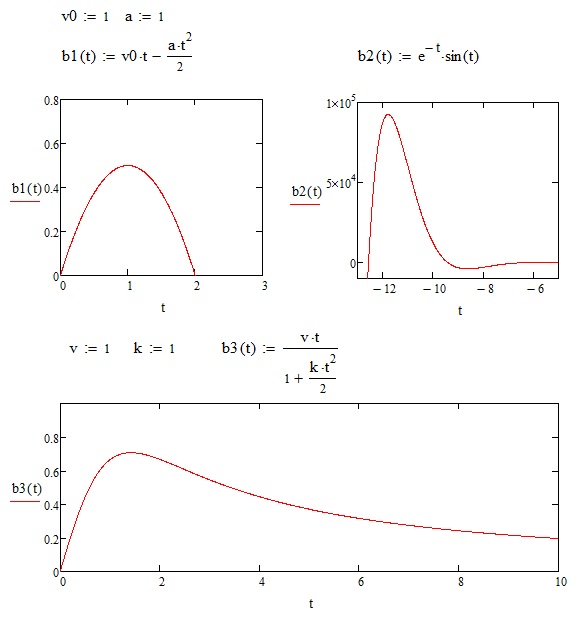
- Equal acceleration attenuation.
- Proper "spring" formula attenuation.
- Third, the old formula.
Now let's transition from theory to practice.
Experiment
What if we could model historical data? We need simplified world models consisting of interacting elements. We'll record events, rewind, introduce changes to the "world," run the simulation, and observe the new scenario. Then we'll quantitatively evaluate the differences between realities, outputting them as graphs. We'll get experimental, not theoretical, history deviation decay curves.
I chose Conway's "Game of Life" algorithm for this "world model" role. Previously knowing little about it, I searched and surprisingly discovered many Habr articles on it. The question of understanding world difference assessment remained. I wanted to build solutions on evolutionary principles since real world history means progress and improvement, not a settled "cell boiling" mode. Something like genetic selection mechanisms or similar, introducing measurable characteristics allowing comparison of history variants (like "quantity of level-42 cells"). Adding rules to Conway's algorithm proved difficult. He selected "Life's" optimal parameters, and my modification attempts made worlds unstable. Eventually I chose the simplest solution: using the classical algorithm without embellishments, simply subtracting worlds pixel-by-pixel (Hamming distance) — this measures the degree of history divergence.
I implemented this: https://github.com/TimeCoder/LifeTime
Before running our time machine, let's get familiar with the UI and code.
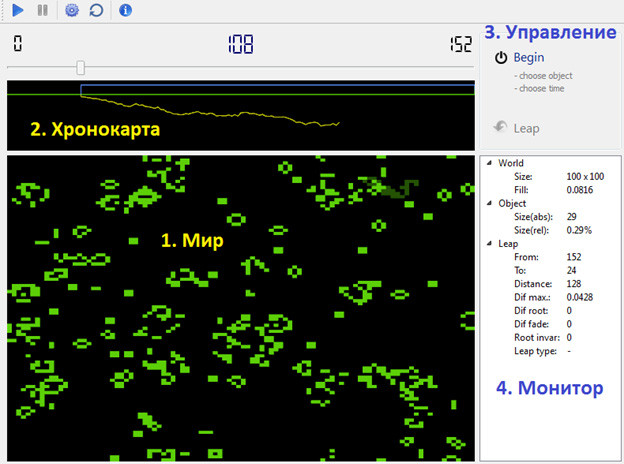
Fig. 10 — Control elements
The program interface consists of 4 regions:
- World — displays life development; after random cell filling, cells form and dissolve per Conway's "Game of Life" algorithm. World edges "sew" together.
- Chronochart — essentially showing the chronotree, the Multiverse, the variation space — call it what you will. Initially one straight line appears — the primary time stream, zero reality (green). When the time machine activates, above the main stream forms a tunnel (blue), and the new event development scenario displays as a curve (yellow).
- Control block — activates the machine and initiates displacement.
- Data output area — for world, traveler, and displacement information.
Now the work sequence:
- After program startup, you'll see a boiling ocean of life and a running time counter. Wait a bit, then click "Begin."
- The time machine activates; the world freezes awaiting action. What should happen next? A traveler must board. Mouse-click world cells to select displacement objects. The selection can be changed or canceled by clicking empty regions.
- With the object selected, the slider above the chronochart is automatically unlocked. Drag left, rewinding history to the desired moment. This isn't the displacement yet — only selecting the destination.
- Click "Leap" — forward to the past! The object transfers to the chosen time, becomes part of the world, and simulation continues. The graph shows the new history scenario deviation; slight highlighting marks the object's location. When time reaches the loop peak (transition point) — the program pauses and outputs data.
Current version specifics:
- Only one past flight per session. Multiple branch capability exists but is disabled, partly due to the unsolved "three branches problem" below.
- No future travel (seemed pointless).
- Stream switching only after loop completion.
- After moving the time slider, can't select another displacement object (code needs additions).
- Large worlds cause program slowdown (optimization needed).
- Rendering uses OpenGL.
Three Branches Problem
The issue: quantitatively evaluating qualitative values. Imagine 3 worlds: the main time stream and two alternates. What's the reference system for displaying history deviation? Two branches are simple: draw the first as a straight line, the second as a curve showing baseline deviation. Now imagine a third. If this reality branched from the trunk deviating quantitatively like the second, their trajectories coincide — but qualitatively different events are occurring! Alternatively: reality three branched from two, and history quickly matches the trunk version. The task: optimal chronochart drawing with such nuances.
Code
Let's briefly examine the project architecture and key fragments. Below is the primary classes diagram:
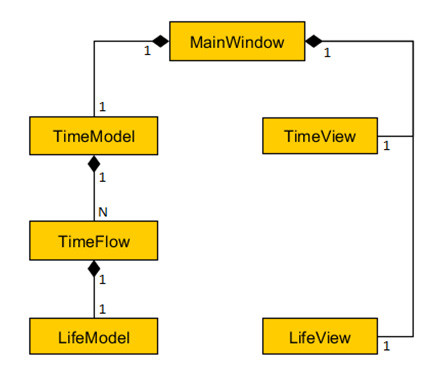
Fig. 11 — Simplified class diagram
It starts with the life calculation algorithm implemented in LifeModel. It contains the current world state (world management via the World class), can fill worlds with random cells (necessary for initial startup) or continue "frame-by-frame" simulation from a given world (necessary when past interference occurs). The LifeView class handles model visualization; signals/slots connect them.
Life simulates but represents only the fleeting "present"; we need all past states — moving from three to four dimensions: the TimeFlow class appears (time stream, reality branch). It aggregates LifeModel, contains a World history collection, history deviation curve points, plus a parent stream pointer from which it branched.
Naturally multiple streams can exist; TimeModel stores them, essentially representing the time tree. TimeModel provides an interface for history viewing and displacement to a specified moment. It stores stream collections, the current stream number, and the time traveler (cell collection). TimeView handles timeline tree rendering with dynamic scaling.
At the top level is the MainWindow class. It holds all views and TimeModel, manages UI logic, and connects models with presentations via signals/slots. The work cycle uses a timer; each tick calls TimeModel's next, which iterates through time streams presently requiring next calls (we might be in the past, and our native stream is already calculated ahead).
Launch!
Trial run, 300x300 world size:
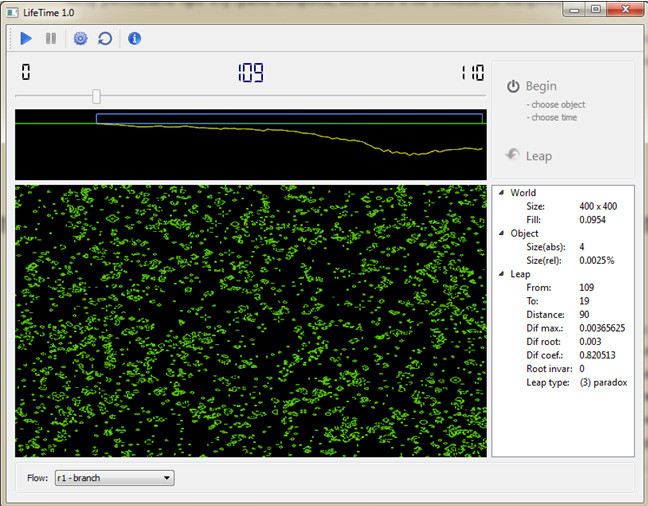
Fig. 12 — Time travel example
History didn't immediately show intensive deviation; it reached a maximum then showed a certain decline. The deviation ratio at the journey's beginning ("loop peak") compared to maximum deviation appears on the monitor as the Dif coef parameter. Here it equals 0.82 — the deformation decreased nearly 20% before returning.
Dif and Branch Curve Character
Setting the world size to 100x100, I traveled to the past and obtained this graph:

Fig. 13 — One branch curve variant
The yellow curve is the program's computed alternate history stream; on top I overlaid the discussed mathematical model graphs. Naturally, I scaled them on both axes — real dimensions are unknown. We don't know the time elasticity coefficient or the graph scale transformation coefficient across the time axis.
The graph shows the first variant (equal acceleration attenuation) clearly misses; the second ("spring" formula) seems closer but the curve fades too early. The third variant (the formula from the error) somehow better reflects the real curve character.
Actually I got lucky on the first try. Not always does dif attenuate; sometimes the deviation constantly grows, including after the loop peak. Identifying dependencies requires program improvements and careful experiments. I haven't noticed world size, object size, or travel distance affecting the curve character. Likely, as in the real world, the specific travel circumstances matter — those "events" where the future arrives.
Anyway, the curves obtained are closer to truth than the usual depiction of reality as straight lines. First, reality deviation probably doesn't happen linearly. One insignificant event eventually triggers (or doesn't) another far more powerful one. Like in "Back to the Future" Part 1: Marty pushed his father from the car — the history deviation curve barely shifted. Only later do events develop steeply. Second, constant oscillations occur; worlds become closer then farther (in similarity).
Does World Size Matter?
All tests used 100-1000 square worlds. Larger worlds better simulate real worlds, but one problem: program slowdown. Optimization is needed. Yet clear patterns already emerge. In small worlds, spatial change centers spread faster. Taking a 100x100 world:
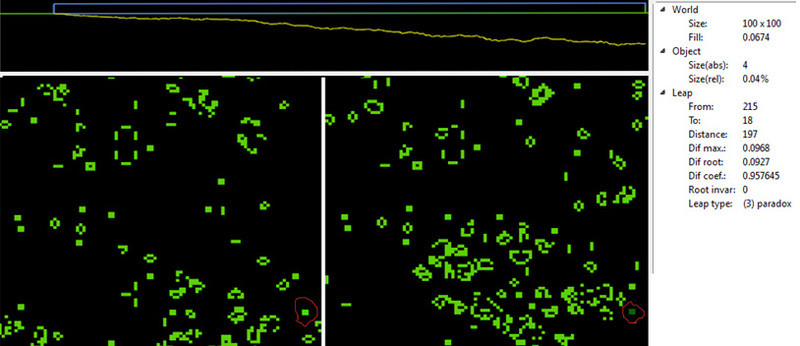
Fig. 14 — Trunk and branch comparison
A 4-cell object traveled to the past; within 200 generations the world nearly completely changed (two realities shown).
Looking at a 1000x1000 world:
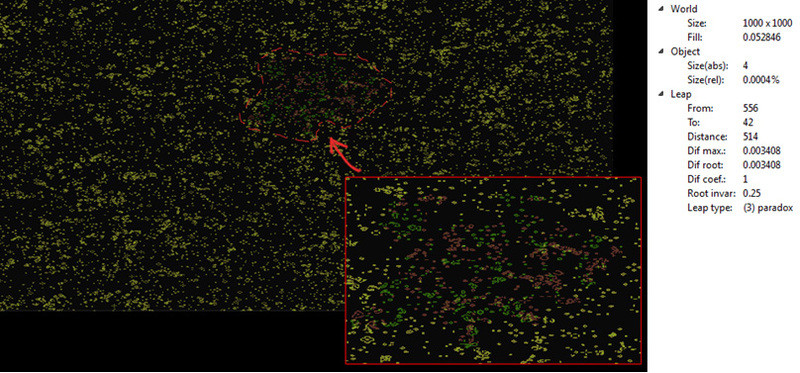
Fig. 15 — Change area spreading
Overlaying two world variants 500 generations later reveals a distinct difference spot (everything else is identical). The spot's radius grows with time — history alterations cover increasing space. But not always. Sometimes strange sequences of events occur and all changes smooth out, even reaching zero, with worlds becoming identical.
Incidentally, after reaching the loop peak, clicking "Play" continues the simulation to view further branch behavior. Generally, if dif grew monotonously inside the loop, it continues growing after (the spot radius increases). However, growth happens slowly, and at large world sizes, the relative spatial change radius is extremely small.
Three Time Loop Types
We've encountered the "serious" interference question multiple times. Perhaps in the future we'll compute reality trajectories like the Calculators in Asimov's "The End of Eternity," but we must start somewhere.
Let's start with reference systems. Two exist, though interconnected: world and traveler. You might travel to the past making colossal changes in an adjacent galaxy but your past Earth experience stays unaffected. Alternatively: travel one day back introducing your double into events, resulting in no journey within a day — history deviation huge to the world, but unnoticeable to the traveler.
The simplest present approach: evaluate the degree of history alteration through its changes' influence on the time loop's peak. Then we can logically distinguish 3 degrees of history alteration:
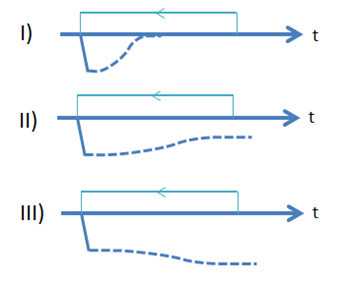
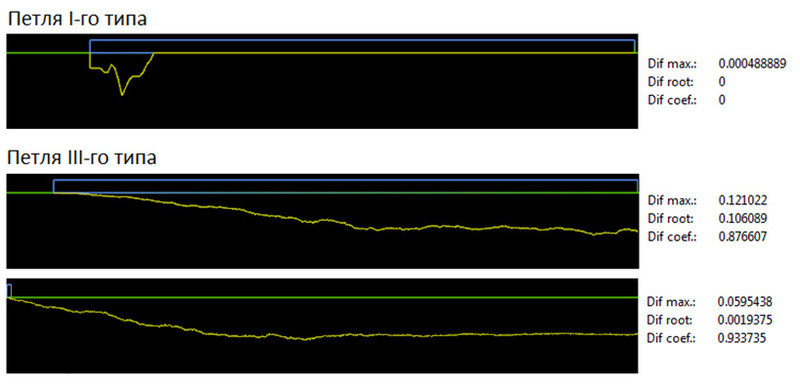
Fig. 16 — Three time loop types
- The alteration nearly completely fades before the loop peak. Like picnicking in the Jurassic — no plastic survives to our days.
- The alteration fades toward the peak but not completely; some trace remains. Like traveling yesterday and drawing in notebooks. Return home, open the notebook — you see it (crucially, don't look before the experiment).
- History deviation is powerful enough to potentially cancel the journey itself.
Importantly: the relativity of these degrees — any history alteration fades; the question is how much before the departure back. Fading continues after that moment.
In my program I somehow couldn't initially catch a Type II loop. The loop type displays on the monitor as the Leap Type parameter. Almost always number 3 appears. What's happening? When the simulation reaches the moment the past displacement launched, the object (which left) overlaps the current world (the branch). If cell positions match — meaning the new history has this object at this spacetime point — the "invariance coefficient" equals 1. Zero means no cells matched. The code has conditional thresholds dividing the 3 loop types (absolutely arbitrary).
Does this mean any past displacement causes paradoxes? I think not; Conway's "Game of Life" is extremely sensitive to changes. It provides world models in a rough approximation lacking goal-oriented processes, while human activity has direction. I suspect the effects of simulation history changes are smaller than in the real world due to the lack of purposefulness.
Readers asked if history truly fades — didn't modeling disprove this? I believe not; it partially confirmed it. Cases of constant deviation growth don't exceed 5-10% of cases showing attenuation. Even registering these cases shows history principally "corrects" and possesses elastic properties. Some noticed specific conditions where branches particularly quickly merge with trunk — interpretable in two ways. Yes, program world history, like real world history, is non-homogeneous, containing "epochs":
- High life density and uniformity
- Life rarefies; complex structures form; isolated cell groups
- Equilibrium epoch
But doesn't this resemble our Universe and planet's evolution? Traveling within one epoch versus traveling between epochs produces different results.
Conclusion
Can we say that history generally tends to return to its course? At minimum, this effect has been registered; determining its frequency requires more experiments. Certainly, experiments need an automatic mode — instead of UI, implementing a program API + scripts for multiple test scenarios. What does this provide?
Minimum: we can evaluate time stream dynamic characteristics. How does the history deviation decay curve depend on object size, world size; what's the curve's general form?
Making the machine "reusable," we can simulate complex paradoxes, seeing what actually happens. History change cancellation of a cancellation? Groundhog Day? The statue paradox? All visible "live" in virtual 5D-tracks.
Beyond conceptual tasks, technical improvements include:
- Optimization is urgently needed; algorithm refinement (like HashLife implementation)
- Automated experiment system
- Transition to Qt5, C++11
- Numerous minor improvements: interface, world saving, object past selection, teleportation during past travel, etc.
The primary thing is understanding the question's foundations! Currently, many "myths" form people's notions about time. Constantly reading "traveling one second back means cosmic displacement since Earth moves" or "chronostasis" (a state where the world "freezes" called "time slowing" when it's actually observer acceleration). Yet such questions resolve easily with elementary logic! I mean that enormous history study work can (and should) occur without working chronotechnologies, armed with common sense. Plus, programming repeatedly helps.
Today we touched the tip of the iceberg, briefly examining one time paradox. The subject of time is boundless, diverse in questions and fascinating. Interested parties are welcome — several projects are open. Without irony: in humanity's study of time, understanding offers no last hope except the people whose logical thought and creative passion might drive new discoveries!